Hip Prosthesis
Hip prosthesis implants replace the femoral head, and in some systems the socket as well, most often following a femoral neck fracture or in degenerative hip disease. Design choice splits mainly along two lines: hemiarthroplasty (replacing only the femoral side, articulating against the patient's natural acetabulum) versus total hip arthroplasty (replacing both sides), and within hemiarthroplasty, unipolar (fixed head) versus bipolar (a head that articulates both internally and against the acetabulum, reducing wear on natural cartilage).
What's in This Collection
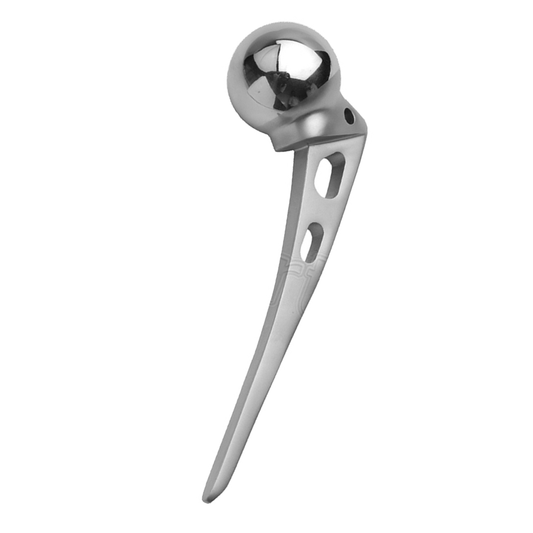
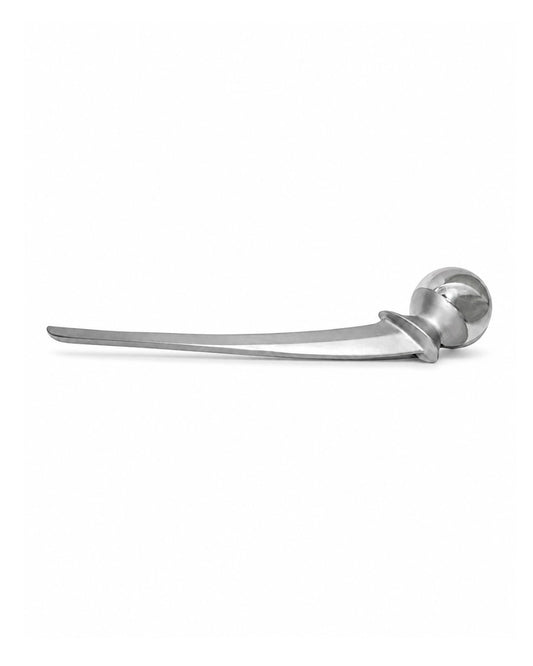
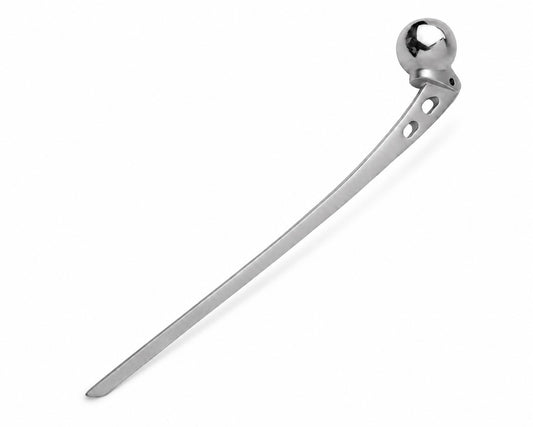
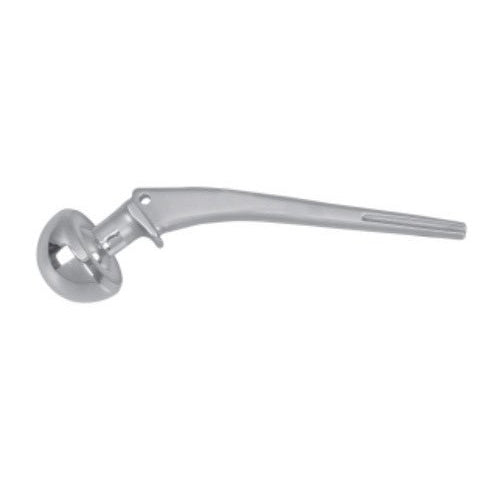
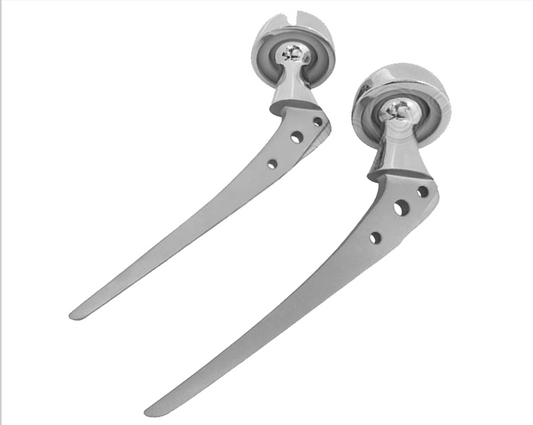
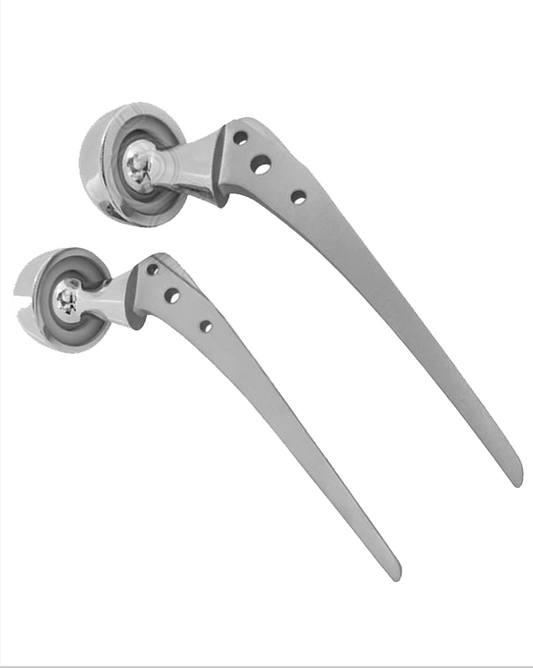
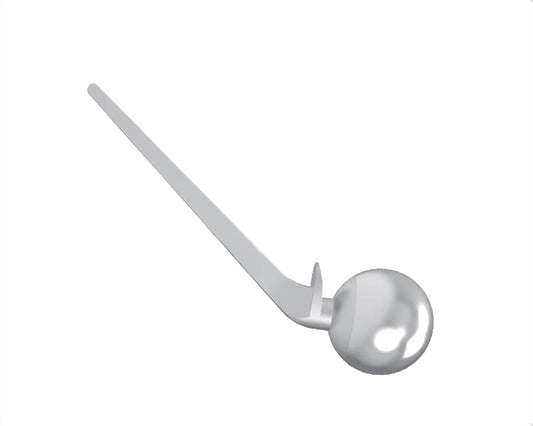
Austin Moore Hip Prosthesis is a classic unipolar hemiarthroplasty design with a fenestrated stem, allowing bone to grow through the stem's openings for biological, cement-free fixation — a long-established pattern still widely used, particularly where cementless fixation is preferred. Thompson Hip Prosthesis, by contrast, uses a solid, non-fenestrated stem designed specifically for cemented fixation, with a monoblock head rather than a modular one. Lazcano Hip Prosthesis offers an alternative unipolar stem pattern. The Bipolar Hip Prosthesis (sterile, in fenestrated and non-fenestrated stem variants) adds a dual-articulation head assembly over the femoral stem, intended to reduce acetabular wear compared with a fixed unipolar head — the fenestrated version suits cementless fixation, the non-fenestrated version cemented fixation.
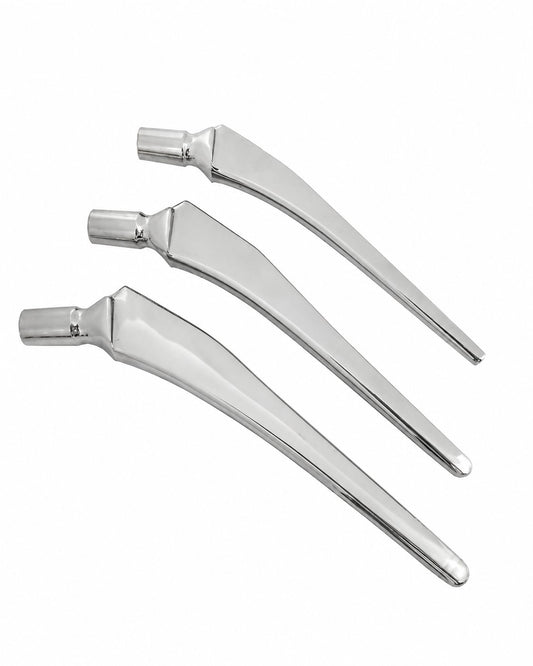
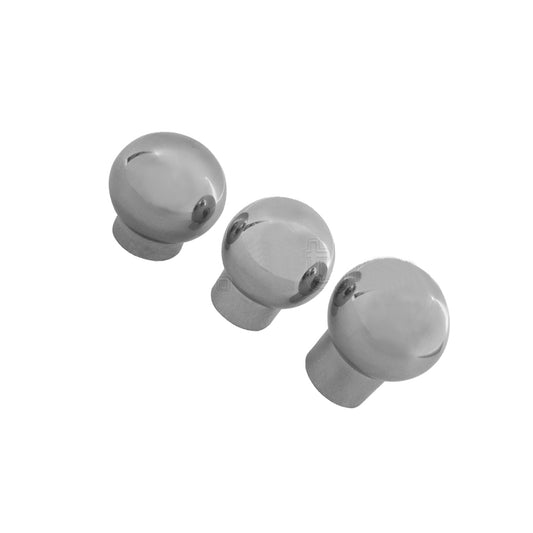
For total hip arthroplasty, Modular Stems are available in Muller and Dual Tapered designs (135–146mm, cemented femoral components), paired with a separate Femoral Head (Sterile, 28–32mm) — a modular component that mounts onto the stem's trunnion, letting the surgeon select head size independently of stem selection.
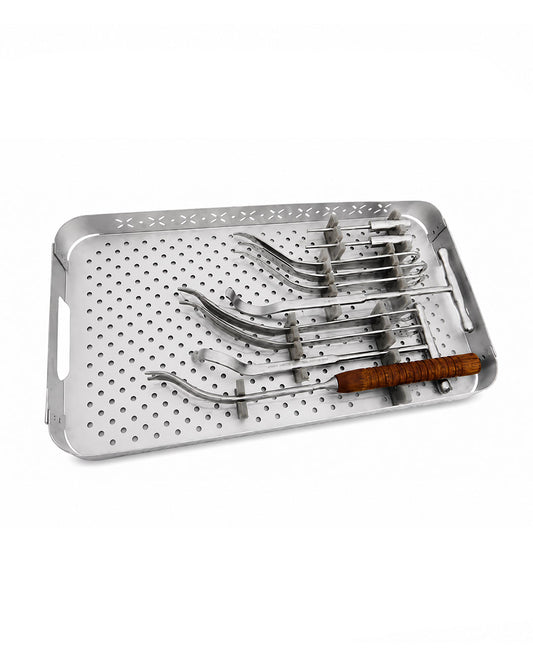
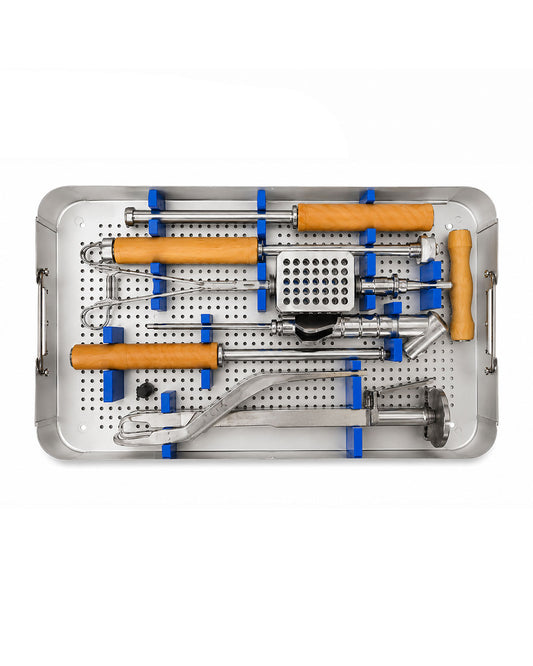
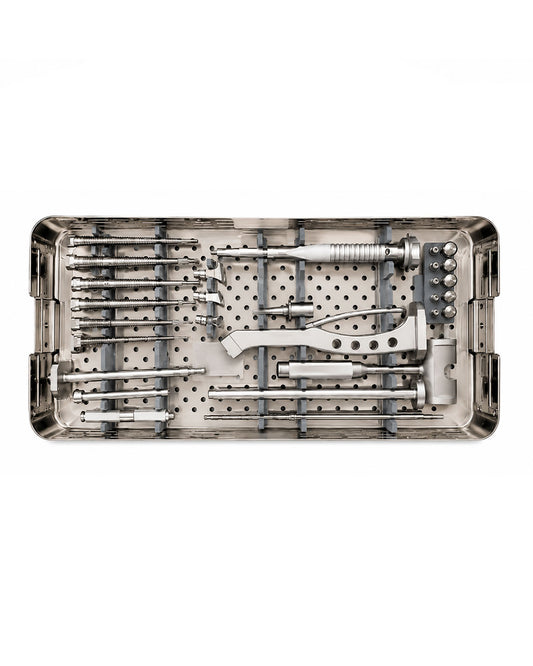
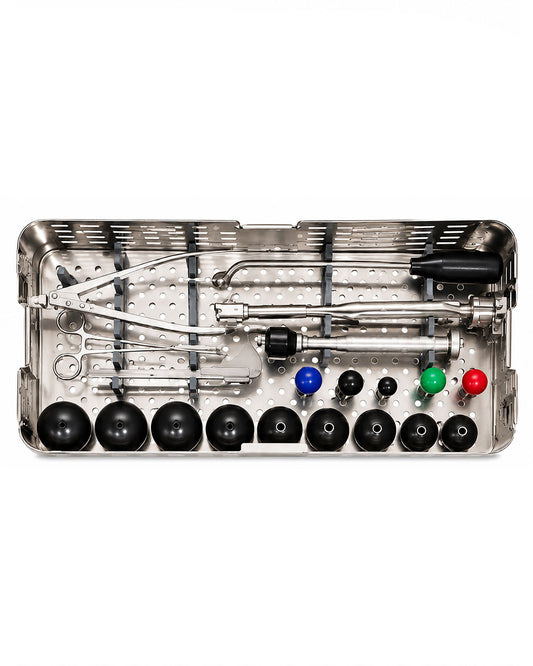
Supporting instrumentation includes matched rasps for femoral canal broaching — separate patterns for Thompson, Bipolar, and Austin Moore stems, since each requires a differently shaped canal preparation — along with the 18-piece Hip Joint Instrument Set, the Total Hip Prosthesis Instrument Set (42–60mm acetabular system), the Hip Stem Instrument Set (covering both cemented and cementless workflow), and the Calcar Replacement Stem Set (9–13mm, for revision cases involving proximal femoral bone loss).
Choosing the Right System
Fracture pattern and bone quality largely drive the decision: a fenestrated, cementless stem (Austin Moore, or fenestrated Bipolar) suits cases where biological fixation is preferred or cement is contraindicated, while a solid, cemented stem (Thompson, or non-fenestrated Bipolar, or the Modular Muller/Dual Tapered stems) suits cases where immediate mechanical fixation is the priority. A bipolar head is generally chosen over a unipolar design when reducing acetabular wear over time is a greater concern, such as in a more active or longer-life-expectancy patient. Revision cases with significant proximal bone loss call for a calcar replacement stem rather than a standard primary stem.
For femoral neck fractures where replacement isn't indicated, fixation with DHS/DCS & Pediatric implants or Headless Compression / Cannulated Screws may be the better-suited alternative to arthroplasty.
Related Products
Pair these implants with broader Hip Surgery Instruments for the full arthroplasty tray, and with Orthopedic Reamers for acetabular and canal preparation beyond what's included in the bundled sets. Bone Mallets are commonly used alongside rasps and stems during impaction, and Bone Drills support any adjunct fixation needed during the procedure. Browse the full Orthopedic Implants catalog, or the Orthopedic Instruments Set range for complete procedure kits across other joint systems.
Ordering
Peak Surgicals manufactures hip prosthesis implants and instrumentation for hospitals and distributors worldwide, with international shipping — contact our team for current stock on instrument sets and wholesale pricing. Note: we do not currently manufacture or distribute branded proprietary systems (Fitmore, Summit, Corail, Actis, Synergy, Anthology, or similar) — our catalog covers Austin Moore, Thompson, Lazcano, Bipolar, and generic modular stem designs.
Frequently Asked Questions
What's the difference between Austin Moore and Thompson hip prostheses?
An Austin Moore prosthesis has a fenestrated stem designed for cementless, bone-ingrowth fixation. A Thompson prosthesis has a solid stem designed specifically for cemented fixation, with a fixed monoblock head rather than a modular one.
What is a bipolar hip prosthesis?
A bipolar hip prosthesis uses a head assembly that articulates both internally (within its own cup) and against the natural acetabulum, intended to reduce wear on the patient's native cartilage compared with a fixed unipolar head.
What's the difference between hemiarthroplasty and total hip replacement?
Hemiarthroplasty replaces only the femoral side of the joint, articulating against the patient's own acetabulum. Total hip arthroplasty replaces both the femoral and acetabular sides.
Does Peak Surgicals sell Fitmore, Summit, Corail, or similar hip systems?
No. Those are proprietary, trademarked implant systems from other orthopedic manufacturers. Our catalog covers Austin Moore, Thompson, Lazcano, Bipolar, and generic modular stem designs.
Why do different stems need different rasps?
Each stem pattern — Thompson, Bipolar, Austin Moore — has a distinct cross-sectional shape, so the femoral canal must be broached with a matching rasp to achieve correct stem fit and fixation.