
Featured Collection
Your cart
Featured Collection

PEAK SURGICALS
SKU:PS-OP-5583
Couldn't load pickup availability


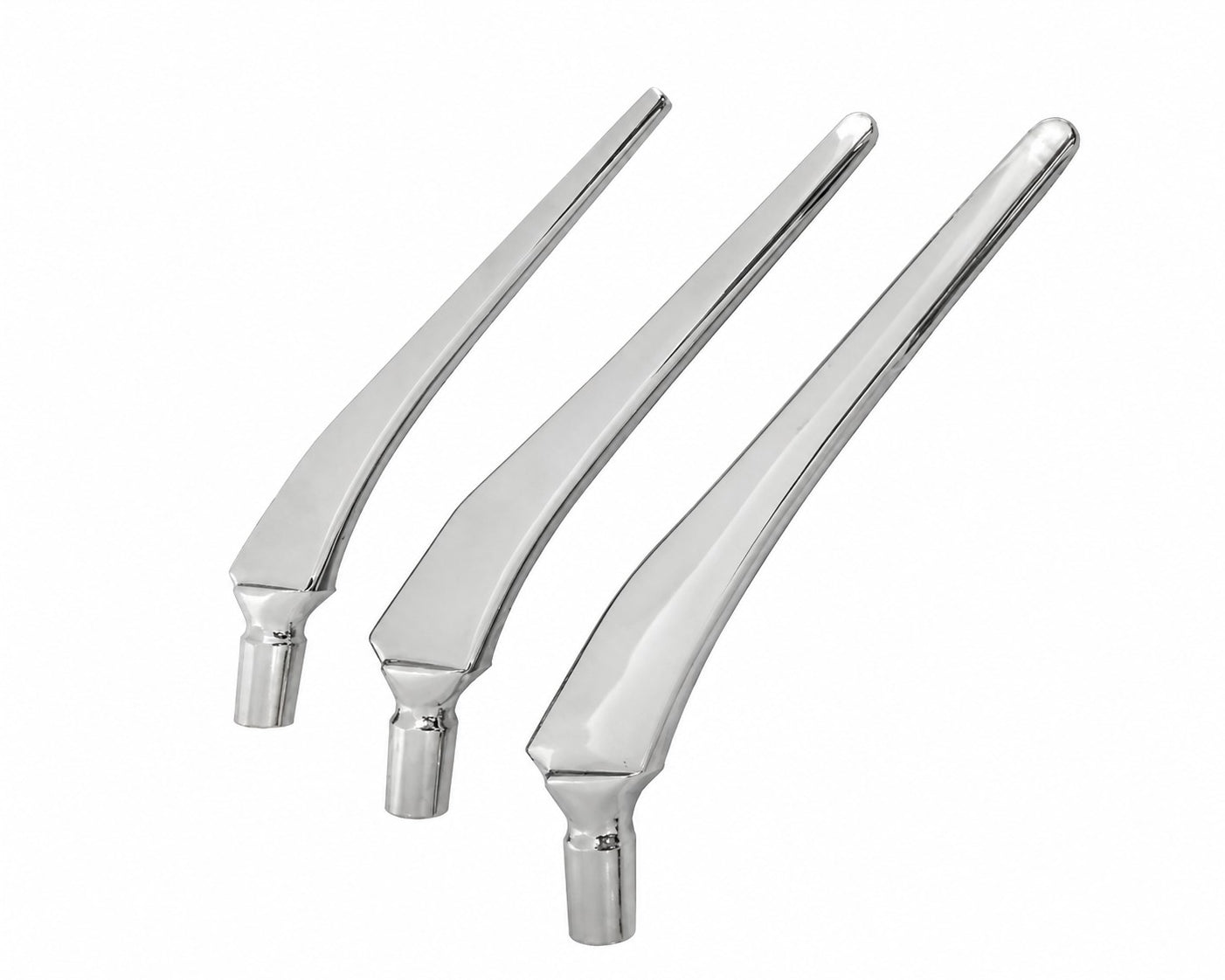
Modular Stems Muller Design, SKU PS-OP-5583, is a sterile medical-grade stainless steel femoral implant system intended for cemented total hip arthroplasty. The available configurations are model 174M-136-S at 136 mm length and 11.5 mm width, model 174M-141-M at 141 mm and 12.5 mm, and model 174M-146-L at 146 mm and 13.5 mm. Müller-pattern straight-stem geometry provides a tapered profile for controlled advancement into the prepared femoral canal and alignment within the cement mantle. The system supports femoral reconstruction during primary hip replacement for end-stage osteoarthritis, degenerative joint disease, avascular necrosis, selected femoral-neck fractures, and post-traumatic articular destruction when cemented fixation is indicated. During implantation, the proximal femur is exposed, the femoral neck is resected, the medullary canal is opened and sequentially prepared, and a compatible trial is used before definitive component insertion. The selected stem is introduced after canal cleaning, distal preparation, cement delivery, and pressurization. It is intended for orthopedic hip surgeons working in hospital operating rooms, specialist arthroplasty centers, trauma units, and joint-reconstruction facilities.
The implant uses a straight Müller-pattern body with progressively increasing dimensions across the three available models. Its longitudinal taper permits controlled passage through the broached femoral canal while supporting central positioning within the prepared cement bed. In the anteroposterior plane, wedge-like geometry assists self-centering as the component advances, reducing reliance on cortical contact for definitive fixation. The stem transfers load through the polymethylmethacrylate mantle rather than through an interference press-fit against cancellous and cortical bone. This distinction requires an adequate circumferential cement envelope, appropriate distal restriction, canal lavage, drying, retrograde cement delivery, and pressurization before insertion. The smooth metallic surface permits intimate contact between the prosthesis and cured cement without the porous coating used on biologic-ingrowth designs. Proximal geometry supports reconstruction of the femoral side of the hip joint, while the modular junction accepts a compatible femoral head selected within the corresponding implant system. The surgeon controls anteversion, axial depth, and coronal alignment during advancement. The component is held motionless while the cement polymerizes so that unintended rotation, subsidence, or varus positioning does not compromise the construct. Final stability is assessed before reduction and range-of-motion testing.
Clinical use begins after acetabular and femoral exposure through the surgeon’s selected posterior, direct lateral, anterolateral, or anterior approach. Following femoral-head removal and neck resection, the canal is entered in line with the proximal femoral axis. Sequential rasps or broaches establish the intended version, remove obstructing cancellous bone, and create space for the planned cement mantle. Trial reduction then evaluates limb length, offset, hip stability, impingement, and soft-tissue tension before the definitive implant is opened. In primary arthroplasty for osteoarthritis or avascular necrosis, the stem replaces the resected proximal femoral articulation and couples with a compatible head and acetabular bearing. In displaced intracapsular femoral-neck fracture management, selection depends on bone condition, patient physiology, acetabular treatment, and the planned total replacement construct. Cemented fixation can be considered where immediate implant stability is required in osteoporotic bone or a widened canal, subject to the operating surgeon’s assessment. After pulse lavage and drying, a distal cement restrictor is positioned, cement is introduced retrogradely, and the chosen component is advanced at the planned anteversion. Excess material is removed before polymerization, followed by reduction and fluoroscopic or radiographic assessment where used.
Model 174M-136-S combines a 136 mm length with an 11.5 mm width and is the smallest configuration. It is selected when templating and sequential canal preparation indicate a narrower intramedullary space while preserving an adequate cement envelope around the implant. Model 174M-141-M measures 141 mm by 12.5 mm and provides an intermediate option for femora whose metaphyseal and diaphyseal preparation falls between the small and large profiles. Model 174M-146-L measures 146 mm by 13.5 mm and occupies a broader prepared canal while extending farther into the femoral shaft. Selection is based on calibrated preoperative radiographs, proximal femoral morphology, canal width, neck resection level, planned center of rotation, trial stability, and the cement-mantle target. The listed width is not a substitute for broach feedback or intraoperative imaging. A larger component must not be chosen solely to obtain cortical engagement because this Müller-pattern implant relies on cemented rather than press-fit fixation. Conversely, an undersized body can produce an excessive or asymmetric mantle and alter axial positioning. Each code therefore identifies a distinct dimensional option, allowing the arthroplasty surgeon to match the definitive prosthesis to the prepared canal after trial reduction and alignment assessment.
Medical-grade stainless steel provides the rigidity, corrosion resistance, and surface durability required for a load-bearing femoral prosthesis. The polished implant finish supports handling during cemented insertion and avoids the textured or porous surface used to promote osseointegration in uncemented stems. Each component is supplied sterile for a single implantation procedure and must remain within its intact sterile barrier until the surgical team has completed sizing and trial reduction. A package that is opened, damaged, wet, expired, or otherwise compromised must not enter the sterile field. This implanted device is not reusable and must not be cleaned for implantation in another patient. CE documentation supports European conformity assessment within the applicable device framework, while ISO 13485 addresses the manufacturer’s medical-device quality management system. FDA-related procurement requires the establishment, device-listing, labeling, importer, and market-access documentation applicable to the destination and transaction; these references do not mean that ISO certification alone constitutes FDA approval. Hospitals and distributors should maintain lot, model, expiration, and patient-traceability records. Receiving teams should reconcile the ordered code with the package label and retain supporting documentation according to institutional implant-control procedures.
| SKU | PS-OP-5583 |
|---|---|
| Product Name | Modular Stems Muller Design |
| Price | $60.50 USD per implant |
| Size/Gauge Variants | 174M-136-S: 136 × 11.5 mm; 174M-141-M: 141 × 12.5 mm; 174M-146-L: 146 × 13.5 mm |
| Instrument Category | Orthopedic femoral implant |
| Procedure | Cemented total hip arthroplasty and selected hip reconstruction procedures |
| Material | Medical-grade stainless steel |
| Finish | Polished implant finish |
| Sterilization | Supplied sterile; single-use implantation device |
| Instrument Classification | Implantable femoral prosthesis |
| Reusable | No |
| Certifications | CE and ISO 13485 documentation; FDA procurement documentation according to destination-market requirements |
| Warranty | 30-day money-back guarantee for eligible unopened products under Peak Surgicals return terms |
| MOQ | 1 implant |
| OEM / Custom Orders | OEM labeling and packaging available subject to technical, regulatory, and order requirements |
| After-Sale Service | Order, documentation, shipment, traceability, and eligible return support |
How does this Müller stem differ from a cementless porous-coated femoral stem?
Modular Stems Muller Design uses a polished stainless steel body intended for fixation within a prepared bone-cement mantle. A cementless porous-coated stem obtains initial stability through a press-fit against prepared femoral bone. Its textured or porous surface subsequently supports biologic bone ongrowth or ingrowth. The Müller configuration therefore requires cement restriction, lavage, drying, retrograde cement delivery, and controlled polymerization. A cementless alternative instead depends more heavily on cortical fit, bone quality, rotational purchase, and avoidance of subsidence. Implant selection must follow patient factors, femoral morphology, surgeon training, and the approved operative technique.
How should the 136 mm, 141 mm, and 146 mm stems be selected?
Modular Stems Muller Design is selected through calibrated radiographic templating followed by intraoperative canal preparation and trial reduction. The 136 × 11.5 mm model suits the narrowest prepared canal among the listed options. The 141 × 12.5 mm version provides an intermediate dimensional profile. The 146 × 13.5 mm component addresses a broader canal requiring the longest available body. Selection must preserve a controlled cement mantle around the stem rather than produce direct press-fit cortical fixation. The surgeon must also evaluate neck resection, femoral version, limb length, offset, canal geometry, trial stability, and the planned center of rotation.
What do CE, ISO 13485, and FDA procurement references mean for this implant?
CE documentation concerns conformity with the applicable European medical-device requirements and the authorized market scope. ISO 13485 addresses the quality management system used for medical-device design, production, documentation, and traceability. Neither designation independently represents FDA approval or clearance. United States procurement requires the applicable establishment, listing, labeling, importer, and device documentation for the supplied product. Modular Stems Muller Design should be purchased with its model code, lot information, sterile status, and expiry data recorded. Procurement teams should retain the accompanying documentation within their implant traceability and supplier-qualification systems.
How is the modular connection managed during implantation?
The modular feature permits a compatible femoral head to be assembled onto the stem junction after definitive positioning. The junction must remain clean, dry, and free of blood, cement, bone fragments, glove powder, or damaged packaging debris. Modular Stems Muller Design must only be coupled with components identified as compatible within the relevant implant system. After selecting the trial head, the surgeon confirms offset, limb length, stability, and impingement through trial reduction. The definitive head is then seated using the system-specific assembly technique and controlled impaction. Mixing unvalidated manufacturers, taper geometries, or component systems can damage the junction and compromise mechanical integrity.
How should hospitals and distributors receive and manage the sterile implant?
Receiving personnel should compare the purchase order with the model code, dimensions, lot number, expiry date, and sterile-barrier condition. Modular Stems Muller Design should be stored in its unopened packaging within a clean, dry area protected from compression, moisture, and temperature extremes. The implant should enter the operating room only after the surgical team has completed planning and confirmed that the required size range is available. Once the barrier is opened, the component cannot be returned to stock or processed for another patient. A damaged, expired, or contaminated package must be segregated under the facility’s nonconforming-product procedure. Hospitals should record the implanted code and lot in the patient file, theater register, implant log, and inventory system.


