
Featured Collection
Your cart
Featured Collection

PEAK SURGICALS
SKU:PS-OP-5567
Couldn't load pickup availability


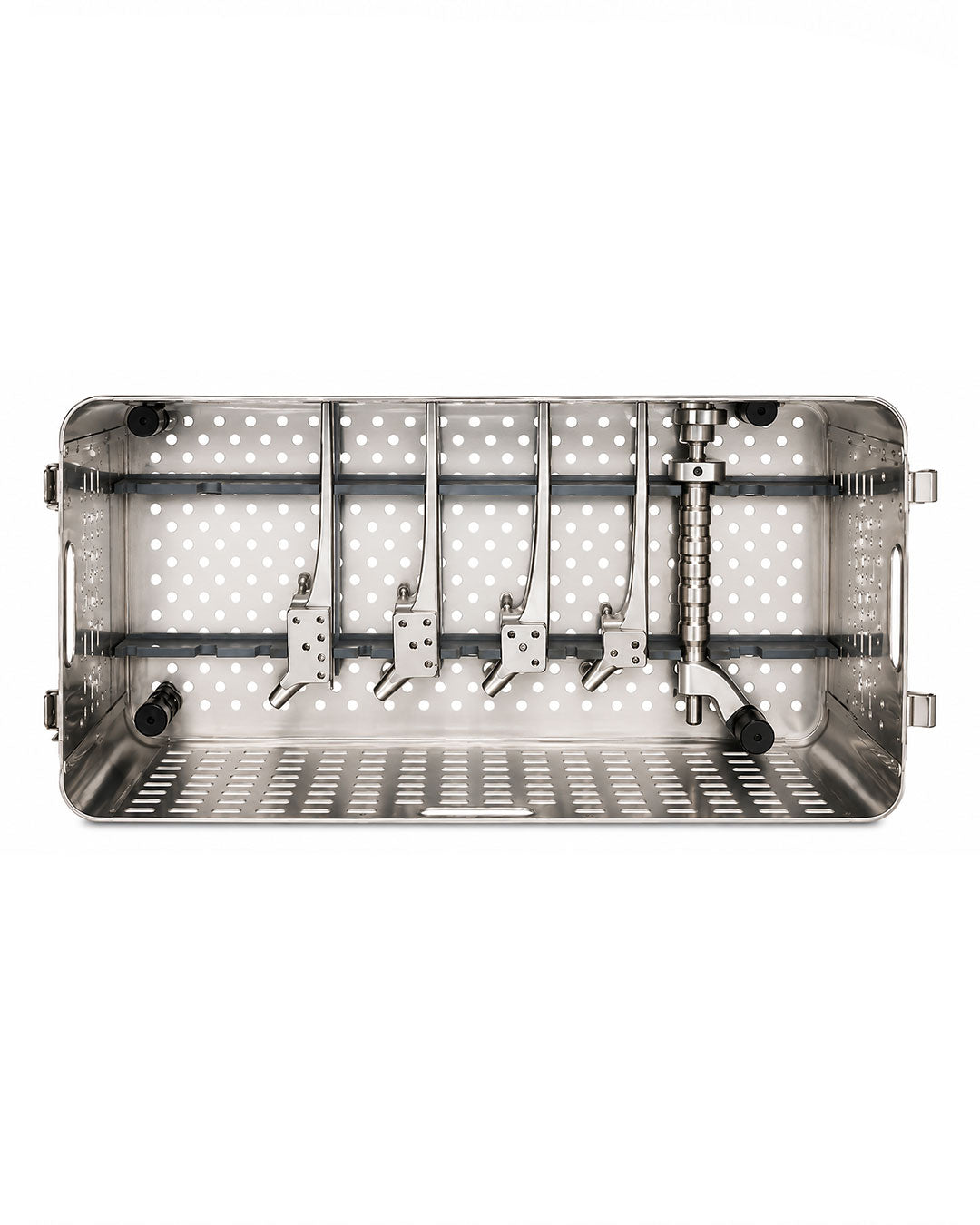
Calcar Replacement Stem Instruments Set, SKU PS-OP-5567, is a 45-component reusable German stainless steel system for femoral canal preparation, calcar-replacement stem implantation, trial reduction, and bipolar head assembly. The set includes a head impactor, femoral head sizing guide, femoral head extractor, head extractor, bipolar head ring forceps, bipolar cup impactor, T-handle, rod, extraction bar, cement plug impactor, hammer, rasp handle, stem impactor, offset template, and chisel. Five 28 mm head trials span −3 to +8 mm offsets, nine bipolar trials cover 42–58 mm diameters, and ten cement plug trials range from 9–18 mm. Calcar replacement rasps are supplied in 9, 11, and 13 mm sizes with corresponding 9, 11, and 13 mm initial femoral drills. Container 9703-000 organizes the inventory. Orthopedic reconstruction, arthroplasty, orthopedic oncology, and trauma surgeons use the system during selected primary or revision hip procedures involving proximal femoral bone deficiency, periprosthetic fracture, pathological destruction, failed implants, or calcar compromise. It supports cemented and system-compatible cementless workflows in hospitals and tertiary joint-reconstruction centers.
Initial femoral drills 9703-0090, 9703-0110, and 9703-0113 establish progressive 9, 11, and 13 mm pathways along the femoral canal axis. The T-handle supplies rotational leverage, while rod 9703-0015 transfers force through the corresponding modular connection. Calcar replacement rasps in matching 9, 11, and 13 mm sizes enlarge the canal according to the supported stem profile and provide tactile feedback regarding axial depth, cancellous engagement, and cortical proximity. Rasp handle 9703-0019 locks onto the selected broach and controls advancement, extraction, version, and coronal alignment. Chisel 9703-0022 releases localized bone, cement, or an accessible implant interface during preparation or revision exposure. Hammer 9703-0018 supplies controlled impaction force. Stem impactor 9703-0020 directs force into the definitive component during seating, while extraction bar 9703-0016 provides axial or lever-assisted control during removal of a compatible stem. Offset template 9703-0021 assesses the relationship between the prepared femur and planned reconstruction. The instrument progression must remain coaxial with the canal because eccentric drilling or rasp advancement can compromise the remaining femoral cortex.
Following exposure, femoral-head removal, and resection of nonviable or obstructing proximal bone, the canal entry point is established along the femoral shaft axis. Progressive drills create the initial track, and matching rasps prepare the implant envelope while the surgeon controls depth, version, and alignment. In cemented reconstruction, a plug trial from 9–18 mm identifies circumferential engagement at the planned distal level. Cement plug impactor 9703-0017 seats the selected restrictor before canal cleaning, drying, retrograde cement delivery, and pressurization. The definitive stem is advanced and seated with the stem impactor. For bipolar reconstruction, femoral head sizing guide 9703-0002 and external trials from 42–58 mm assess correspondence with the native acetabulum. Ring forceps control the bipolar component during handling and assembly, and cup impactor 9703-0012 applies directed seating force. The 28 mm head trials assess neck length, offset, limb length, soft-tissue tension, stability, and impingement before final head selection. Head impactor 9703-0001 assembles the definitive component onto a clean compatible taper. Femoral head extractor and head extractor support disassembly during revision or component exchange.
The 9 mm rasp and initial drill provide the smallest femoral preparation pathway in the supplied system. The 11 mm pair expands the working diameter for an intermediate stem configuration, while the 13 mm instruments address the broadest listed canal preparation. Selection is based on calibrated templating, remaining diaphyseal bone, canal width, cortical thickness, fixation strategy, and stability of the system-matched trial. Head trials retain a 28 mm articulation while changing neck displacement from −3 mm through neutral to +4, +6, and +8 mm. Negative displacement shortens the reconstructed neck relative to neutral, whereas positive options progressively increase length and offset according to the supported implant geometry. Bipolar shell trials progress from 42–58 mm in 2 mm increments and assess external articulation against the retained acetabulum. Cement plug trials increase from 9–18 mm in 1 mm steps, permitting close selection at the intended restrictor depth. The rasp, plug, internal head, and bipolar shell measurements describe different components and cannot be transferred between sizing sequences. Final selection follows trial findings, anatomy, reconstruction objective, and documented implant compatibility.
German stainless steel provides the rigidity, corrosion resistance, and dimensional stability required for drilling, broaching, extraction, and repeated impaction. Cutting teeth and drill flutes require inspection for retained bone, dulling, chipping, bending, or eccentric wear. The extraction bar, hammer, handles, impactors, forceps, templates, sizing guide, and trials should be examined for cracks, deformation, damaged interfaces, or unreadable markings. Modular instruments must be disassembled where their validated design permits so cleaning reaches recesses, threads, teeth, and connection surfaces. Components should be cleaned, rinsed, inspected, dried, packaged, and steam sterilized according to institutional validation and manufacturer instructions. CE documentation concerns conformity with applicable European medical-device requirements, while ISO 13485 addresses the quality management system governing manufacture and traceability. FDA procurement depends on the establishment, listing, labeling, importer, and destination-market documentation applicable to the supplied set. Container 9703-000 supports organized transport, instrument counting, and processing but does not independently establish sterilization efficacy, cycle parameters, drying, or sterile shelf life. Damaged or incompletely cleaned instruments must be removed from use.
| 9703 Calcar Replacement Stem Instruments Set | Set Consisting of | Units |
|---|---|---|
| 9703-0001 | Head Impactor | 1 |
| 9703-0002 | Femoral Head Sizing Guide | 1 |
| 9703-0005 | Femoral Head Extractor | 1 |
| 9703-0007 | Head Extractor | 1 |
| 9703-0010 | Bipolar Head Ring Forceps | 1 |
| 9703-0012 | Bipolar Cup Impactor | 1 |
| 9703-0014 | T-Handle | 1 |
| 9703-0015 | Rod | 1 |
| 9703-0016 | Extraction Bar | 1 |
| 9703-0017 | Cement Plug Impactor | 1 |
| 9703-0018 | Hammer | 1 |
| 9703-0019 | Rasp Handle | 1 |
| 9703-0020 | Stem Impactor | 1 |
| 9703-0021 | Offset Template | 1 |
| 9703-0022 | Chisel | 1 |
| 9703-0003 | Head Trial, Ø28−3, Small | 1 |
| 9703-0000 | Head Trial, Ø28+0, Medium | 1 |
| 9703-0004 | Head Trial, Ø28+4, Large | 1 |
| 9703-0006 | Head Trial, Ø28+6, Extra Large | 1 |
| 9703-0008 | Head Trial, Ø28+8, Extra Extra Large | 1 |
| 9703-0042 | Bipolar Head Trial, Ø42 mm | 1 |
| 9703-0044 | Bipolar Head Trial, Ø44 mm | 1 |
| 9703-0046 | Bipolar Head Trial, Ø46 mm | 1 |
| 9703-0048 | Bipolar Head Trial, Ø48 mm | 1 |
| 9703-0050 | Bipolar Head Trial, Ø50 mm | 1 |
| 9703-0052 | Bipolar Head Trial, Ø52 mm | 1 |
| 9703-0054 | Bipolar Head Trial, Ø54 mm | 1 |
| 9703-0056 | Bipolar Head Trial, Ø56 mm | 1 |
| 9703-0058 | Bipolar Head Trial, Ø58 mm | 1 |
| 9703-0209 | Cement Plug Trial, Ø9 mm | 1 |
| 9703-0210 | Cement Plug Trial, Ø10 mm | 1 |
| 9703-0211 | Cement Plug Trial, Ø11 mm | 1 |
| 9703-0212 | Cement Plug Trial, Ø12 mm | 1 |
| 9703-0213 | Cement Plug Trial, Ø13 mm | 1 |
| 9703-0214 | Cement Plug Trial, Ø14 mm | 1 |
| 9703-0215 | Cement Plug Trial, Ø15 mm | 1 |
| 9703-0216 | Cement Plug Trial, Ø16 mm | 1 |
| 9703-0217 | Cement Plug Trial, Ø17 mm | 1 |
| 9703-0218 | Cement Plug Trial, Ø18 mm | 1 |
| 9703-0009 | Calcar Replacement Stem Rasp, 9 mm | 1 |
| 9703-0011 | Calcar Replacement Stem Rasp, 11 mm | 1 |
| 9703-0013 | Calcar Replacement Stem Rasp, 13 mm | 1 |
| 9703-0090 | Initial Femoral Drill, Ø9 mm | 1 |
| 9703-0110 | Initial Femoral Drill, Ø11 mm | 1 |
| 9703-0113 | Initial Femoral Drill, Ø13 mm | 1 |
| 9703-000 | Empty Container | Included |
| SKU | PS-OP-5567 |
|---|---|
| Product Name | Calcar Replacement Stem Instruments Set |
| Price | $3,515.49 USD |
| Size/Gauge Variants | Femoral drills and rasps: 9, 11 and 13 mm; head trials: Ø28−3 to Ø28+8; bipolar trials: 42–58 mm; cement plug trials: 9–18 mm |
| Instrument Category | Orthopedic femoral reconstruction instrument system |
| Procedure | Calcar replacement hip arthroplasty, bipolar reconstruction, and selected revision femoral procedures |
| Material | German stainless steel with aluminum container |
| Finish | Satin orthopedic finish with polished functional interfaces |
| Sterilization | Reusable instruments for validated hospital cleaning and steam sterilization |
| Instrument Classification | Reusable orthopedic implant instrumentation system |
| Reusable | Yes |
| Certifications | CE and ISO 13485 documentation; FDA procurement documentation according to destination-market requirements |
| Warranty | 1 year |
| MOQ | 1 set |
| OEM / Custom Orders | Available for documented component, size-range, tray, labeling, and packaging requirements |
| After-Sale Service | Replacement instrument, documentation, order, return, and maintenance support |
How does this set differ from a standard hip stem instrument system?
Calcar Replacement Stem Instruments Set is organized around 9, 11, and 13 mm preparation instruments for the corresponding reconstruction stem family. A standard primary hip tray usually contains rasps and trials for femora with preserved proximal support. Calcar-replacement surgery addresses cases where the planned implant must compensate for deficient proximal femoral bone. This set also includes an extraction bar, cement plug sequence, bipolar trials, and dedicated sizing components. The instruments are not substitutes for standard stem broaches merely because their diameters overlap. Selection must follow the implant system, remaining bone, fixation strategy, and operative technique.
How are the drill, rasp, bipolar trial, and plug sizes selected?
Calcar Replacement Stem Instruments Set uses separate sizing sequences for different operative stages. The 9, 11, and 13 mm drills establish the canal pathway, while matching rasps create the supported stem envelope. Bipolar trials from 42–58 mm assess external articulation against the retained acetabulum. Cement plug trials from 9–18 mm identify canal engagement at the intended restrictor depth. The 28 mm head trials alter neck displacement from −3 to +8 mm during reduction assessment. Measurements from one sequence cannot be applied directly to another component group.
What do CE, ISO 13485, and FDA references mean for procurement?
CE documentation concerns conformity with applicable European medical-device requirements. ISO 13485 addresses the quality management system governing instrument manufacture and traceability. Neither designation independently means that Calcar Replacement Stem Instruments Set has received FDA approval. United States procurement requires the applicable establishment, listing, labeling, importer, and market-access documentation. Hospitals should retain these records with the SKU, component list, maintenance history, and supplier information. The documentation supports vendor qualification, inventory management, traceability, and complaint handling.
How do the handles, impactors, and extraction bar function?
The T-handle provides rotational leverage for compatible femoral preparation components. The rasp handle locks onto a broach and controls advancement, extraction, version, and coronal alignment. Stem impactor transmits directed seating force to the definitive component, while the head impactor assembles the compatible head junction. Cement plug impactor controls restrictor placement in the distal canal. Calcar Replacement Stem Instruments Set includes an extraction bar for controlled stem removal during compatible revision workflows. Every connection must be fully seated, aligned, and functionally tested before force is applied.
How should the set and aluminum container be reprocessed?
All components should be counted and transferred for decontamination immediately after surgery. Drill flutes, rasp teeth, extractors, forceps, impactors, trials, and connection recesses require direct cleaning and inspection. Calcar Replacement Stem Instruments Set should be disassembled where its validated design permits. Instruments must then be rinsed, dried, functionally tested, packaged, and steam sterilized according to institutional and manufacturer instructions. The aluminum container organizes the inventory but does not independently establish sterilization efficacy. The tray should be released only after count reconciliation, cycle completion, drying, packaging inspection, and sterilization-record approval.


