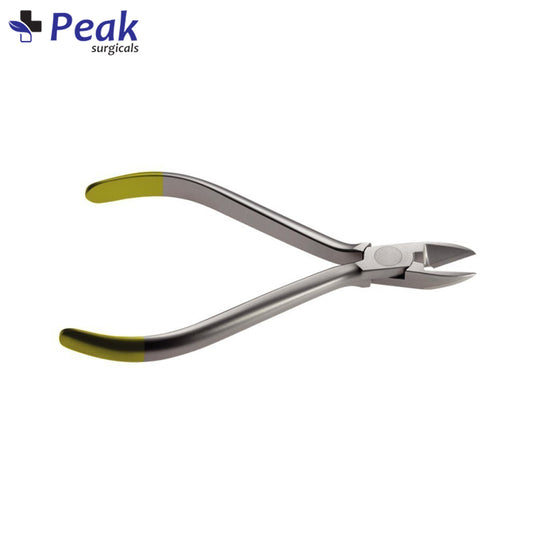
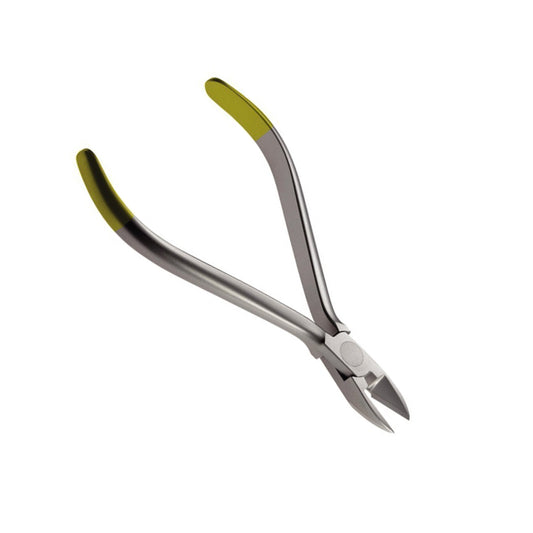
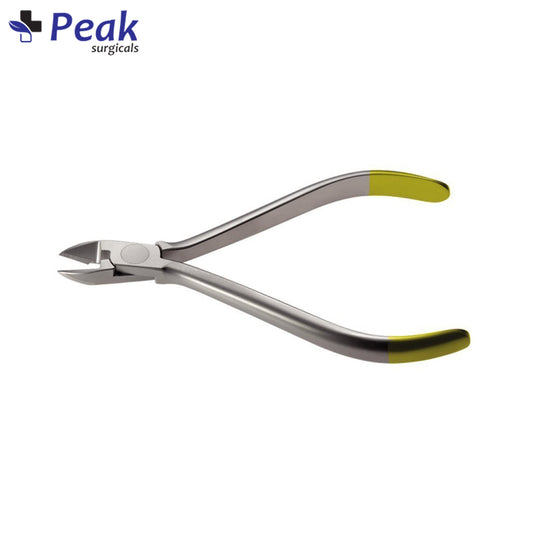
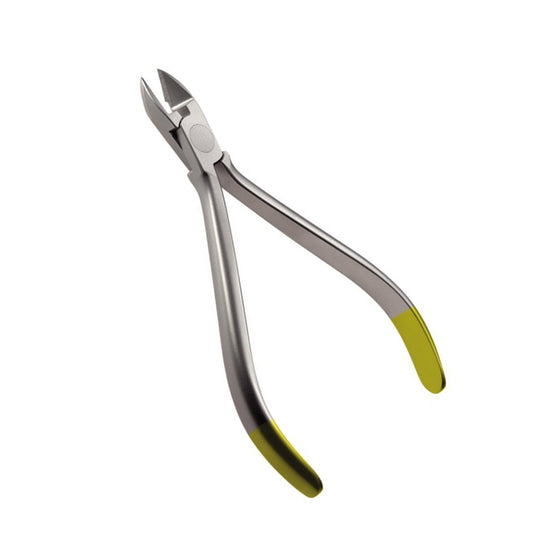
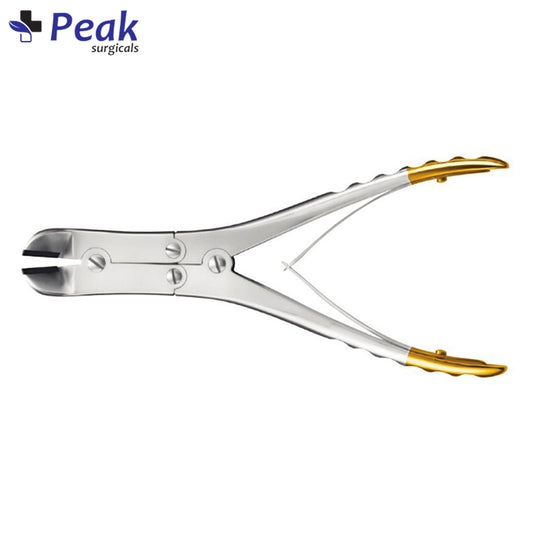
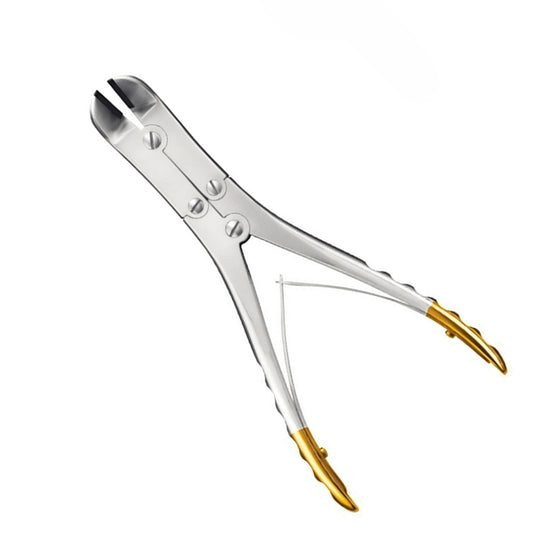
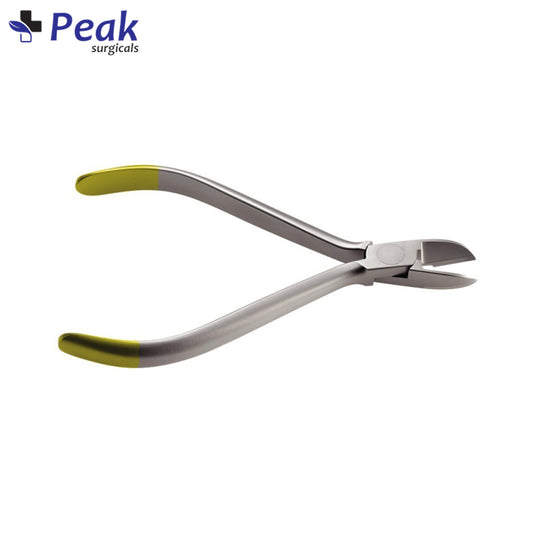
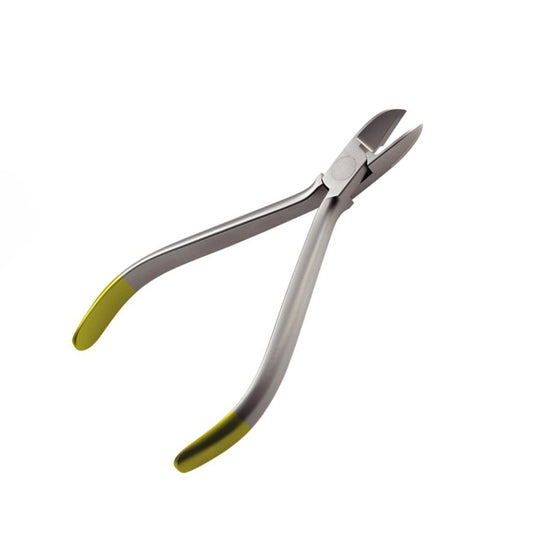
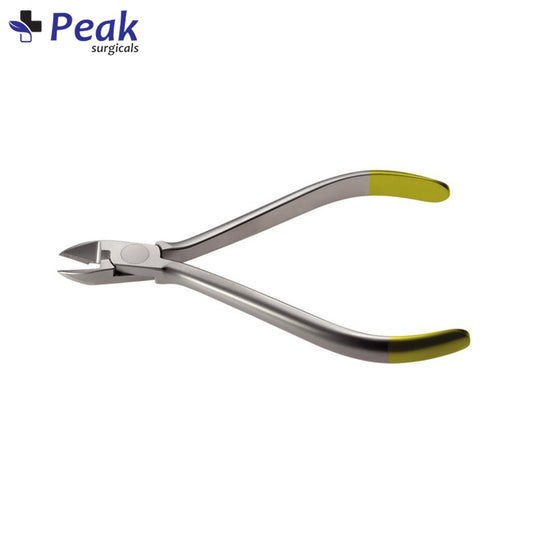
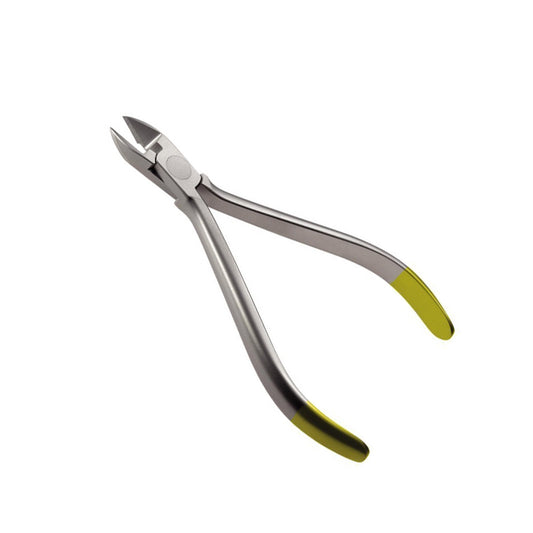
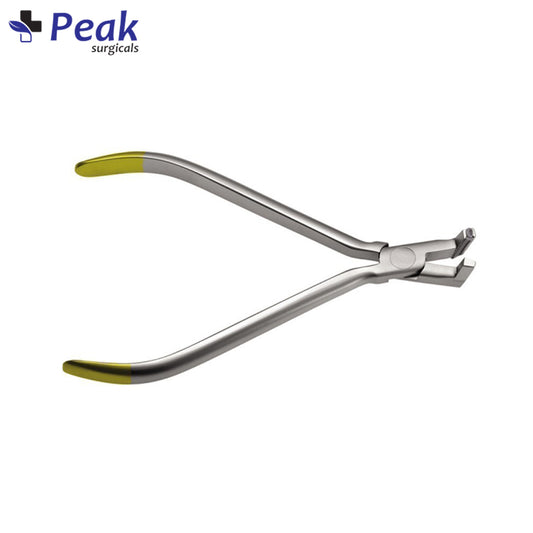
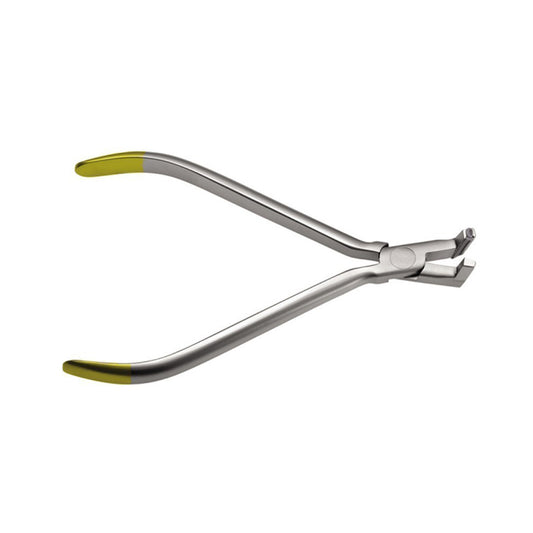
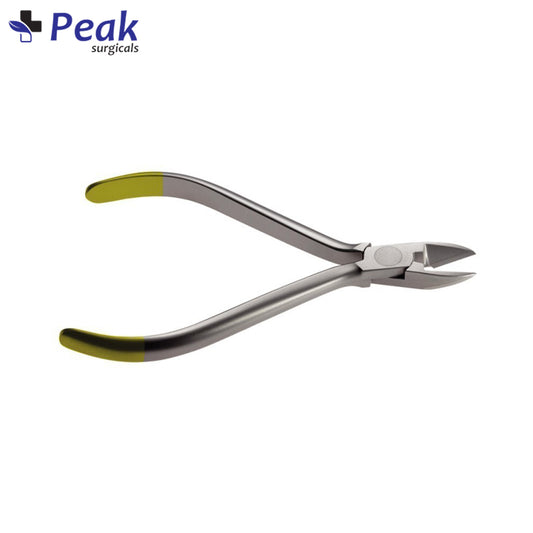
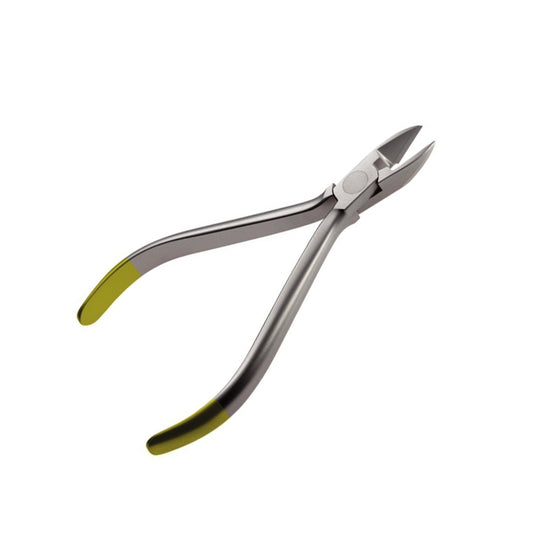
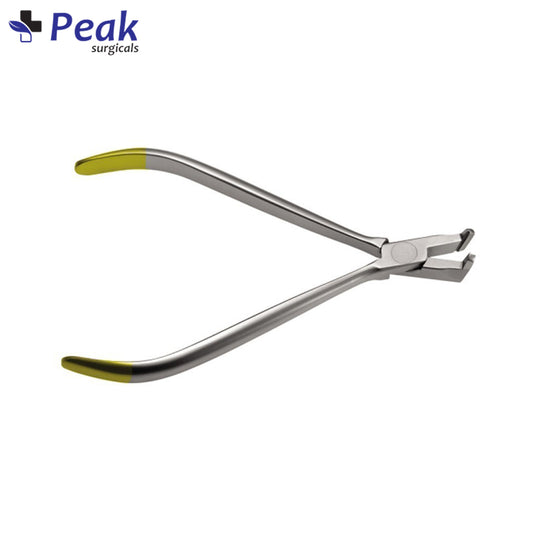
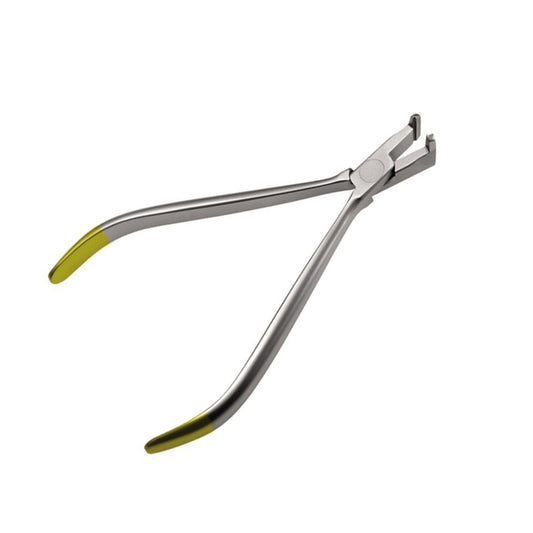
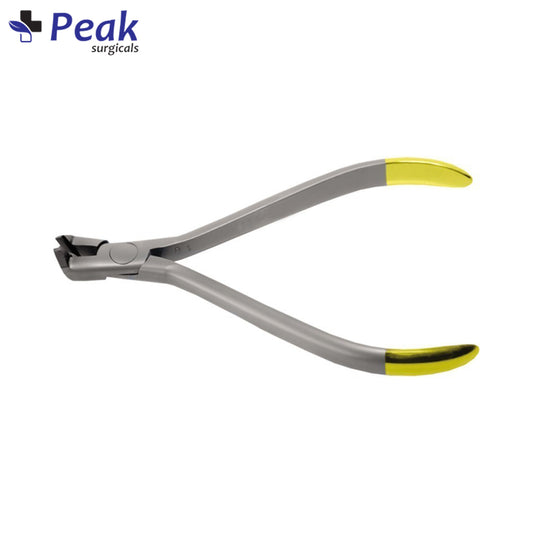
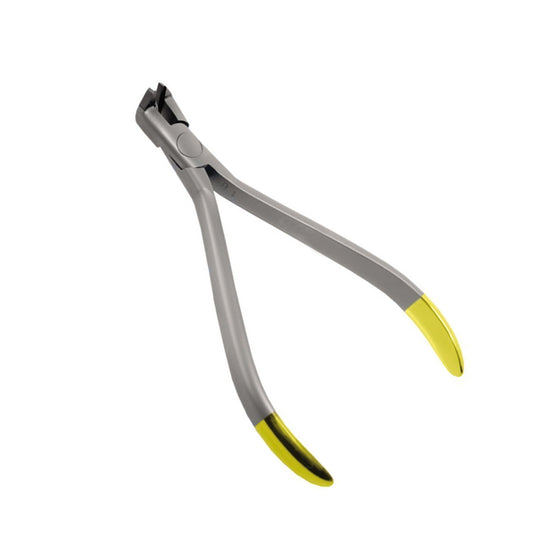
Orthodontic wire cutters divide into three jobs, and the distal end cutter is the one that does something the others do not: it holds the fragment it cuts. Peak Surgicals stocks nine patterns from Distal End Cutter Long Handle TC ($15.40) to Heavy Wire Cutter ($27.50), all CE marked and built under ISO 13485. Compare all nine patterns in the grid below.
Why a Distal End Cutter Holds What It Cuts
A distal end cutter is designed to work inside the patient's mouth, which changes what the instrument has to do. It shear-cuts the archwire within about half a millimetre of the buccal tube, close enough that no sharp end is left to catch tissue, and it retains the severed fragment rather than releasing it into the oral cavity. A cutter that only cuts leaves the operator chasing a loose wire end in a field they cannot fully see.
That retention is why the category exists as a separate instrument rather than a variant of a wire cutter. Distal End Cutter Flush Cut ($16.50) gives the closest trim to the tube, Distal End Cutter TC ($16.50) is the standard head, Distal End Cutter Long Handle TC ($15.40) adds leverage for heavier archwire, and Micro Distal End Cutter TC ($15.40) reduces head size for posterior access where a standard head will not seat. We supply every pattern at MOQ 1.
Ligature, Hard or Heavy? Match the Cutter to the Gauge
Outside the mouth, the selection runs on wire hardness and gauge rather than access. Ligature cutters take the lightest work: Ligature Cutter Fine Tip ($17.60) and Ligature Cutter Micro ($16.50) cut ligature wire and elastomeric ties with a fine tip that reaches between brackets without disturbing the archwire. Using a ligature cutter on hard archwire will chip the edge, and the damage is usually invisible until a cut goes ragged.
Hard and heavy wire cutters take the rest. Hard Wire Cutter (.022 × .028, $16.50) covers rectangular archwire at full working gauge, Wire Cutter 15 Degree Hard TC ($16.50) angles the head so the cut can be made without rotating the wrist into the arch, and Heavy Wire Cutter ($27.50) handles appliance and auxiliary wire heavier than any archwire in the mouth. Matching the cutter to the gauge is what keeps an edge alive.
What TC Inserts and a Box Joint Actually Do
Tungsten carbide inserts are the reason most of this range carries a TC designation. Carbide is substantially harder than the stainless steel body it is brazed into, so the cutting edge holds its geometry through far more cuts before it rounds over. On an instrument that meets hardened archwire several times a day, that is the difference between an edge lasting months and lasting years.
The joint matters as much as the edge. A box joint holds the two halves in alignment under load, so the cutting faces meet squarely rather than shearing past each other, and a cutter with play at the joint will crush wire instead of cutting it, however sharp the inserts are.
Material, Reprocessing and Certification
Every pattern is built on a stainless steel body with tungsten carbide inserts on the TC designations. The inspection point is the edge and the joint: close the handles slowly and check the cutting faces meet along their full length with no daylight, then flex the head laterally to confirm no play at the joint. Flush debris before it dries, using water at 40 to 60 degrees Celsius, work a soft brush into the joint where wire fragments collect, then rinse with deionised water and dry fully before autoclaving. Hinged instruments need longer drying time than solid ones.
These are Class I reusable devices, CE-marked and built to ISO 13485, with a 1-year manufacturing warranty. We ship at MOQ 1 with free shipping over $99, and OEM production is available for distributors. See Orthodontic Pliers for wire forming and bracket work, or browse all Dental Orthodontic Instruments. Talk to us about OEM terms.