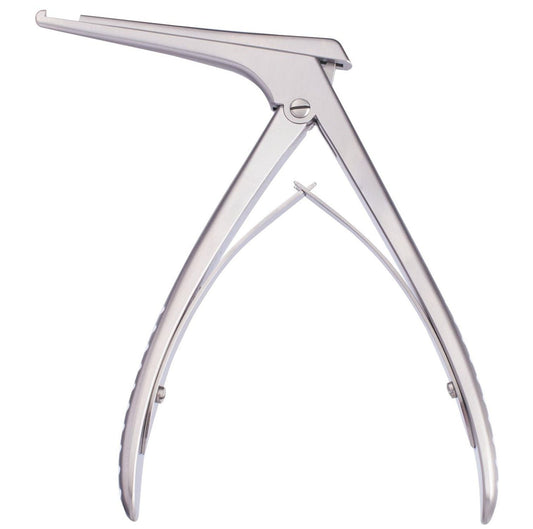
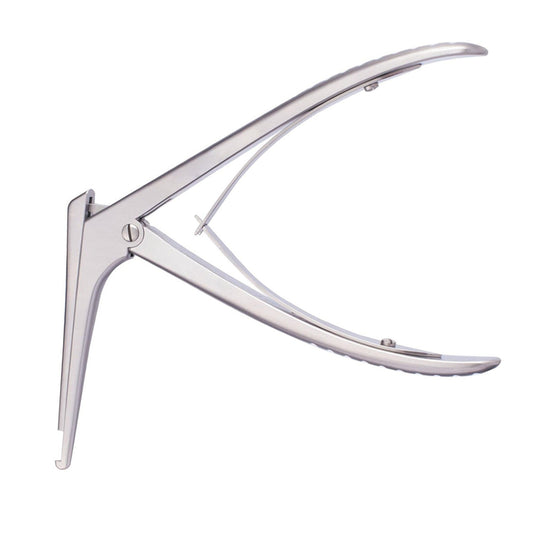
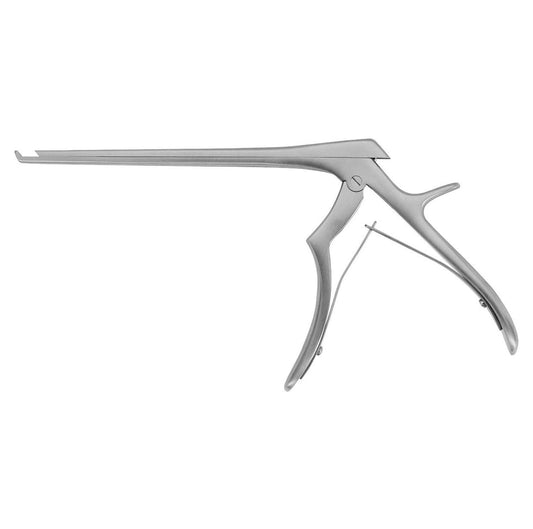
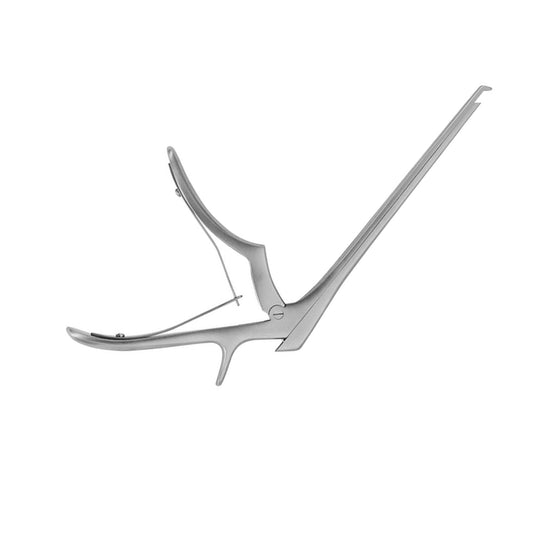
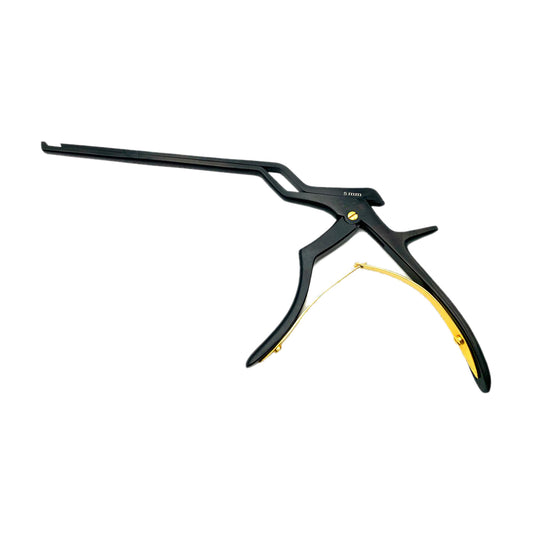
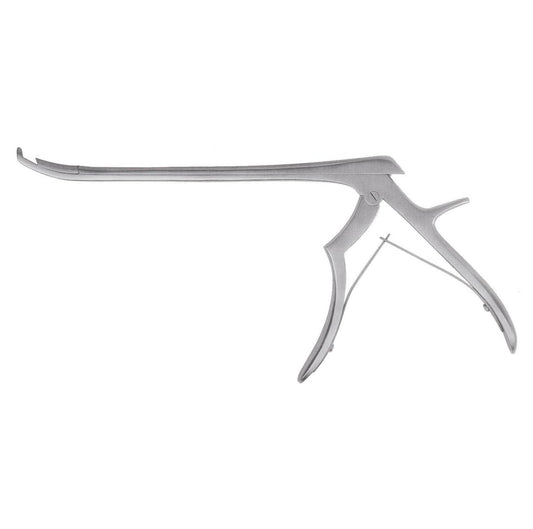
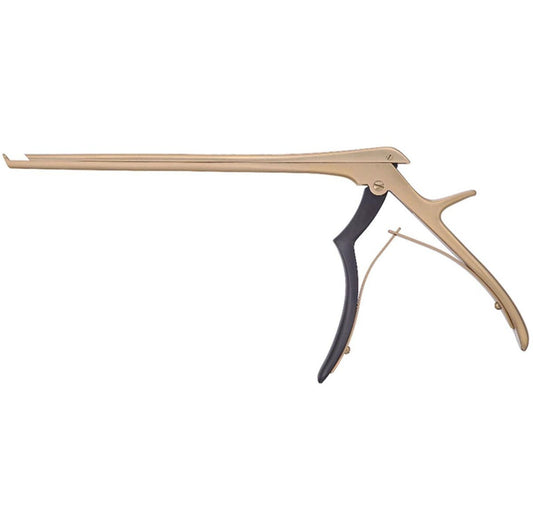
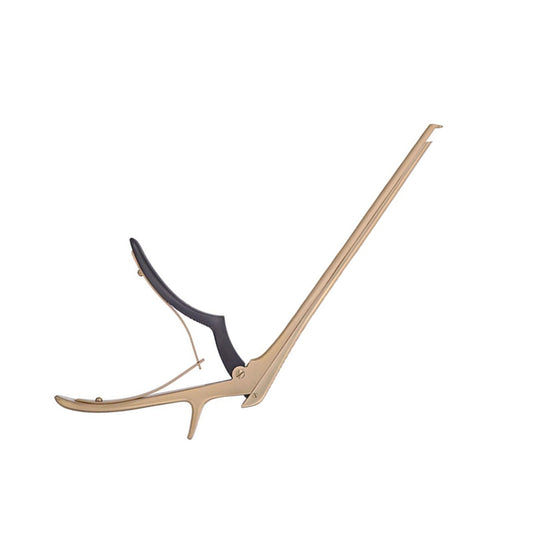
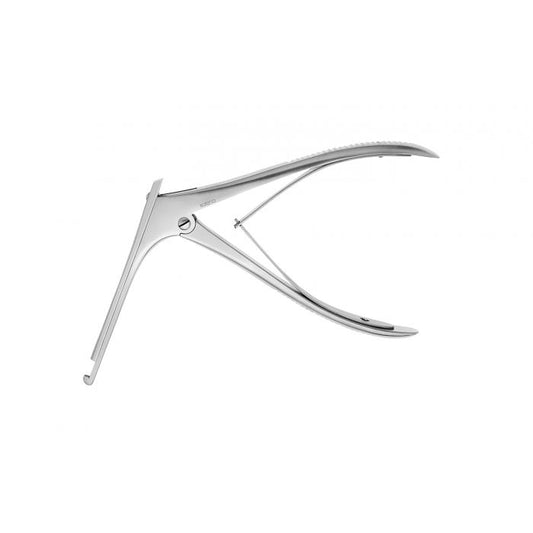
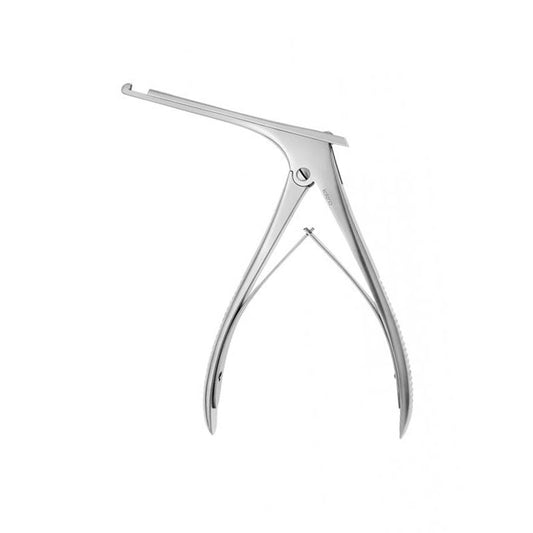
A Kerrison rongeur bites bone from underneath. The footplate slides into a space the surgeon must not disturb, the jaw closes down onto it from above, and the bite is taken without ever lifting or levering what sits beneath. That is the whole reason the pattern exists, and it is why it dominates spinal decompression. Peak Surgicals stocks six Kerrison patterns from 1mm to 10mm bite, from $38.50, in German stainless steel and CE marked and built under ISO 13485. Compare the full range in the grid below.
Why the Footplate Goes Under
Consider what a conventional rongeur has to do to take a bite of lamina. Its jaws close on bone from both sides, which means something has to get underneath, and in a laminectomy what is underneath is dura and the cord behind it. A Kerrison removes that problem. The thin footplate passes into the epidural space first, flat against the dura rather than pressing into it, and the upper jaw then descends and shears the bone against the footplate.
The bite is taken by a punching action rather than a crushing one, which is why the pattern is also called a Kerrison punch. Nothing is pulled outward, nothing is levered, and the fragment is removed cleanly rather than fractured off. In a decompression the surgeon is working millimetres from neural tissue, and that difference in mechanism is the difference between a controlled procedure and one that cannot be attempted this way at all.
Bite Width, Length and Shaft Offset
Bite width is the primary selection, and it is set by the space available rather than by how much bone needs removing. The range here runs from 1mm to 10mm: narrow jaws work in a tight foraminotomy or where the epidural space will not accept more, and wider jaws clear lamina faster once the decompression has room. Kerrison Rongeur Forceps (PS-9311, $49.50) covers the 3mm to 6mm range, and Kerrison Rongeurs (PS-9333, from $38.50) and Open Up Kerrison (PS-9329, from $38.50) run the full 1mm to 10mm span.
Working length follows the depth of the approach. The 8 to 12 inch range covers everything from a shallow cervical exposure to a deep lumbar one in a large patient, and the shaft has to reach without the hand entering the wound. Micro Handle Kerrison Rongeurs (PS-9325, from $44.00) reduce the handle for finer work, and Kerrison Bayonet Black Rongeur 45° (PS-OR-00100, $49.50) offsets the shaft so the hand and instrument body sit clear of the microscope or endoscope line of sight.
Material, Reprocessing and Certification
Every pattern is forged from German stainless steel and passivated for corrosion resistance across repeated cycles, with black finishes available where glare control matters under the microscope. The inspection point on a Kerrison is the footplate and the cutting edge, and it should be checked before every case rather than periodically: hold the jaw closed against light and confirm the edge meets the footplate along its full width with no daylight, because a Kerrison that no longer shears cleanly tears bone instead of cutting it and transmits that force to the tissue underneath. Check the footplate tip for burring or thickening, since the footplate is what sits against dura, and work the handle through full travel to confirm it opens and closes without binding. Clean immediately with a neutral-pH enzymatic solution, brushing bone debris out of the jaw and the footplate junction before it dries, then rinse with deionised water and dry fully, following the reprocessing instructions supplied.
These are Class I reusable devices, supplied non-sterile, CE marked and built under ISO 13485, with a one-year manufacturing warranty. We ship at MOQ 1 with free shipping over $99, and OEM production is available for distributors. See Bone Rongeurs for the wider range, or browse all Orthopedic Instruments.