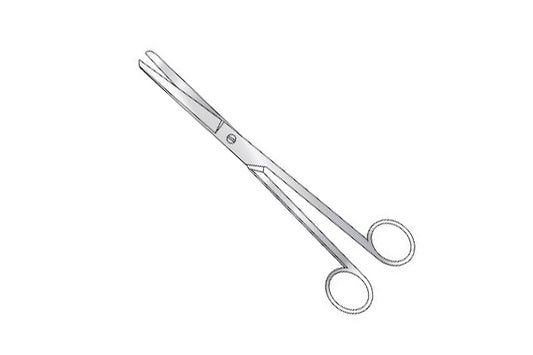
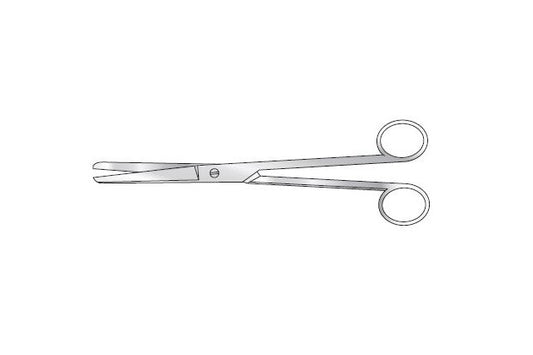
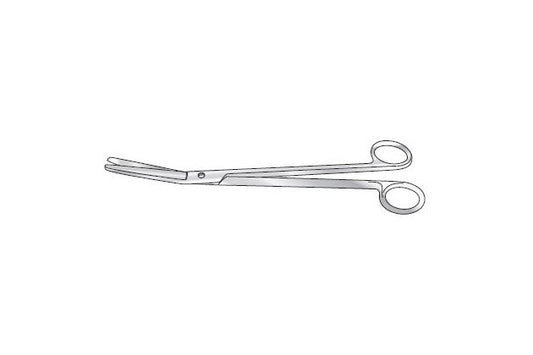
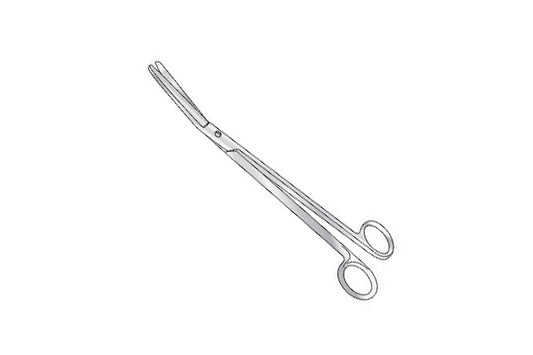
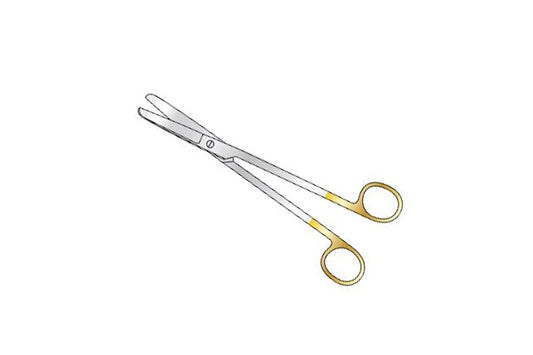
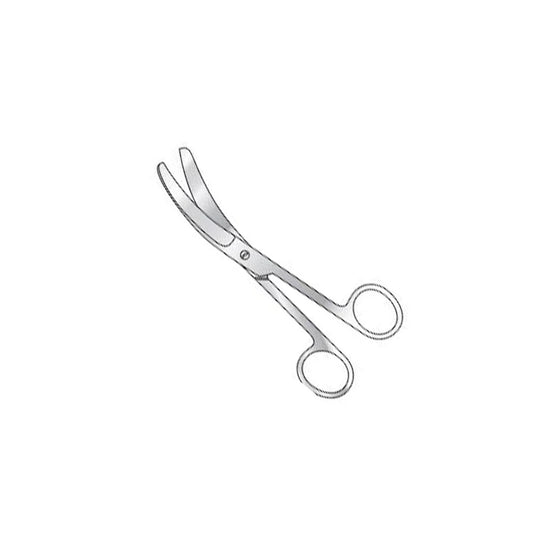
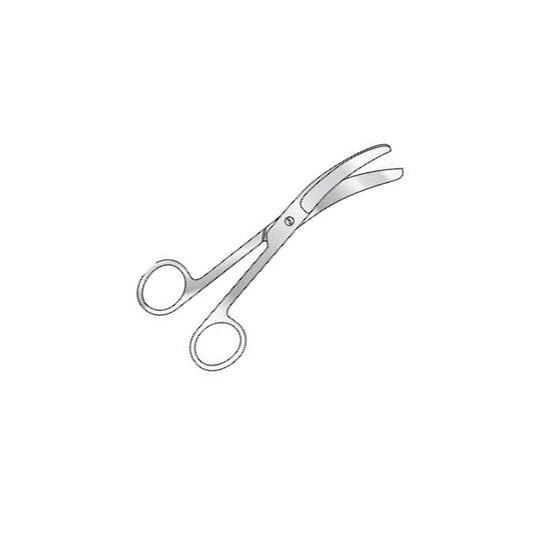
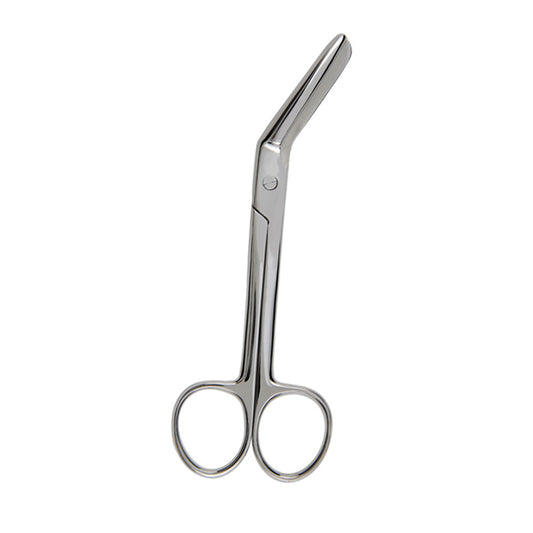
Gynecology and obstetric scissors cover three distinct cutting tasks, episiotomy incision, uterine dissection, and umbilical cord division, each with its own blade shape and angle. Peak Surgicals supplies eight patterns across all three, in German stainless steel, from $11.00 to $19.80. Each is CE marked and built under ISO 13485. Compare all eight patterns in the grid below.
Episiotomy, Uterine or Umbilical: Which Scissors?
Episiotomy scissors carry angled blades that enlarge the birth canal during delivery, uterine scissors handle general gynaecological dissection with curved or straight blunt-tipped blades, and umbilical scissors use a curved blade specifically shaped to divide the cord without splashing blood, the task decides both the blade angle and the tip. Three procedures, three distinct geometries.
For episiotomy, the Vant Episiotomy Scissors 241mm (PS-GS-0044, $19.80) carry a long blade for clean cutting; the Braun Stadler 140mm (PS-GS-00039, $16.50) angle the blades away from the handle for easier manipulation during delivery; the Barnes 127mm (PS-GS-0038, $13.20) cover the shorter-length option. For uterine work, the Uterine Scissors 203mm (PS-GS-0043, $19.80) curve on a flat blade for general dissection, the Sims Uterine Scissors 20cm (PS-GS-0042, $19.80) carry tungsten carbide inserts for precision cutting, and the Dubois Uterine Scissors (PS-GS-0041, $19.80) cover regular-size gynaecological work. For the cord, the Busch Umbilical Scissors 16cm (PS-GS-000400, $19.80) curve to the task, and the American Pattern Umbilical Scissors (PS-GS-0037, $11.00) carry a blunt blade across all sizes. We supply every pattern at MOQ 1.
Blade Angle, Curve and Why the Shape Matters
The angle on an episiotomy scissor exists for one reason: it keeps the surgeon's hand clear of the perineum while the blade tip reaches the incision line, letting the cut be made without the handle obstructing the view or the delivery. Straight-handled scissors force an awkward wrist angle at exactly the moment control matters most.
Umbilical scissors solve a different problem with the same principle, a curved blade. Early cord scissors used a straight blade, and the cord would slip toward the tip mid-cut, splashing blood across the operator's hand and the surrounding field. The arcuate blade curve holds the cord in place through the cut, containing the bleed rather than spraying it. Uterine scissors carry the least specialised geometry of the three, since general gynaecological dissection covers tissue planes rather than a single anatomical target, which is why both curved and straight patterns, with tungsten carbide options for precision, sit in this category rather than one dominant shape.
Reprocessing, Edge Integrity and Certification
These scissors are forged from German stainless steel corrosion-resistant across repeated autoclave cycles, and holding blade alignment where a softer instrument would splay. The pivot and blade edges are the inspection point: check that blades close cleanly along their full length, and that any tungsten carbide insert shows no chipping, since a compromised edge tears tissue instead of cutting it. Ultrasonic-clean before autoclaving so tissue and blood residue does not collect at the pivot.
Every instrument is Class I, reusable, CE marked and built under ISO 13485 the documentation a hospital supply team verifies before qualifying a vendor. Warranty is one year with return-and-replacement, MOQ is 1 piece, orders over $99 ship free in carton box packing, and OEM marking is available for distributors. For additional uterine and episiotomy patterns see gynecological scissors; browse all gynecology instruments. Talk to us about OEM and volume terms.
Our Top Selling Products
Safety Lock Screw Ø3.5mm Self Tapping | Cortex Screws for Epiphyseal Plate Self Tapping Cannulated 4.5mm | Headless Compression Screw Cannulated Ø 2.5mm Fully Threaded | Headless Compression Screw (Herbert Screw) Cannulated Ø 2.5mm | Thompson Hip Prosthesis Excel Stainless Steel Standard Stem Narrow Stem | Crile Wood Needle Holder - Tungsten Carbide Surgical Needle Holder | Galabin Uterine Sound - Graduated Gynecological Measuring Instrument (Regular Size) | Cortex Screw ∅3.5mm Self Tapping | Cannulated Cancellous Screw Ø 4.0mm Short Thread | Diagnostic Instruments