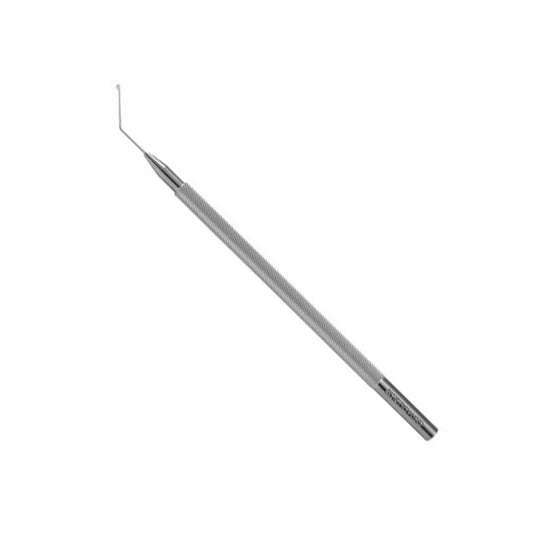
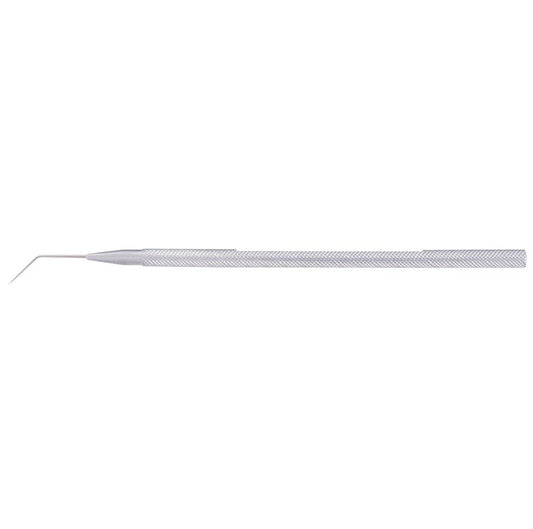
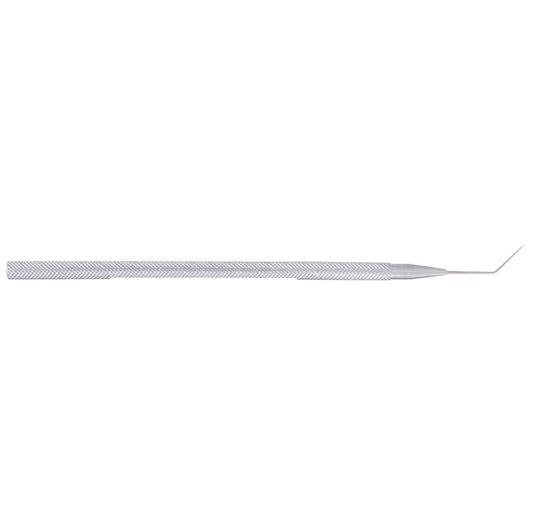
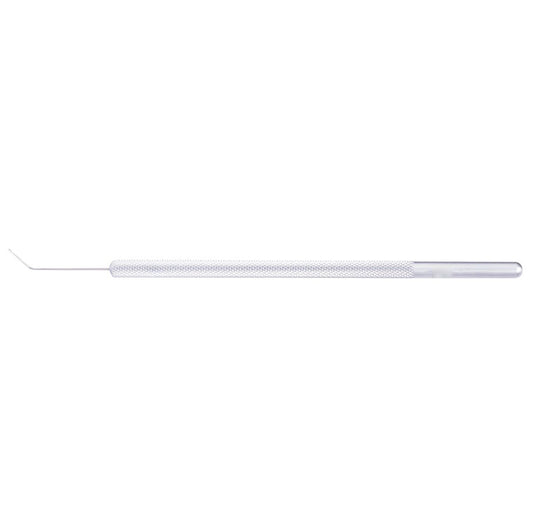
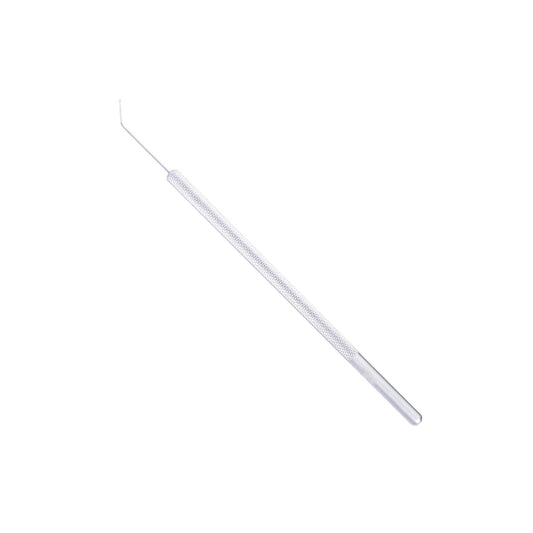
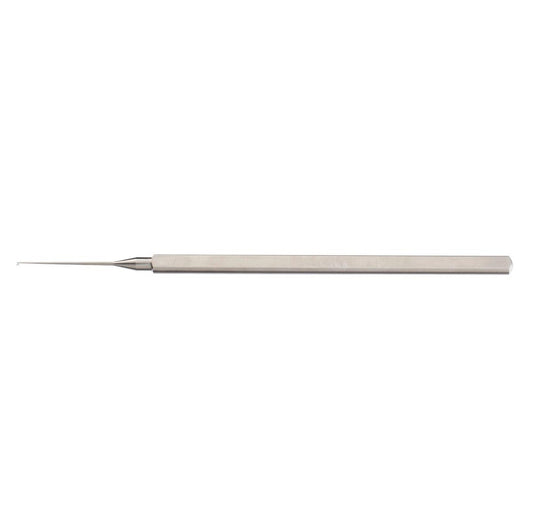
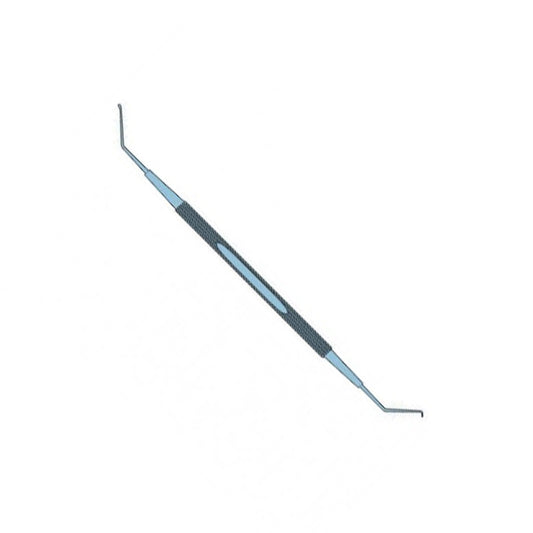
Ophthalmic choppers and manipulators are second-hand instruments in cataract surgery: the phaco tip holds the nucleus, and these break it and move it. Peak Surgicals stocks Nagahara Nucleus Choppers ($4.18), Kuglen Iris Hook Lens Manipulators (PS-9842, from $4.95), and Titanium Phaco Chopper Double-Ended 120mm ($27.50), all CE marked and built under ISO 13485. Compare every pattern in the grid below.
Horizontal or Vertical? Tip Geometry Decides
Chopper tip geometry follows the chopping technique, and the two are not interchangeable: a horizontal chopper is blunt because it has to slide under the rhexis rim and hook the nucleus at its equator, while a vertical chopper is sharp because it impales the nucleus from above. Get that backwards and a sharp tip passing under the rim risks tearing the capsulorhexis or catching in the zonules.
Kunihiro Nagahara introduced the technique at the 1993 ASCRS meeting in Seattle, where his film on it won an award. He used a modified lens hook drawn from the periphery toward the phaco tip, splitting the nucleus along the natural cleavage planes of the lens fibres rather than sculpting a trench through it. Nagahara Nucleus Choppers ($4.18) carry that original horizontal pattern, and Titanium Phaco Chopper Double Ended 120mm ($27.50) puts a tip at each end so one instrument covers both planes. We supply every pattern at MOQ 1.
Manipulators, and Why Titanium Costs Six Times More
A manipulator does the other half of the work, and the two are not substitutes. Kuglen Iris Hook Lens Manipulators (PS-9842, from $4.95) retract a small pupil, rotate the nucleus between chops and position the intraocular lens once the bag is clear. The hook is blunt and angled so it engages iris and lens capsule without cutting either, which is why it cannot be used to chop.
Titanium is the material question here, and the price gap is the reason to ask it. Titanium is roughly half the density of stainless steel and non-magnetic, so a titanium chopper transmits tip resistance to the fingers with less of the instrument's own mass in the way. In microsurgery where the working stroke is a millimetre or two, that feedback is what tells the surgeon the nucleus has cracked. Steel patterns remain the standard choice for routine lists and volume buying.
Material, Reprocessing and Certification
Steel patterns are forged from German stainless steel and passivated for corrosion resistance across repeated cycles; titanium patterns are machined from medical-grade titanium alloy. The inspection point on any ophthalmic micro-instrument is the tip under magnification: check a horizontal chopper for burring that would turn a blunt profile sharp, and check the shaft for any bend, since a millimetre of deflection is a millimetre of error inside the eye. Clean immediately with a neutral-pH enzymatic solution and a soft brush, rinse with deionised water and dry fully before autoclaving at 134°C.
These are Class I reusable devices, CE marked and built under ISO 13485, with a one-year manufacturing warranty. We ship at MOQ 1 with free shipping over $99, and OEM production is available for distributors. See Hooks and Manipulators for the wider hook range, Lens Injectors for implantation instruments, or browse all Ophthalmology Instruments. Talk to us about OEM terms.