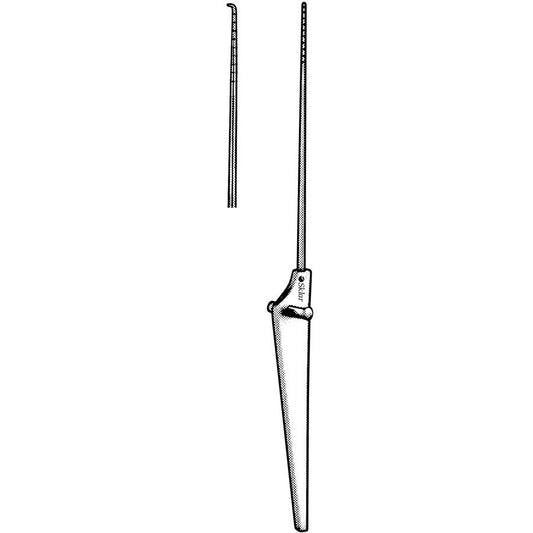
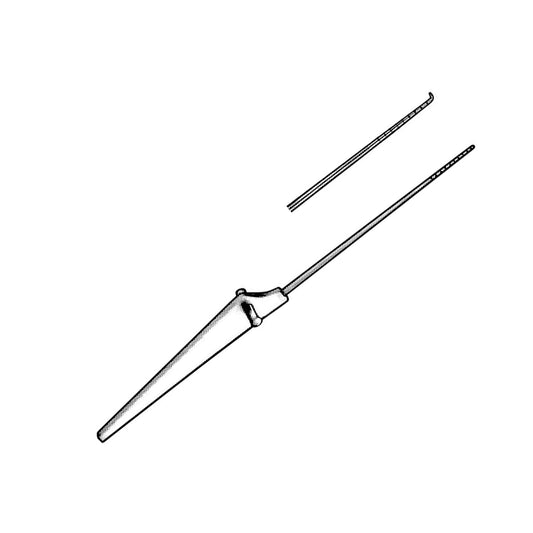
Arthroscopy is done through a lens, and a lens shows surface only. The arthroscopic exploring hook is what tells the surgeon what is underneath: whether cartilage that looks intact is soft, whether a meniscal tear extends further than it appears, whether a ligament under tension is actually holding. Peak Surgicals stocks Exploring Hook 2.5 mm (PS-8704, $123.20) in German stainless steel, CE marked and built under ISO 13485. See the full specification in the grid below.
Why the Camera Is Not Enough
Vision inside a joint is limited in a specific way. The arthroscope gives magnification and light but no depth cue and no sense of consistency, so a cartilage surface that appears normal on the monitor may be softened underneath, and a tear may run further beneath an intact edge than the image suggests. Palpation with a probe is what converts a picture into a finding.
The hooked tip does two jobs the shaft alone cannot. Drawn across a cartilage surface it reports resistance, so the operator feels softening the camera cannot show. Passed under a meniscal edge and lifted, it demonstrates whether that edge is attached or mobile, and how far a tear extends. A straight probe can press; only a hook can lift and pull back. That is why the instrument is a hook rather than a rod. We supply at MOQ 1.
The Tip Is Also a Ruler
Tip dimension is the measuring reference as much as the working end. A known tip size lets the surgeon size what is being examined against it: a defect two tip-widths across is measured, not estimated, and that measurement determines whether a lesion is treated, monitored or documented. It is the same principle as a graduated shaft, applied at the point of contact.
Access sets the rest. The tip has to pass the working portal and reach the compartment being examined, so a probe used through a standard knee or shoulder portal is built slim through its working length with the strength to lift tissue without deflecting. The handle is shaped to be found and rotated without the eye leaving the monitor, since the operator is working entirely on the screen while the hand works by feel.
Material, Reprocessing and Certification
The instrument is forged from German stainless steel and passivated for corrosion resistance across repeated cycles. The inspection point is the hook tip and the shaft: examine the tip under magnification and confirm it is smooth and intact, because a probe drawn across articular cartilage with a burr or a raised edge scores the surface it was passed in to assess, and check the hook has not opened out, since a spread hook no longer lifts a meniscal edge cleanly. Sight along the shaft to confirm it is true, as a bent shaft will not pass a cannula and changes where the tip sits relative to the hand. Clean immediately with a neutral-pH enzymatic solution, working around the hook curve, then rinse with deionised water and dry fully, following the reprocessing instructions supplied.
This is a Class I reusable device, supplied non-sterile, CE marked and built under ISO 13485, with a one-year warranty. We ship at MOQ 1 with free shipping over $99. See Arthroscopy Grasping Forceps for grasping patterns, or browse all Arthroscopy Instruments.