
Featured Collection
Your cart
Featured Collection

PEAK SURGICALS
SKU:PS-OP-55740
Couldn't load pickup availability


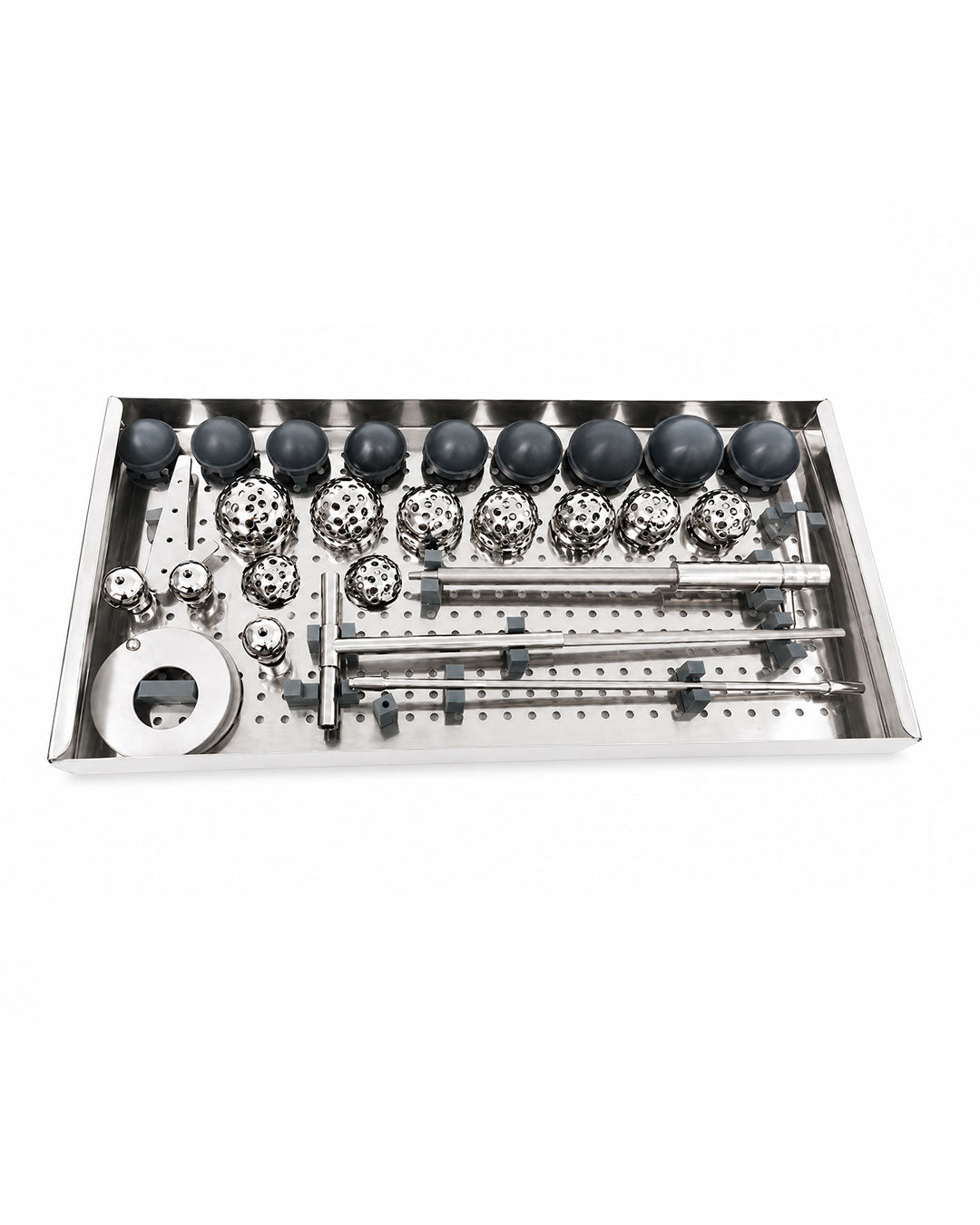
Instruments Set for Modular Bipolar and Total Hip Replacement System Modified, SKU PS-OP-5574, is a 31-component reusable German stainless steel orthopedic set for bipolar hemiarthroplasty and total hip arthroplasty. The AS214MU configuration includes a rasp stem introducer, nylon-head prosthesis impactor, T-handle, three-piece 28 mm femoral head trials, nine-piece acetabular reamer set, nine cup trials, nineteen bipolar head trials, three Gen-X rasp trial stems, trial neck, rasp handle, box chisel, Moore head remover, even and odd head-diameter gauges, 7 × 9 mm and 9 × 11 mm taper reamers, bone cement stopper, cup introducer, reamer handle, neck cutting guide, centralizer sizer, pin retractor, Pins A and B, neck remover, Murphy Lane bone skid, Charnley hip retractor, small and large retractor blades, and container 214.000. Optional 32 mm instrumentation comprises femoral head trials, seven acetabular reamers, and seven cup trials. Orthopedic arthroplasty and trauma surgeons use the system for displaced femoral-neck fracture reconstruction, primary bipolar replacement, cemented or system-compatible total hip replacement, and selected revision workflows in hospitals and specialist joint-reconstruction centers.
The set combines fixed working ends with detachable handles, trial couplings, driven impactors, and controlled retraction components. Rasp handle 186.012M and T-handle 186.006M transmit axial and rotational force to compatible canal-preparation instruments while allowing removal between sequential sizes. Rasp stem introducer 186.001 controls the direction and extraction of the broach or trial body within the proximal femoral canal. The nylon face on prosthesis drive impactor 186.003 delivers seating force while limiting direct metal contact with the implant. Reamer handle 186.015 connects to the acetabular cutting heads and maintains the reaming axis during progressive cavity preparation. Cup introducer 186.048 supports acetabular component orientation during final placement. The Charnley frame and interchangeable 186.076-S and 186.076-L blades create adjustable exposure according to incision depth and soft-tissue thickness. Pin retractor 186.057 works with Pins A and B to maintain targeted tissue displacement. The Murphy Lane bone skid provides a smooth lever surface during femoral-head delivery and reduction. Taper reamers use calibrated 7 × 9 mm and 9 × 11 mm cutting profiles, while the neck cutting guide establishes the planned osteotomy level before canal entry.
During bipolar hemiarthroplasty for a displaced intracapsular femoral-neck fracture, the Charnley and pin retractors establish exposure before the neck cutting guide directs femoral osteotomy. The Moore head remover disengages the excised head, and the bone skid assists delivery while protecting the operative pathway. Even and odd diameter gauges measure the retrieved femoral head from 37 through 55 mm to guide bipolar shell trialing. The box chisel opens the proximal canal, after which the rasp handle, introducer, trial stems, and trial neck establish stem size, version, depth, offset, and reduction mechanics. Nineteen modular bipolar head trials assess shell diameter and articulation with the native acetabulum. For total hip replacement, the reamer handle drives the 28 mm acetabular reamers progressively until the planned cup bed is obtained. Nine cup trials evaluate diameter, seating, coverage, and orientation before the introducer places the definitive component. Three femoral head trials assess neck-length selection, limb length, offset, stability, and impingement. In cemented femoral fixation, the stopper establishes a distal boundary for cement delivery, and the centralizer sizer identifies the corresponding distal component. The nylon impactor controls definitive stem seating before final head assembly and reduction.
AS214MU identifies the primary tray configuration listed in the component table. AS214GX retains the corresponding exposure, preparation, trialing, measuring, implantation, and removal instruments while supplying Gen-X-design rasps. AS214MU+GX combines Müller and Gen-X rasp coverage for facilities maintaining both femoral stem families. The three listed trial stems, 186.027-G-1, 186.027-G-2, and 186.027-G-3, prepare and assess progressively different Gen-X canal profiles. Trial neck 186.027N connects to the selected rasp body so the surgeon can perform reduction testing before opening the definitive implant. The standard acetabular workflow is configured around a 28 mm femoral head and includes 186.030 head trials, 186.024 reamers, and 186.042 cup trials. Procedures using a 32 mm articulation require optional items 186.130, 186.124, and 186.142, ordered separately. The 32 mm head trials evaluate compatible neck options, the seven cutting heads prepare the receiving acetabulum, and the seven cup trials assess component fit. Container 214.000 organizes the principal inventory for counting, transport, decontamination, inspection, assembly, and sterilization. Procurement teams should select the configuration according to the stocked stem family, head diameter, acetabular system, and operative technique.
The reusable working instruments are manufactured from German stainless steel selected for corrosion resistance, dimensional stability, edge retention, and repeated handling during orthopedic reprocessing. Cutting components such as acetabular and taper reamers require inspection for dull teeth, deformation, retained debris, and damaged couplings after every procedure. Trial junctions, handles, impactors, retractors, gauges, pins, and removable blades should be disassembled where their validated design permits so cleaning solution can reach hinges, recesses, lumens, and connection surfaces. The nylon impactor face must be examined for cracking, excessive indentation, loosening, or embedded particles. Instruments are supplied for validated hospital cleaning, disinfection, packaging, and steam sterilization under the facility’s approved protocol and manufacturer instructions. CE documentation concerns conformity with applicable European medical-device requirements, while ISO 13485 addresses the quality management system governing manufacture and traceability. FDA procurement depends on the establishment, listing, labeling, importer, and market-access records applicable to the destination. Hospitals should record the tray configuration, component codes, maintenance activity, sterilization history, and replacement instruments. The container supports organization but does not replace validated sterilization packaging, load preparation, cycle selection, drying, or sterility-maintenance procedures.
| AS214MU Instruments Set for Modular Bipolar and Total Hip Replacement System with Müller Rasps | Set Consisting of | Units |
|---|---|---|
| 186.001 | Rasp Stem Introducer | 1 |
| 186.003 | Prosthesis Drive Impactor with Nylon Head | 1 |
| 186.006M | T-Handle | 1 |
| 186.030 | Femoral Head Trials for 28 mm Diameter, Set of 3 | 1 set |
| 186.024 | Acetabular Cup Reamers for 28 mm Diameter, Set of 9 | 1 set |
| 186.042 | Acetabular Cup Trials for 28 mm Diameter, Set of 9 | 1 set |
| 186.044 | Modular Bipolar Head Trials, Set of 19 | 1 set |
| 186.027-G-1 | Rasp Trial Stem, Gen-X Design, Size 1 | 1 |
| 186.027-G-2 | Rasp Trial Stem, Gen-X Design, Size 2 | 1 |
| 186.027-G-3 | Rasp Trial Stem, Gen-X Design, Size 3 | 1 |
| 186.027N | Neck for Rasp Trial Stem | 1 |
| 186.012M | Rasp Handle | 1 |
| 186.009 | Box Type Chisel | 1 |
| 186.036 | Moore Head Remover, Judet Pattern | 1 |
| 186.033A | Head Diameter Gauges, Even Sizes 38, 40, 42, 44, 46, 48, 50, 52 and 54 | 1 set |
| 186.033B | Head Diameter Gauges, Odd Sizes 37, 39, 41, 43, 45, 47, 49, 51, 53 and 55 | 1 set |
| 186.039A | Taper Reamer, Small, 7 × 9 mm | 1 |
| 186.039B | Taper Reamer, Large, 9 × 11 mm | 1 |
| 186.045 | Bone Cement Stopper | 1 |
| 186.048 | Acetabular Cup Introducer | 1 |
| 186.015 | Reamer Handle | 1 |
| 186.051M | Neck Cutting Guide | 1 |
| 186.054 | Centralizer Sizer | 1 |
| 186.057 | Pin Retractor | 1 |
| 186.060A | Pin A | 1 |
| 186.060B | Pin B | 1 |
| 186.074 | Neck Remover | 1 |
| 186.073 | Murphy Lane Bone Skid | 1 |
| 186.076 | Charnley Initial Incision Hip Retractor | 1 |
| 186.076-S | Small Blade for Charnley Initial Incision Hip Retractor | 1 |
| 186.076-L | Large Blade for Charnley Initial Incision Hip Retractor | 1 |
| 214.000 | Empty Container | 1 |
| AS214GX | Corresponding set configuration with Gen-X Rasps | 1 set |
| AS214MU+GX | Corresponding set configuration with Müller and Gen-X Rasps | 1 set |
| Optional 32 mm Femoral Head Instruments | Ordered Separately | Units |
| 186.130 | Femoral Head Trials for 32 mm Diameter, Set of 3 | 1 set |
| 186.124 | Acetabular Cup Reamers for 32 mm Diameter, Set of 7 | 1 set |
| 186.142 | Acetabular Cup Trials for 32 mm Diameter, Set of 7 | 1 set |
| SKU | PS-OP-5574 |
|---|---|
| Product Name | Instruments Set for Modular Bipolar and Total Hip Replacement System Modified |
| Price | $3,958.90 USD |
| Size/Gauge Variants | AS214MU, AS214GX and AS214MU+GX configurations; standard 28 mm instrumentation with optional 32 mm sets |
| Instrument Category | Orthopedic hip arthroplasty instrument set |
| Procedure | Modular bipolar hemiarthroplasty and total hip arthroplasty |
| Material | German stainless steel with nylon impactor component |
| Finish | Satin orthopedic instrument finish with polished functional surfaces |
| Sterilization | Reusable instruments for validated hospital cleaning and steam sterilization |
| Instrument Classification | Reusable orthopedic surgical instrument system |
| Reusable | Yes |
| Certifications | CE and ISO 13485 documentation; FDA procurement documentation according to destination-market requirements |
| Warranty | 1 year |
| MOQ | 1 set |
| OEM / Custom Orders | Available for documented instrument substitutions, tray configuration, labeling, and packaging requirements |
| After-Sale Service | Replacement instrument, order, documentation, return, and replacement support |
How does AS214MU differ from the AS214GX instrument set?
AS214MU is configured for the Müller-pattern rasp and trial workflow identified for the corresponding femoral stem system. AS214GX supplies the associated tray with Gen-X rasp preparation components. The combined AS214MU+GX configuration supports facilities maintaining both stem families. Instruments Set for Modular Bipolar and Total Hip Replacement System Modified otherwise retains the principal exposure, acetabular preparation, trialing, measuring, insertion, and removal functions. Rasp profiles are not interchangeable merely because they connect to a similar handle. Procurement teams should match the selected set with the implanted femoral stem system and its operative technique.
When are the 28 mm and optional 32 mm components required?
Instruments Set for Modular Bipolar and Total Hip Replacement System Modified includes standard trialing and acetabular preparation for a 28 mm femoral head. Codes 186.030, 186.024, and 186.042 provide the corresponding head trials, reamers, and cup trials. A planned 32 mm total hip construct requires optional codes 186.130, 186.124, and 186.142. Those three sets are ordered separately and should be added to the tray before the procedure. Diameter selection depends on the compatible head, liner, cup system, acetabular dimensions, and trial reduction. A 32 mm trial or reamer set must not be substituted into a 28 mm implant workflow.
What do CE, ISO 13485, and FDA procurement references mean?
CE documentation concerns conformity with applicable European medical-device requirements for the supplied instruments. ISO 13485 addresses the quality management system governing manufacture, documentation, and traceability. These designations do not independently mean that every component has received FDA approval. United States procurement requires the establishment, listing, labeling, importer, and market-access records applicable to the supplied set. Instruments Set for Modular Bipolar and Total Hip Replacement System Modified should be purchased with identifiable component codes and supplier documentation. Hospitals and distributors should retain those records within vendor qualification, inventory, maintenance, and complaint procedures.
How do the handles and coupling mechanisms control the instruments?
The T-handle and rasp handle provide removable connections for transmitting axial and rotational force during femoral preparation. The reamer handle drives compatible acetabular cutting heads while the surgeon maintains the planned reaming axis. Rasp stem introducer 186.001 controls insertion and extraction of the trial body. The nylon-head impactor delivers directed force during prosthesis seating without using an unprotected metal striking face. Instruments Set for Modular Bipolar and Total Hip Replacement System Modified requires every coupling to be fully seated before force is applied. Loose, worn, deformed, or contaminated connections should be removed from service until inspected or replaced.
How should the complete tray be cleaned and sterilized?
All reusable components should be accounted for and transferred for decontamination immediately after the procedure. Removable blades, handles, reamers, trials, pins, and coupled parts should be separated where permitted by their validated design. Cutting teeth, connection recesses, impactor faces, and trial junctions require direct inspection after cleaning. Instruments Set for Modular Bipolar and Total Hip Replacement System Modified should be packaged and steam sterilized under the facility’s validated protocol and manufacturer instructions. Container 214.000 organizes the inventory but does not independently establish sterility or determine cycle parameters. The tray should be released for surgery only after count reconciliation, functional testing, packaging inspection, cycle completion, drying, and sterilization-record approval.


