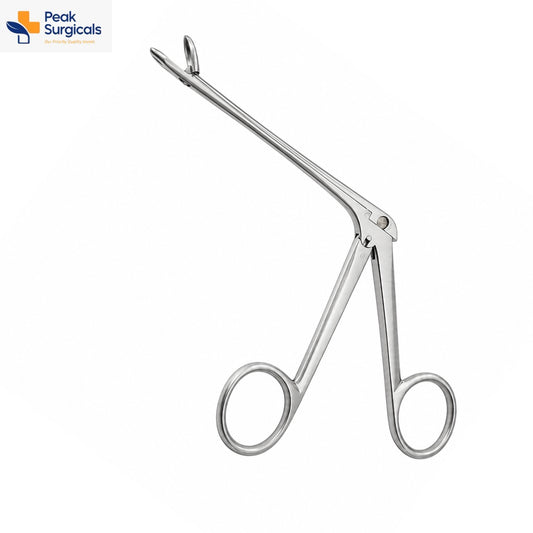
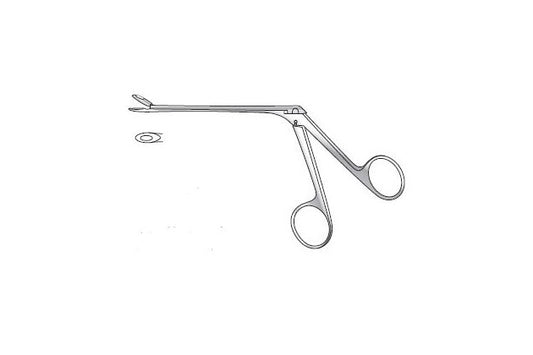
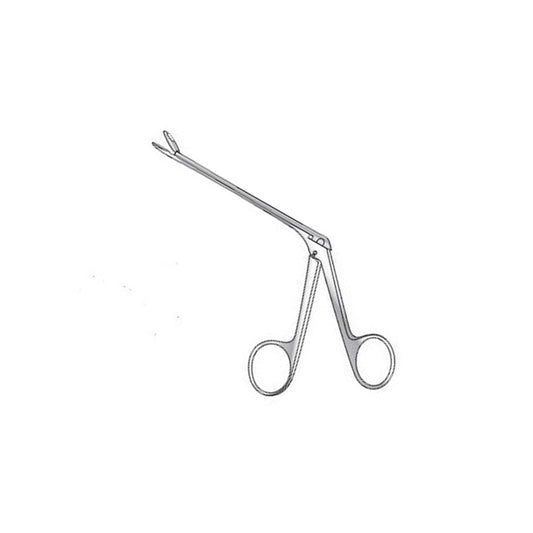
Ethmoid forceps work in a corridor bounded by the orbit on one side and the skull base above, which is why the jaw is designed as much for what it must not touch as for what it removes. Peak Surgicals supplies the Weil-Blakesley pattern on a 120mm shaft, in German stainless steel, CE marked and built under ISO 13485. Compare both listings in the grid below.
Why the Jaw Is Fenestrated and the Outside Is Blunt
The fenestrated cup jaw does two things a solid jaw cannot. Cutting the window out of the cup removes mass from the working end, and less mass at the tip means more of what the tissue is doing travels back up the shaft to the fingers; in a cavity the surgeon is viewing on a monitor, that tactile feedback is a second channel of information. The opening also lets the operator see the tissue inside the jaw before closing, which confirms only the intended pathology is being taken.
The outer surfaces are blunt for the same reason the jaw is slender. Ethmoid air cells sit directly against the lamina papyracea and the skull base, so an instrument working between them is in contact with structures it must not damage. A blunt outer profile lets the shaft and jaw back rest against bone without cutting into it. We supply at MOQ 1.
Straight Jaws, and What Angle Changes
Both listings here carry the straight jaw on a 120mm shaft, the standard configuration for anterior ethmoid work and for polyp removal where the approach runs along the axis of the nose: Weil Blakesley Rongeur 120mm Shaft (PS-S-0047, $28.60) and Weil Blakesley Rongeur 120mm Long Shaft (PS-S-0031, $22.00).
Angle is the variable that matters beyond straight. Upturned jaws at 45 and 90 degrees exist because the frontal recess and the ethmoid roof cannot be reached along a straight line from the nostril, and a straight jaw forced toward them levers against the middle turbinate instead. Bite size is the second variable: narrower jaws take smaller, more controlled bites in a tight cell, wider jaws clear bulk tissue faster.
Material, Reprocessing and Certification
Both are forged from German stainless steel and passivated for corrosion resistance across repeated cycles. The inspection point is the jaw rim and the shaft: check the cup edge under light for chips or rolled metal, because a dulled rim tears tissue rather than taking a clean bite, and check the outer jaw surfaces are still smooth, since a burr on the back of a jaw is a burr against the lamina papyracea. Sight down the shaft against a straight edge to confirm it is true. Clean immediately with a neutral-pH enzymatic solution, brushing through the fenestration and into the joint, then rinse with deionised water and dry fully before autoclaving at 134°C.
These are Class I reusable devices, CE marked and built under ISO 13485, with a one-year warranty. We ship at MOQ 1 with free shipping over $99, and OEM production is available. See ENT Nibbling Forceps for punch patterns, or browse all ENT Surgical Instruments. Talk to us about OEM terms.
Top search Results: Bone Cutting Forceps | Clamps | Dissecting Forceps | Dressing Scissors | Dog Grooming Tools | Gallbladder Surgery Instruments | Large Animal | Small Animal -Dental Surgical Instruments | Veterinary Orthopedic instruments |TPLO Instruments | American Pattem Forceps |Amalgam & Composite Carriers | Armalgam Pluggers |Aspiratiors | Burnishers | Cannulas Irrigations | Crown Removers | Dental Diagnostic | Dental Luxation Elevators | Peak Surgcials