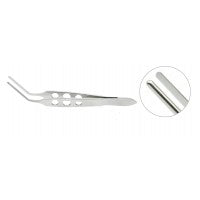
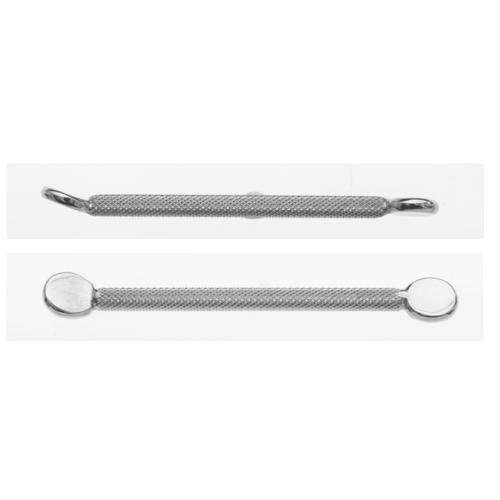
An expressor paddle and an expressor forceps do the same job with different amounts of force, and the paddle is the gentler of the two. Peak Surgicals stocks Expressor Paddle Flat (PS-J-149, $24.20) and Bruder Longnose Expressor (PS-J-118, $17.95) in German stainless steel, CE marked and built under ISO 13485. Compare both patterns in the grid below.
One Surface, Not Two: Why a Paddle Is Gentler
A paddle is a single working surface, not a pair of jaws. It goes behind the eyelid, and the counter-pressure comes from the clinician's thumb or a cotton-tip applicator on the outside, sliding the paddle upward along the lid. That gives the operator continuous control over how hard the lid is being squeezed, because the pressure is coming from a finger rather than from a spring.
Forceps close on the lid from both sides and deliver considerably more force, which clears heavier obstruction but also limits how long a patient will tolerate the procedure. A paddle trades that force for comfort. It is the instrument for mild to moderate meibomian gland dysfunction, for patients who have found forceps expression difficult, and for the assessment stage where the question is whether glands express at all rather than how completely they can be cleared. We supply both patterns at MOQ 1.
Flat or Longnose, and the Lighter Heat Protocol
Expressor Paddle Flat (PS-J-149, $24.20) carries the flat oval paddle used for gentle expression along the lid margin, the pattern also catalogued as the Livengood or Mastrota type. Bruder Longnose Expressor (PS-J-118, $17.95) extends the working end, which reaches the upper lid more easily once it is everted and suits clinicians who prefer to keep the hand further from the eye.
Heat comes first with either pattern, but the protocol is lighter than the forceps sequence: three to five minutes under a moist heat compress is enough to soften meibum for paddle expression, where firm forceps work generally calls for in-office device heating to reach full melting temperature. Express soon after the compress comes off, since the glands cool quickly, and treat both lids rather than the lower alone.
Material, Reprocessing and Certification
Both patterns are forged from German stainless steel and passivated for corrosion resistance across repeated cycles. The inspection point is the paddle face and its edge: the face sits directly against tarsal conjunctiva under sustained pressure, so run a gloved finger across it and check for pitting, burring or loss of polish, and check the perimeter is still smoothly rounded, because a paddle edge that has sharpened will score the conjunctiva as it slides. Check the shaft is true, since a bent shaft changes the angle at which the paddle meets the lid. Clean immediately with a neutral-pH enzymatic solution, then rinse with deionised water and dry fully before autoclaving at 134°C.
These are Class I reusable devices, CE marked and built under ISO 13485, with a one-year warranty. We ship at MOQ 1 with free shipping over $99. See Meibomian Gland Expressors for the forceps patterns, or browse all Ophthalmology Instruments. Talk to us about OEM terms.