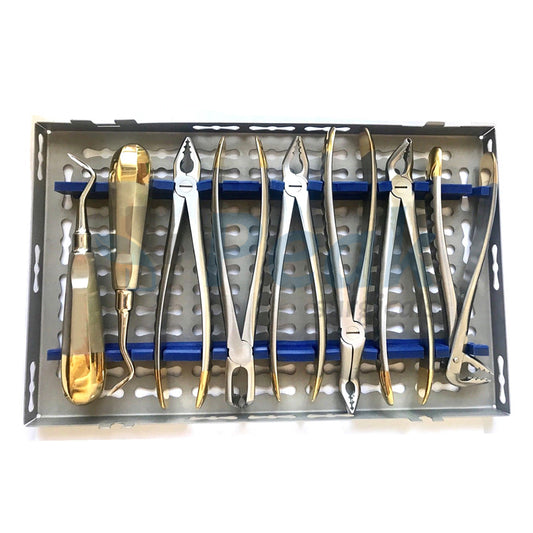
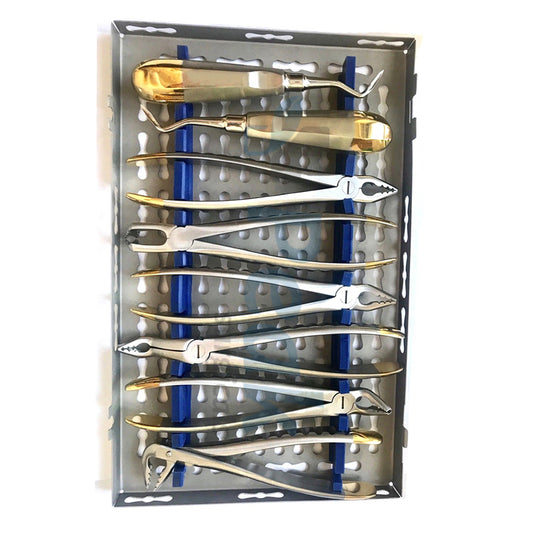
Dental extraction kits carry the full exodontia sequence in one cassette, the instruments that lift the flap, cut the ligament, mobilise the tooth and deliver it. Peak Surgicals supplies a complete kit at $145.20 with straight and angled elevators, curved luxators, root-fragment forceps, extraction forceps and a perforated sterilization cassette, in German stainless steel. It is CE marked and built under ISO 13485. See the kit contents in the grid below.
What Each Instrument Does in the Extraction Sequence
Luxators cut the periodontal ligament, elevators mobilise the tooth within its socket, extraction forceps grasp and deliver it, and root-fragment forceps retrieve any root that separates during delivery. Exodontia fails at the transitions between those four steps, which is why the instruments are supplied together rather than bought piecemeal.
The luxator goes in first, worked down the periodontal ligament space to sever the fibres anchoring the root the curved patterns follow root curvature where a straight blade would bind. Elevators then apply controlled force to expand the socket and mobilise the tooth; straight elevators work most positions, angled elevators reach posterior teeth where the handle would otherwise foul the opposing arch. Only once the tooth moves do forceps come into play, and applying them to an unmobilised tooth is the most common cause of crown fracture. Root-fragment forceps exist for exactly that moment a narrow beak that grips a retained root below the gingival margin where standard forceps cannot seat.
Kit or Separates: When the Cassette Earns Its Place
Buying a kit is a workflow decision, not a discount. The perforated cassette is the reason: instruments stay in sequence, steam and air circulate through the perforations during autoclaving, and the tray goes from ultrasonic to sterilizer to chairside without individual handling. A practice running extractions regularly loses more time to hunting instruments and reassembling trays than to any single procedure step.
The alternative is worth stating honestly. If a practice already owns elevators and forceps in the patterns it prefers, individual instruments make more sense than duplicating them — our elevator sets and extracting forceps sets cover those cases, and luxation elevators are available separately. The combined kit is the right purchase for a practice equipping a new operatory, a clinic standardising trays across surgeries, or a training programme that needs the full sequence in one autoclavable unit.
Material, Reprocessing and Certification
The kit is forged from German stainless steel — corrosion-resistant across the repeated steam autoclave cycles an extraction tray sees daily. Elevator and luxator blades are the inspection point: these instruments transmit high force, and a blade that has deformed or dulled transmits it unpredictably into bone rather than into the ligament. Check working ends after each cycle, and ultrasonic-clean before autoclaving so tissue and bone debris do not bake onto the blades. The cassette should be loaded with instruments unlocked and separated so steam reaches every surface.
Every instrument is Class I, reusable, CE marked and built under ISO 13485, the documentation a dental supply team verifies before qualifying a vendor. Warranty is one year with return-and-replacement, MOQ is 1 piece, orders over $99 ship free in carton box packing, and OEM marking is available for distributors. For the wider range, see dental extraction instruments or browse all dental instruments. Talk to us about OEM and volume terms.
Our Top Selling Products:
Safety Lock Screw Ø3.5mm | Cortex Screw Ø3.5mm Self Tapping Star Like | Citoject Syringe for Periodontal Ligament Anesthetic Delivery | Rubio Wire Twister | Forceps Stripping Dura Mater | Saliva Ejector Stainless Steel for 4mm x 18cm Dental Fluid Evacuation | Cortex Screw Ø3.5mm Self Tapping | TC Lister Bandage Scissors - 8.89-20.32 cm Blunt Tip Bandage Removal | Pratt Uterine Dilators | High Level Bandage Scissors Super Sharp Tungsten Carbide |