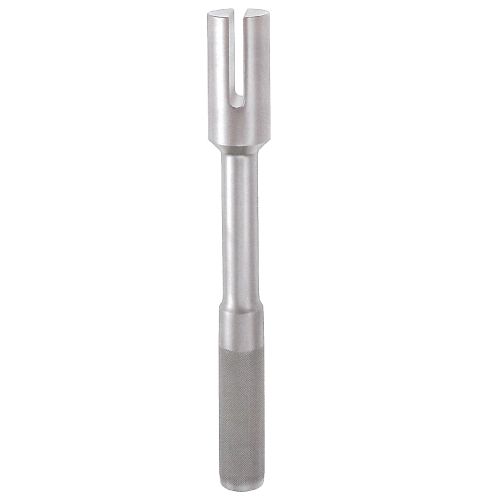
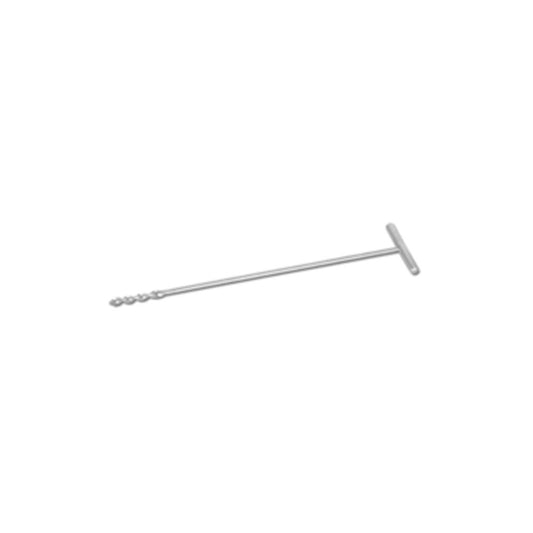
Intramedullary nailing began with Gerhard Kuntscher, who in 1939 drove a nail down the medullary canal of a femur and fixed the fracture from inside the bone. The instruments carrying his name still do the three things that operation required: open the canal, drive the nail, and get it back out. Peak Surgicals stocks Kuentscher Reamer ($22.00) and Slotted Mallet for Nail Extraction Hook 29cm ($54.45), CE marked and built under ISO 13485. Compare both patterns in the grid below.
Why the Canal Is Reamed First
Reaming comes first, and it is doing more than making room. The canal is not a uniform tube; it narrows at the isthmus and widens above and below it, so a nail driven into an unprepared canal engages at one point and is loose everywhere else. Reaming opens the canal to a consistent diameter along the length the nail will occupy, which is what converts a rod inside a bone into a fixation construct.
The reamer that does it works by hand or by power along a flexible shaft, cutting cortex from the inside. Kuentscher Reamer ($22.00) is sized to the canal rather than to the nail: the canal is reamed a little larger than the implant so the nail advances without wedging, because a nail forced into an under-reamed canal can split the cortex or seize part-way down where neither advancing nor withdrawing is straightforward.
Why the Extraction Mallet Is Slotted
Extraction is the other end of the same problem, and it is why a slotted mallet exists. A nail that has been in place through union has bone grown around it and needs a directed, repeated pull rather than a single force. The slot lets the mallet slide along an extraction rod or hook, so each strike drives the nail outward along its own axis instead of levering against the bone around it.
Slotted Mallet for Nail Extraction Hook 29cm ($54.45) runs long enough to develop useful momentum on that stroke. Mass and length are the specification here, not the head shape: the mallet is being swung against a stop rather than tapped against an osteotome, and it is the accumulated energy of repeated controlled strikes that breaks the bond between nail and bone.
Material, Reprocessing and Certification
Both instruments are manufactured from German stainless steel and passivated for corrosion resistance across repeated cycles. On the reamer the inspection point is the flutes and the shaft: check the cutting edges under magnification for chipping, because a dull reamer generates heat in a canal that cannot dissipate it, and confirm the flutes are clear of packed bone before use since a loaded flute stops cutting and starts burnishing. On the slotted mallet, check the slot edges for spread or burring where the extraction rod passes, and confirm the striking faces have not mushroomed, as a spread face throws the strike off the axis it is meant to follow. Clean immediately with a neutral-pH enzymatic solution, brushing bone debris from flutes and out of the slot before it dries, then rinse with deionised water and dry fully, following the reprocessing instructions supplied.
These are Class I reusable instruments, supplied non-sterile, CE marked and built under ISO 13485, with a one-year warranty. We ship at MOQ 1 with free shipping over $99. See Intramedullary Nail Sets for complete nailing instrumentation, or browse all Orthopedic Instruments.