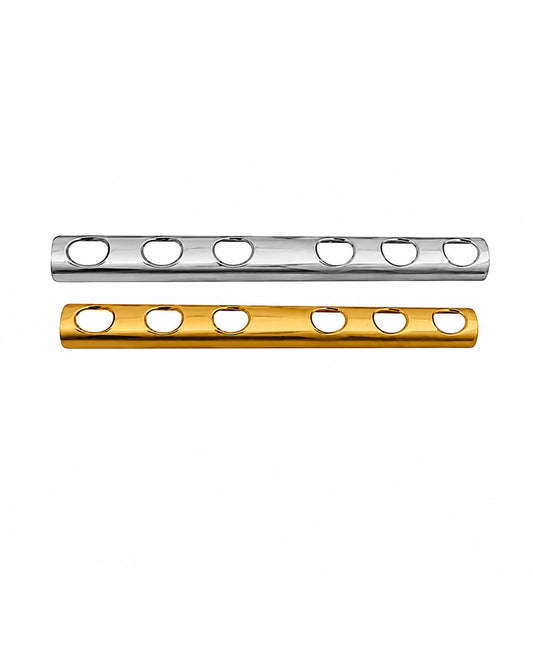
Small Fragment Standard
Small fragment refers to the 3.5mm screw-and-plate category in the AO/ASIF fixation system, used for small to mid-sized long bones — the forearm, humerus, fibula, and other sites where a 4.5mm "large fragment" construct would be oversized. This range covers both general shaft plates and site-specific patterns shaped for particular anatomical locations.
General Shaft Plates
The DCP Plate (3.5mm, Stainless Steel/Titanium) and LC-DCP Plate (3.5mm) are standard dynamic compression plates, with the LC-DCP's limited-contact design reducing the plate's footprint against bone to help preserve periosteal blood supply. The Semi-Tubular Plate (3.5mm) and One Third Tubular Plate offer a lower-profile option suited to smaller bones or areas with less soft tissue coverage. The Reconstruction Plate (3.5mm) is notched between holes for multi-plane contouring, useful where the plate needs to follow a curved bone surface.
Site-Specific Plates
Several plates in this range are shaped for a single anatomical site rather than general shaft use. The Proximal Humeral Plate and Proximal Ulna Plate are contoured for their respective proximal anatomy. The Distal Radius Plate, Distal Lateral Humeral Plate, and Distal Fibular Plate cover distal fixation at the wrist, elbow, and ankle respectively. The Cloverleaf Plate is shaped for distal tibial fixation. For the olecranon specifically, the Olecranon Plate and Lecestre Plate (a tension-band-style design) address fractures at the elbow tip, while the Hook Plate (3.5mm) uses a hooked end for fixation near a bone margin or avulsion site. The Y Reconstruction Plate and Y Fork Plate are shaped for bifurcating anatomy, such as the distal humerus, where two separate columns of bone need to be bridged by one construct. The T-Plate (3.5mm) provides a cross-bar for fixation near a joint junction.
Fixation Screws
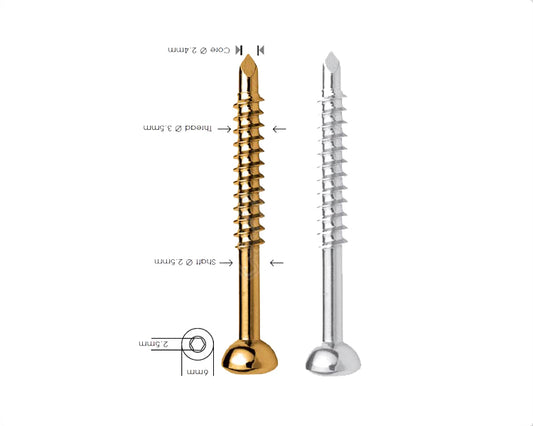
The Cortex Screw (Ø3.5mm, standard and self-tapping) is used in dense cortical bone, typically in the plate's non-locking holes. The Cancellous Bone Screw (Ø3.5mm and Ø4.0mm, in short and full thread options) suits softer cancellous bone, with thread length chosen based on how much of the screw needs to cross the fracture versus anchor in the far fragment. The Shaft Screw (Ø3.5mm) and Malleolar Screw (Ø3.5mm) round out the range for shaft and ankle-specific fixation.
Choosing the Right Plate
Site-specific plates (proximal/distal humeral, ulna, radius, fibular, olecranon, Y-shaped) should be matched to their named anatomical location rather than substituted for a general shaft plate, since their contouring is purpose-built. For straightforward shaft fractures without a site-specific option needed, the DCP, LC-DCP, or tubular plates cover most general applications.
Related Products
Pair these implants with Large Fragment – Standard for larger bones, Mini Fragment Implants for smaller hand and foot work, and Locking Screws Self Tapping for locking-plate applications. For placement support, see Screw Holding Forceps, Taps & Countersinks and Bone Drills. Browse the full Orthopedic Implants catalog for the complete range.
Ordering
Peak Surgicals manufactures small fragment plates and screws for hospitals and distributors worldwide, with international shipping — contact our team for wholesale pricing.
Frequently Asked Questions
What's the difference between small fragment and large fragment plating?
Small fragment uses 3.5mm screws and plates for smaller to mid-sized bones like the forearm, humerus, and fibula, while large fragment (4.5mm/6.5mm) is used for larger bones like the femur and tibia.
What's the difference between a DCP and an LC-DCP plate?
Both are dynamic compression plates; the LC-DCP (Limited Contact) design reduces the plate's contact area with bone, helping preserve periosteal blood supply compared to a standard DCP.
What is a Lecestre plate used for?
It's a tension-band-style plate used for olecranon fractures at the tip of the elbow.
What is a Y reconstruction plate used for?
It's shaped for bifurcating anatomy, such as the distal humerus, where one construct needs to bridge two separate columns of bone.
When should I use a cortex screw versus a cancellous screw?
A cortex screw suits dense cortical bone, typically in a plate's non-locking holes. A cancellous screw is used in softer cancellous bone, where its partial thread helps compress the fracture as it seats.