
Featured Collection
Your cart
Featured Collection

PEAK SURGICALS
SKU:PS-OP-5569
Couldn't load pickup availability


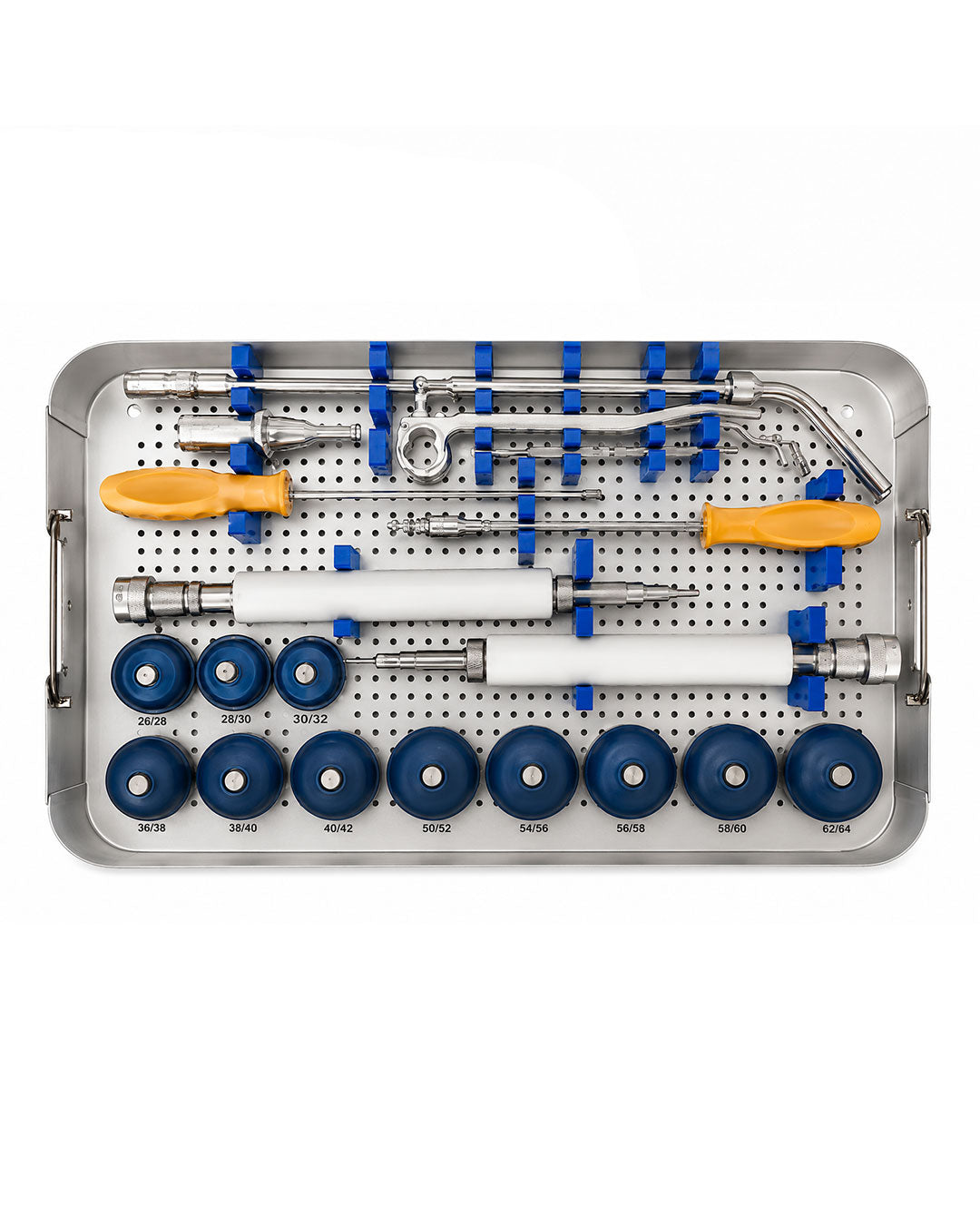
Total Hip Prosthesis Instruments Set, SKU PS-OP-5569, is a 44-component reusable German stainless steel system for cementless acetabular preparation, cup fixation, liner
seating, and femoral head trialing during total hip arthroplasty. The set includes an acetabular trial holder, reamer holder, mandrel handle, connection part, 22 mm and two 28 mm cup impactor parts, acetabular screw-head drill, flexible drill, combined drill guide and liner extractor, acetabular screw drill, screw forceps, angle device, cup holder, liner holder, cup and liner impactor, and screwdriver. Ten acetabular reamers and ten matching cup trials cover 42, 44, 46, 48, 50, 52, 54, 56, 58, and 60 mm diameters. Head trials comprise 22+0 mm medium, 22+4 mm large, 28−3 mm small, 28+0 mm medium, 28+4 mm large, 28+6 mm extra-large, and 28+8 mm extra-extra-large options. Container 9713-000 organizes the inventory. Orthopedic arthroplasty surgeons use the system during primary total hip replacement and selected acetabular revision procedures in hospitals, joint-reconstruction centers, trauma departments, and specialist orthopedic operating rooms.
Acetabular reamer holder 9713-0002 connects the selected hemispherical cutting head to the driving system and transfers rotational force along the planned reaming axis. Mandrel handle 9713-0003 provides manual leverage, while connection part 9713-0004 interfaces compatible modular components. The 42–60 mm reamers progressively remove cartilage and subchondral bone to form a hemispherical cavity corresponding with the intended cup system. Trial holder 9713-0001 connects to the matching trial so depth, rim contact, and component diameter can be assessed without inserting the definitive implant. Cup holder 9713-0015 controls introduction and initial orientation. Angle device 9713-0014 provides an external reference for the planned abduction and anteversion relationship. The 22 mm and 28 mm impactor parts transmit directed seating force through their compatible connections. Liner holder 9713-0016 presents the bearing insert without contaminating its locking surfaces, and cup or liner impactor 9713-0017 applies axial force for definitive seating. Every coupling must be fully engaged before driven use. Looseness, eccentric rotation, damaged threads, or an incorrect impactor interface can impair control and must be addressed before continuing.
After hip exposure, femoral-head resection, and visualization of the acetabulum, residual labrum and obstructing osteophytes are managed according to the operative plan. Reaming begins with a diameter suited to the native cavity and progresses in 2 mm increments while the surgeon controls medialization, inclination, anteversion, and preservation of the acetabular walls. A corresponding cup trial evaluates seating depth, rim contact, coverage, and the intended implant size. The definitive shell is connected to the cup holder, oriented with the angle device, and seated using the compatible impactor. Where supplementary screw fixation is included in the implant technique, drill guide and liner extractor 9713-0011 establishes the trajectory through the cup hole. Acetabular screw drill 9713-0012 and screw-head drill 9713-0009 prepare the designated pathway, while flexible drill 9713-0010 reaches trajectories restricted by the exposure. Screw forceps 9713-0013 hold and introduce the fixation screw; screwdriver 9713-0018 advances it under controlled alignment. After fixation, liner holder 9713-0016 positions the insert and impactor 9713-0017 seats the locking interface. Trial reduction then evaluates head diameter, neck length, stability, offset, and limb length.
The reamer series advances from 42 to 60 mm in even 2 mm increments, with a corresponding trial for every listed diameter. The 42 and 44 mm instruments address the smallest acetabular preparations in this system, while 46, 48, 50, 52, and 54 mm provide the central range. Diameters 56, 58, and 60 mm support broader cavities or selected revision preparation within the implant system’s limits. The final reamer and cup trial are chosen from preoperative templating, intraoperative bone quality, rim engagement, cavity depth, implant dimensions, and the desired fixation strategy. Head trial 9713-2200 provides a 22 mm articulation with neutral displacement, while 9713-2204 adds 4 mm. The 28 mm range includes −3, neutral, +4, +6, and +8 mm neck-length options. These offsets alter the reconstructed center, limb length, abductor tension, reduction force, and stability without changing the seated stem position. Trial diameter must match the intended liner, and the trial junction must correspond with the femoral stem taper. Larger offsets should not be selected solely to tighten the hip because excessive length or tension can alter biomechanics and reduction.
German stainless steel provides the rigidity, corrosion resistance, and dimensional stability required for reaming, drilling, component impaction, screw placement, and repeated sterilization. Reamer teeth require inspection for retained bone, rounding, chipping, bending, and eccentric wear. Flexible drill sections should be assessed for kinking, separation, restricted rotation, or surface damage. Holders, handles, impactors, drill guides, extractors, forceps, and screwdrivers require functional testing of every connection and working end. Modular parts should be separated where permitted by their validated design so cleaning reaches threads, recesses, interfaces, and internal connection surfaces. The system should be cleaned, rinsed, inspected, dried, packaged, and steam sterilized according to institutional validation and manufacturer instructions. CE documentation concerns conformity with applicable European medical-device requirements, while ISO 13485 addresses the manufacturer’s quality management system. FDA procurement depends on the establishment, listing, labeling, importer, and market-access records applicable to the destination. Container 9713-000 supports organization and counting but does not independently determine cleaning efficacy, sterilization parameters, packaging configuration, drying, or sterile shelf life.
| 9713 Total Hip Prosthesis Instruments Set | Set Consisting of | Units |
|---|---|---|
| 9713-0001 | Acetabular Trial Holder | 1 |
| 9713-0002 | Acetabular Reamer Holder | 1 |
| 9713-0003 | Mandrel Handle | 1 |
| 9713-0004 | Connection Part | 1 |
| 9713-0005 | Cup Impactor Part, Ø22 mm | 1 |
| 9713-0006 | Cup Impactor Part, Ø28 mm | 1 |
| 9713-0007 | Cup Impactor Part, Ø28 mm | 1 |
| 9713-0009 | Acetabular Screw Head Drill | 1 |
| 9713-0010 | Flexible Drill | 1 |
| 9713-0011 | Drill Guide and Acetabular Liner Extractor | 1 |
| 9713-0012 | Acetabular Screw Drill | 1 |
| 9713-0013 | Acetabular Screw Forceps | 1 |
| 9713-0014 | Acetabular Angle Device | 1 |
| 9713-0015 | Acetabular Cup Holder | 1 |
| 9713-0016 | Acetabular Liner Holder | 1 |
| 9713-0017 | Acetabular Cup and Liner Impactor | 1 |
| 9713-0018 | Screwdriver | 1 |
| 9713-0042 | Acetabular Reamer, Ø42 mm | 1 |
| 9713-0044 | Acetabular Reamer, Ø44 mm | 1 |
| 9713-0046 | Acetabular Reamer, Ø46 mm | 1 |
| 9713-0048 | Acetabular Reamer, Ø48 mm | 1 |
| 9713-0050 | Acetabular Reamer, Ø50 mm | 1 |
| 9713-0052 | Acetabular Reamer, Ø52 mm | 1 |
| 9713-0054 | Acetabular Reamer, Ø54 mm | 1 |
| 9713-0056 | Acetabular Reamer, Ø56 mm | 1 |
| 9713-0058 | Acetabular Reamer, Ø58 mm | 1 |
| 9713-0060 | Acetabular Reamer, Ø60 mm | 1 |
| 9713-1042 | Acetabular Cup Trial, Ø42 mm | 1 |
| 9713-1044 | Acetabular Cup Trial, Ø44 mm | 1 |
| 9713-1046 | Acetabular Cup Trial, Ø46 mm | 1 |
| 9713-1048 | Acetabular Cup Trial, Ø48 mm | 1 |
| 9713-1050 | Acetabular Cup Trial, Ø50 mm | 1 |
| 9713-1052 | Acetabular Cup Trial, Ø52 mm | 1 |
| 9713-1054 | Acetabular Cup Trial, Ø54 mm | 1 |
| 9713-1056 | Acetabular Cup Trial, Ø56 mm | 1 |
| 9713-1058 | Acetabular Cup Trial, Ø58 mm | 1 |
| 9713-1060 | Acetabular Cup Trial, Ø60 mm | 1 |
| 9713-2200 | Head Trial, Ø22+0, Medium | 1 |
| 9713-2204 | Head Trial, Ø22+4, Large | 1 |
| 9713-2803 | Head Trial, Ø28−3, Small | 1 |
| 9713-2800 | Head Trial, Ø28+0, Medium | 1 |
| 9713-2804 | Head Trial, Ø28+4, Large | 1 |
| 9713-2806 | Head Trial, Ø28+6, Extra Large | 1 |
| 9713-2808 | Head Trial, Ø28+8, Extra Extra Large | 1 |
| 9713-000 | Empty Container | Included |
| SKU | PS-OP-5569 |
|---|---|
| Product Name | Total Hip Prosthesis Instruments Set |
| Price | $3,508.78 USD |
| Size/Gauge Variants | Acetabular reamers and cup trials from 42 to 60 mm; 22 and 28 mm head trials with −3 to +8 mm offsets |
| Instrument Category | Orthopedic total hip arthroplasty instrument set |
| Procedure | Primary and selected revision total hip arthroplasty with cementless acetabular cup fixation |
| Material | German stainless steel |
| Finish | Satin orthopedic finish with polished coupling surfaces |
| Sterilization | Reusable instruments for validated hospital cleaning and steam sterilization |
| Instrument Classification | Reusable orthopedic implant instrumentation system |
| Reusable | Yes |
| Certifications | CE and ISO 13485 documentation; FDA procurement documentation according to destination-market requirements |
| Warranty | 1 year |
| MOQ | 1 set |
| OEM / Custom Orders | Available for documented component, size-range, tray, labeling, and packaging requirements |
| After-Sale Service | Replacement instrument, documentation, order, return, and maintenance support |
How does this set differ from a modular bipolar hemiarthroplasty instrument set?
Total Hip Prosthesis Instruments Set includes complete acetabular preparation and cementless cup-fixation instrumentation. A modular bipolar set primarily emphasizes femoral canal preparation, bipolar head sizing, and articulation with the retained native acetabulum. This system includes reamers, matching cup trials, an angle device, screw drills, screw forceps, a liner holder, and liner impactor. Those components support replacement of the acetabular side of the joint. Both systems can contain femoral head trials, but their operative constructs are different. Procurement teams should select the tray according to total hip replacement or bipolar hemiarthroplasty workflow and the intended implant system.
How are the 42–60 mm reamers and cup trials selected?
Total Hip Prosthesis Instruments Set provides matching reamers and trials in 2 mm increments. Reaming begins below the anticipated definitive diameter and progresses according to templating, bone quality, cavity geometry, and the implant technique. Each trial evaluates seating depth, rim contact, coverage, and correspondence with the prepared cavity. The final reamer size does not automatically equal every manufacturer’s labeled cup diameter. Selection must follow the intended implant system and its operative instructions. Larger sizes should be used only when the acetabular anatomy and remaining bone stock support that preparation.
What do CE, ISO 13485, and FDA references mean for this set?
CE documentation concerns conformity with applicable European medical-device requirements. ISO 13485 addresses the quality management system governing instrument production and traceability. Neither designation independently means that Total Hip Prosthesis Instruments Set has received FDA approval. United States procurement requires the applicable establishment, listing, labeling, importer, and market-access records. Hospitals should retain those documents together with the component list, SKU, maintenance history, and supplier information. These records support vendor qualification, inventory control, instrument traceability, and complaint handling.
How do the holders, angle device, and modular connections control cup placement?
The cup holder controls introduction and initial orientation of the acetabular shell. The angle device supplies an external reference for the planned inclination and anteversion relationship. Impactor parts transfer axial seating force through the compatible cup connection. Total Hip Prosthesis Instruments Set uses a separate liner holder and cup or liner impactor for bearing insertion after shell fixation. Every modular interface must be fully engaged and aligned before force is applied. A loose connection, damaged thread, incorrect impactor, or unstable holder must be removed from use before definitive component placement.
How should the complete instrument system be reprocessed?
All components should be counted and transferred for decontamination immediately after the procedure. Reamer teeth, drill flutes, flexible sections, screw forceps, guides, extractors, impactors, and connection recesses require direct cleaning and inspection. Total Hip Prosthesis Instruments Set should be disassembled where its validated design permits. The instruments must then be rinsed, dried, functionally tested, packaged, and steam sterilized according to institutional and manufacturer instructions. Container 9713-000 organizes the inventory but does not independently establish sterilization efficacy. The tray should be released only after count reconciliation, cycle completion, drying, packaging inspection, and sterilization-record approval.


