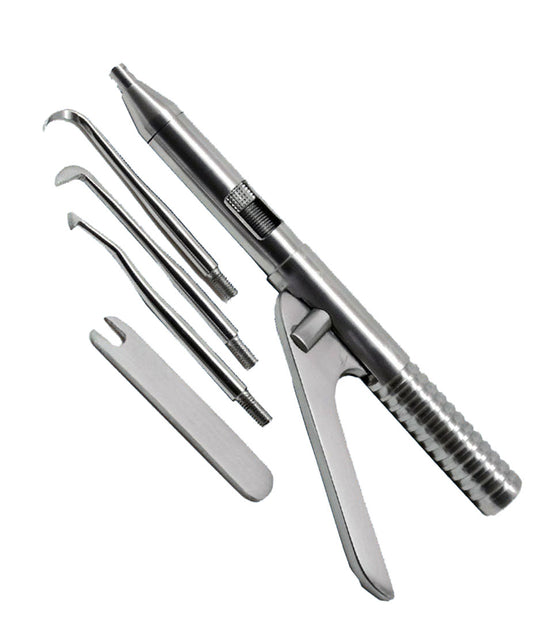
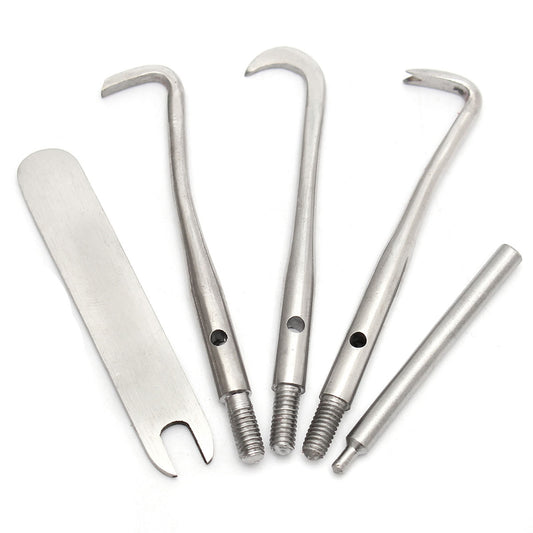
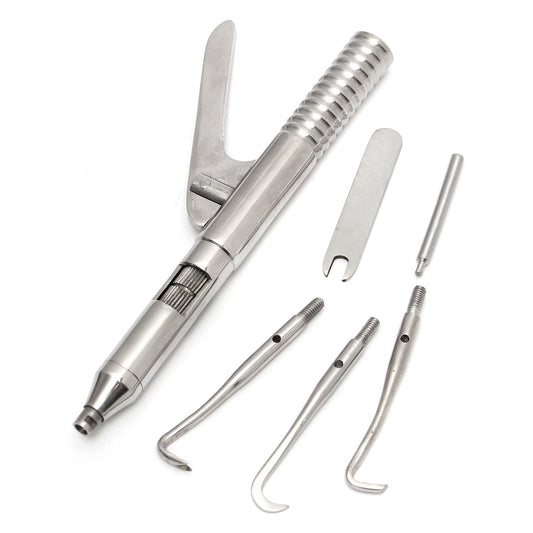
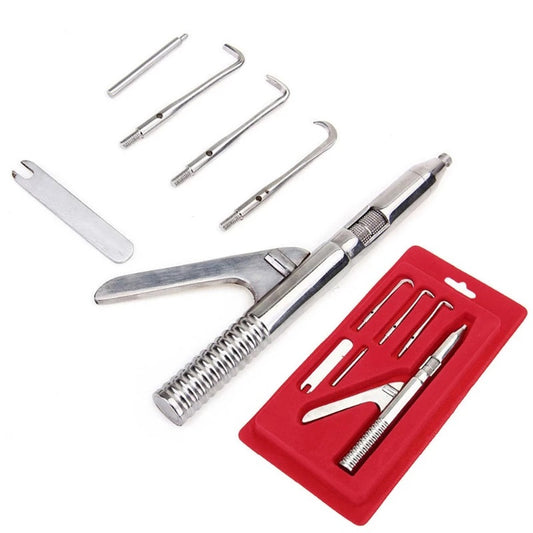
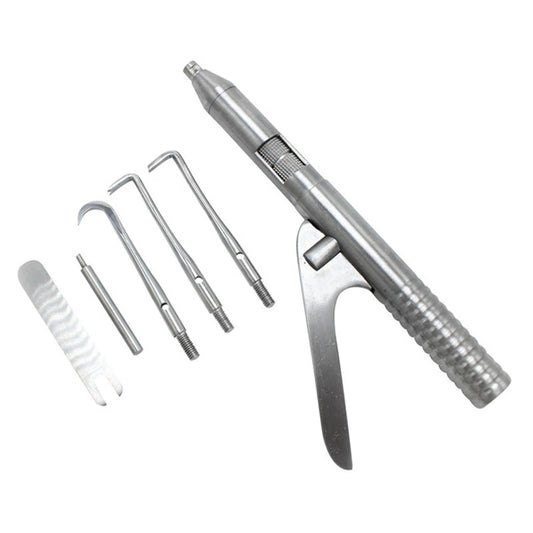
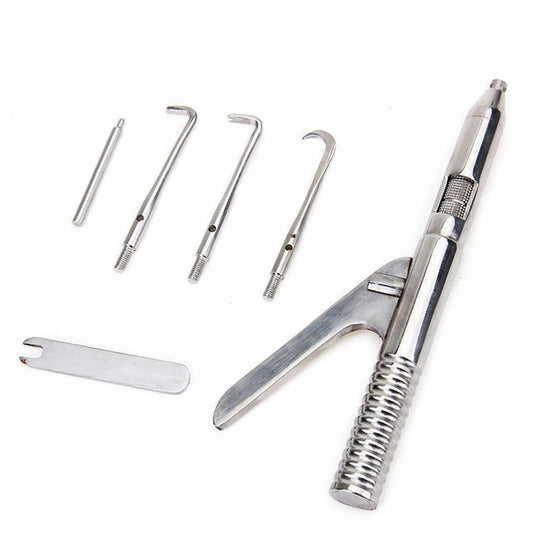
Dental crown removers break the cement seal on a fixed crown or bridge and deliver a controlled axial force to lift it without fracturing the abutment. Peak Surgicals supplies five patterns automatic, gun-type and manual sets in German stainless steel, from $21.51. Each is CE marked and built under ISO 13485. See all five patterns in the grid below.
Which Crown Remover for Which Removal?
The Automatic Crown Remover ($30.80) and Dental Crown Remover Gun ($27.50) apply spring-loaded axial force for intact removal of a reusable crown, while the Tooth Extraction and Crown Removal set ($33.00) and Dental Crown Remover Equipment ($21.51) supply the tips and adapters for varied clinical situations. The choice turns on one question: is the crown being saved or sacrificed?
For a crown that must survive a temporary being refitted, or a costly restoration being repositioned, the automatic and gun patterns matter. Both convert a controlled slide-hammer action into axial pull along the tooth's long axis, so force lifts the crown rather than shearing the abutment beneath it. The Dental Crown Remover Gun ($27.50) delivers that impulse through a trigger mechanism; the Automatic Crown Remover ($30.80) through a sprung sliding weight. Where the crown is being removed to access decay or a failed abutment, the set-based patterns give the range the crown and bridge remover kits carry interchangeable tips, hooks and adapters for anterior and posterior teeth. We supply each at MOQ 1, so a practice can trial a mechanism before committing.
Mechanism: Why Axial Force Protects the Abutment
A crown remover is a force-delivery instrument, and the direction of that force is the whole design. Cement fails in shear, but the abutment fails in shear too — so the instrument must load the crown along the tooth axis, not laterally. Pull straight and the cement lets go; pull at an angle and the prepared tooth structure fractures. This is the difference between the patterns here and improvised removal.
The automatic and gun mechanisms exist to make that axial impulse repeatable. A slide weight or trigger stores energy, then releases it in a single controlled increment along the shaft — the clinician sets the attachment on the crown margin and the mechanism does the pulling, not the wrist. The automatic crown remover removes the guesswork of manual tapping. Attachment tips grip the crown edge or a bridge connector; the sliding mass transfers a measured jolt through that grip. Every instrument here is reusable and forged from German stainless steel, which holds the tip geometry that a worn or deformed attachment would lose.
Material, Reprocessing and Certification
These crown removers are forged from German stainless steel — corrosion-resistant across the repeated steam autoclave cycles a chairside instrument sees daily. The mechanism is the reprocessing point that matters: sliding shafts and trigger assemblies must be cleaned and dried so cement debris does not seize the action across cycles, and ultrasonic cleaning before autoclaving clears the moving parts hand-brushing misses.
Every instrument is Class I, reusable, CE marked and built under ISO 13485 — the documentation a dental supply team verifies before qualifying a vendor. Warranty is one year with return-and-replacement, MOQ is 1 piece, and orders over $99 ship free in carton box packing. OEM marking is available for distributors building private-label ranges. For related tools, see dental extracting forceps and dental luxation elevators, or browse all dental instruments. Talk to us about OEM and volume terms.
Our Top Selling Products:
Ross Aortic Valve Retractor | Cleland Valve Leaflet Retractor | Kick Bucket Complete - Stainless Steel Surgical Waste Bucket | DCP Plate 3.5mm Stainless Steel/Titanium | Cloward Style Blade Retractors | Colibri Corneal Forceps | Entner Liposuction Cannula | Hill Ferguson Rectal Retractors | DA Reverse Cutting Needle for Large Animal Tissue Suturing and Closure | Tubing Clamp Forceps