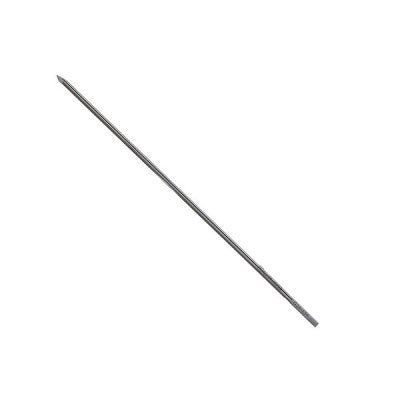
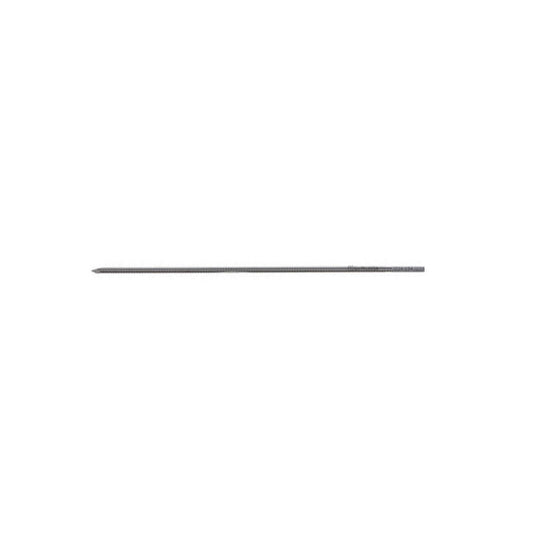
A Kirschner wire is a temporary implant. It holds bone fragments in position while they unite, and then it comes out, often in clinic and often without anaesthesia, because one end is usually left protruding through the skin. Peak Surgicals supplies Kirschner Wire 12 Inch Surgical K-Wire for Orthopedic Fixation ($6.60). See the full specification in the grid below.
What a Kirschner Wire Does
The wire works by percutaneous fixation. Fragments are reduced, the wire is driven across the fracture with a power driver or a hand chuck, and it holds the reduction by spanning the fracture line rather than by compressing it. Two or three wires crossed at angles resist rotation as well as displacement, which is why K-wires are placed in pairs or crosses rather than singly.
This is fixation that is meant to be undone. In a distal radius fracture, a paediatric supracondylar fracture or a hand fracture, the wire holds for the weeks that union takes and is then withdrawn, leaving no permanent hardware in the bone. That is its advantage over a plate: no second operation is required to remove it, no implant remains near a growth plate, and the bone is left as it was. It is also why the wire is not intended to bear load. It holds position; the cast or splint carries the limb.
Diameter, Tip and Thread
Three specifications decide which wire is used, and none of them is length. The first is diameter, which runs from around 0.6mm for phalangeal work up to 3.0mm for larger bones, and it is matched to the bone rather than to convenience: too fine and the wire bends under the driver, too thick and it splits a small fragment.
The second is tip geometry. A trocar tip cuts through cortex under power and is the general-purpose choice; a diamond tip is finer and more precise for smaller bone. The third is whether the wire is smooth or threaded along part of its length. A smooth wire withdraws easily but can migrate; a partially threaded wire grips the far cortex and stays where it was put, at the cost of being harder to remove. Confirm diameter, tip type and thread configuration against the catalogue before ordering.
Specifications and Documentation
These wires are manufactured under an ISO 13485 quality management system. Because a Kirschner wire is implanted rather than reused, the specifications that matter at purchase differ from those on a surgical instrument, and buyers should confirm each of the following against the product documentation before ordering: the exact wire diameter and length; the material and alloy grade; the tip geometry; whether the wire is smooth, partially threaded or fully threaded; whether it is supplied sterile or non-sterile, and the validated sterilization method if the latter; the applicable regulatory clearance for the intended market; and lot and batch traceability arrangements.
We supply at MOQ 1 with free shipping over $99, and OEM production is available for distributors. See Orthopedic Instruments for the wider catalogue. Talk to us about wire specifications and volume terms.