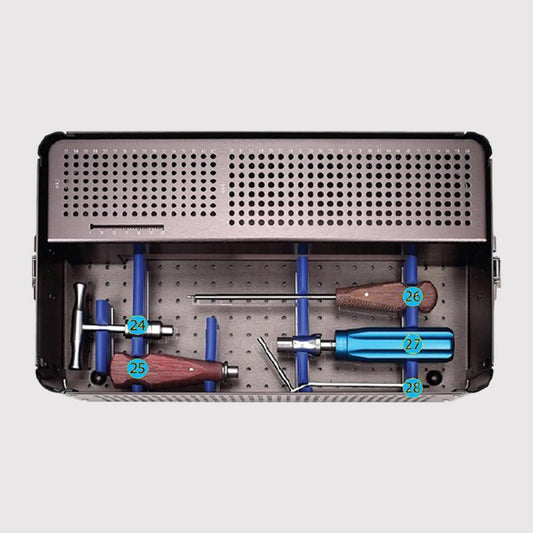
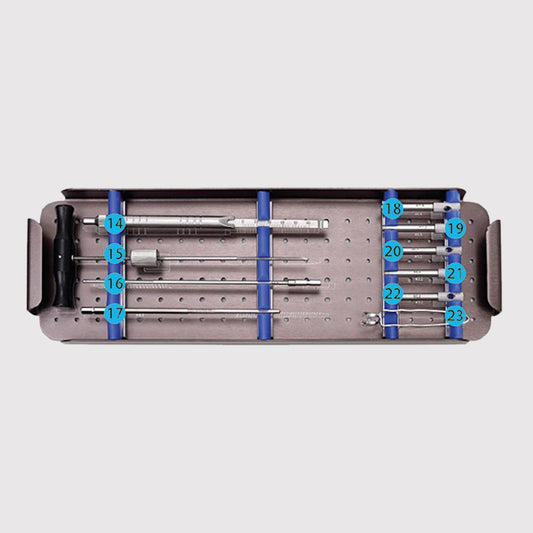
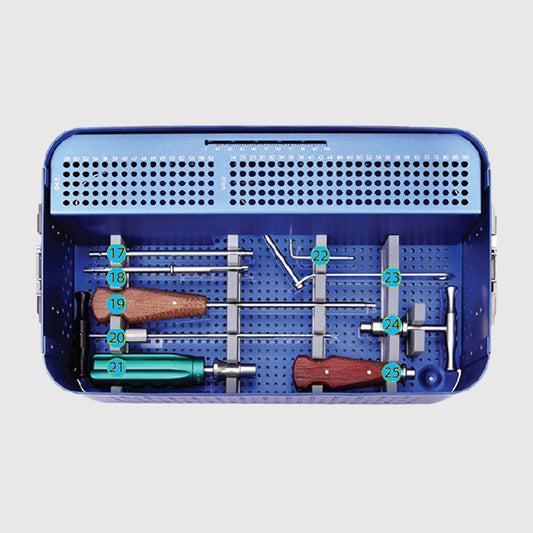
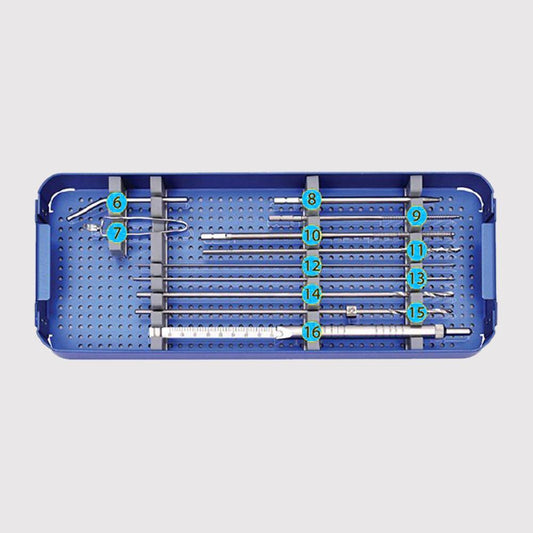
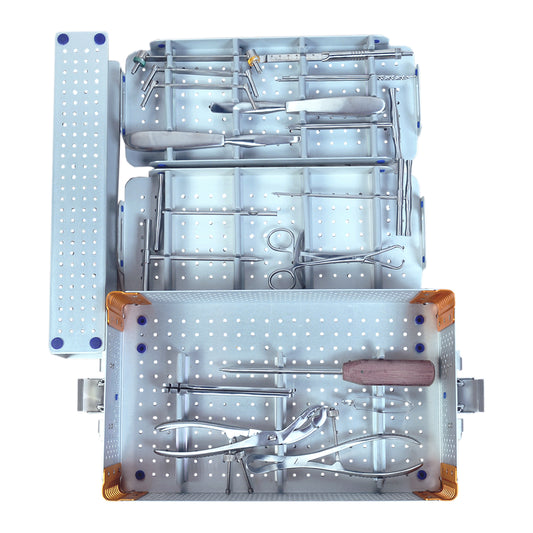
Small fragment and large fragment are not sizes of the same set. They are two different screw systems, and an instrument from one will not correctly prepare a hole for the other. Peak Surgicals supplies both as complete locking plate instrument sets, from $495.00. See the full specification in the grid below.
Screw Diameter Sets Everything Else
The division is set by screw diameter, and every instrument in a fragment set exists to serve one of them. Small fragment instrumentation is built around 3.5mm cortical and 4.0mm cancellous screws, which is the system used for the radius, ulna, fibula, clavicle, distal tibia and most periarticular work where the bone will not accept anything larger. Large fragment instrumentation is built around 4.5mm cortical and 6.5mm cancellous screws, for the femur, tibial shaft and humerus.
That single number cascades through the whole set. The drill bit is sized to the screw's core diameter, the tap cuts the matching thread, the drill sleeve and guide are bored to accept that bit, the countersink prepares a seat for that head, the depth gauge reads against that screw length range, and the screwdriver matches that recess. Mixing systems means a hole prepared for one screw and a screw that does not fit it.
What Makes a Locking Set Different
Small Fragment Locking Plate Instrument Set ($605.00) covers the 3.5mm and 4.0mm system, and Large Fragment Locking Plate Instrument Set ($495.00) covers the 4.5mm and 6.5mm system. Both are locking-plate sets rather than conventional plating sets, which changes what is in them.
A conventional plating set does not need to control screw angle, because a standard screw takes whatever trajectory the drill made. A locking screw threads into the plate, so its angle relative to the plate is fixed by design, and the hole has to be drilled along that exact axis or the screw will not seat. That is why locking sets carry threaded drill guides that screw into the plate hole itself, and torque-limiting handles that tighten the locking head to a defined value rather than to hand feel. Both features exist to protect a mechanism that fails silently if it is overtightened or cross-threaded.
Material, Reprocessing and Specifications
These sets contain instruments rather than implants, and they are supplied as reusable instrumentation manufactured under an ISO 13485 quality management system. Inspection on a fragment set is done by function: check every drill bit and tap under magnification for chipping, because a dull cutting edge generates heat in bone that cannot dissipate it; confirm drill sleeves and guides are clear and their bores unworn, since a worn sleeve no longer constrains the bit to the intended axis; check screwdriver tips for rounding at the recess, as a cammed-out tip damages the screw head it is meant to drive; and verify torque handles against their rated value on the schedule the manufacturer specifies. Clean immediately with a neutral-pH enzymatic solution, flushing cannulated components and brushing bone debris from flutes before it dries, then rinse with deionised water and dry fully, following the reprocessing instructions supplied.
Buyers should confirm the exact screw system each set serves, the complete component inventory and the plate range it is compatible with before ordering. We ship at MOQ 1 with free shipping over $99, and OEM production is available for distributors. See Orthopedic Fragment Sets for the wider range. Talk to us about set specifications and volume terms.