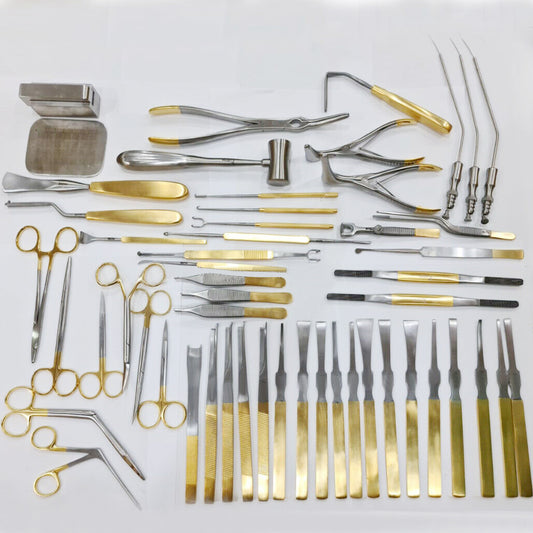
A rhinoplasty instrument set is bought as a set because the procedure moves through bone, cartilage and soft tissue in one sitting, and no single instrument family covers all three. Peak Surgicals supplies the Rhinoplasty Instrument Set of 50Pcs ($671.00) in German stainless steel, CE marked and built under ISO 13485. See the full specification in the grid below.
Exposure, Dissection, Osteotomy
Rhinoplasty runs in a fixed order, and the set is assembled to follow it. Exposure comes first: Aufricht and Nievert nasal retractors hold the dorsum open while the Desmarres lid retractor keeps adjacent soft tissue clear. Dissection follows with the Cottle lower lateral forceps and the Ballenger swivel knife, which carries a 4mm blade for cartilage.
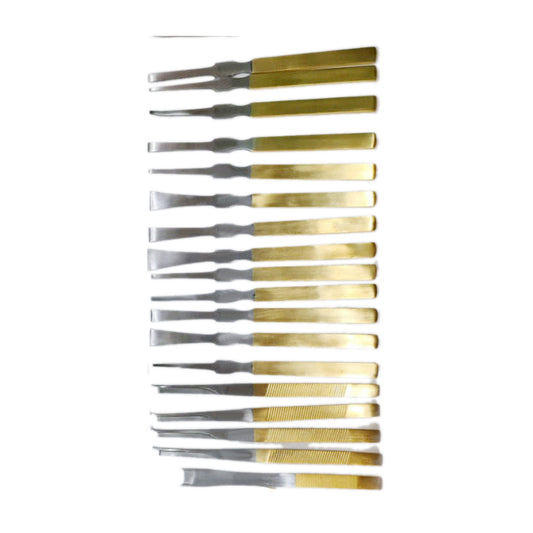
Bone work is the largest part of the set, with fourteen osteotomes. Rounded guard osteotomes in 2.2mm, 3mm and 4mm and micro double-edged osteotomes from 2.0mm to 4mm take the fine cuts, while dual-edged osteotomes with rounded corners run 10mm to 18mm for wider dorsal work. Cinelli and Silver guarded osteotomes handle hump removal and lateral osteotomy specifically, and the Cottle mallet drives all of them.
Contouring, Cartilage and Soft Tissue
Contouring and refinement come after the cuts. The Glabella rasp in a push-pull curved 20cm pattern and the Joseph raspatory smooth the bony dorsum, and double-ended tungsten carbide bone rasps in medium and fine grades, sizes 5 to 8, take the profile down in controlled stages rather than one pass.
Cartilage and septal work has its own instruments. The Asch septum straightening forceps, angled at 9 inches, correct a deviated septum, and the Cottle cartilage crusher prepares grafts to an even thickness. Soft tissue is handled by four scissor patterns: rhinoplasty scissors straight and curved at 10cm for delicate work, Walter angular tungsten carbide scissors, Fomon dorsal nasal scissors and Giunta tungsten carbide nasal scissors at 13.5cm. Adson Brown and Adson dressing forceps at 12cm and nasal speculums at 35mm and 55mm complete the tray.
Material, Reprocessing and Certification
The set is manufactured from German stainless steel and passivated for corrosion resistance across repeated cycles, with tungsten carbide inserts on the rasps and two scissor patterns. The inspection point is the osteotome edges and the rasp faces: check every bevel under light for chips, since a chipped edge is driven by a mallet and will split rather than cut, and check rasp teeth for clogging or flattening. Confirm scissor tips meet cleanly and forceps tips align. Clean immediately with a neutral-pH enzymatic solution, brushing bone debris out of rasp teeth before it dries, then rinse with deionised water and dry fully before autoclaving at 134°C.
These are Class I reusable devices, CE marked, FDA registered and built under ISO 13485, supplied with a sterilizing pouch, a one-year warranty and a 30-day money-back guarantee. We ship at MOQ 1 with free shipping over $99, and OEM production is available for distributors. See Rhinoplasty Surgery Instruments for individual patterns, or browse all Plastic Surgery Instruments. Talk to us about OEM terms.