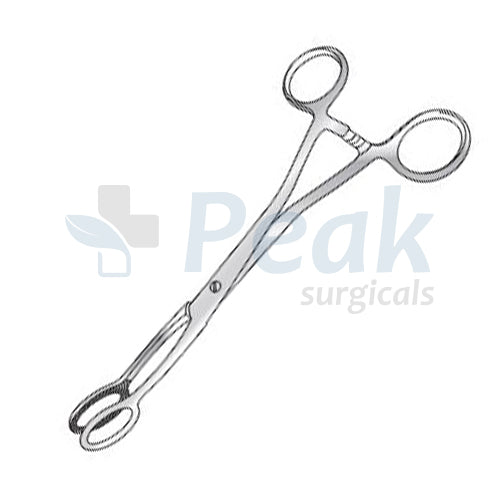
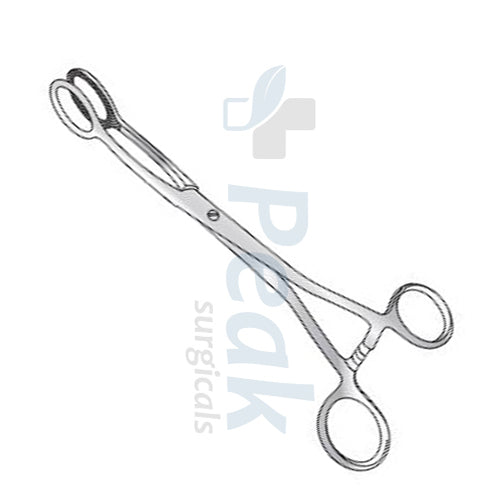
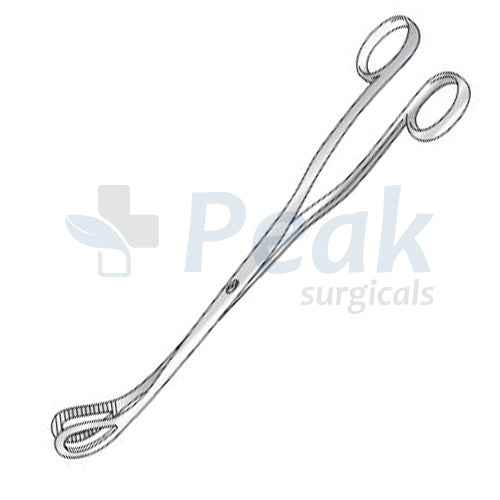
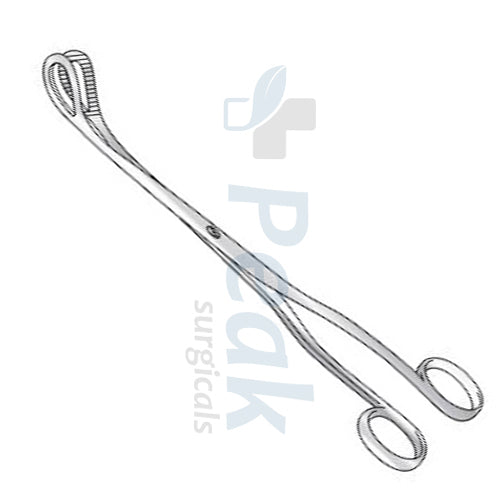
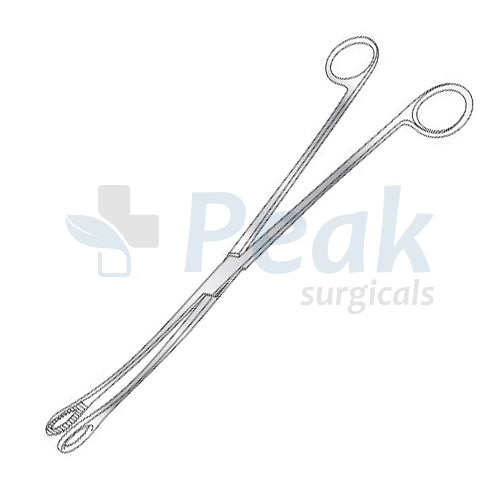
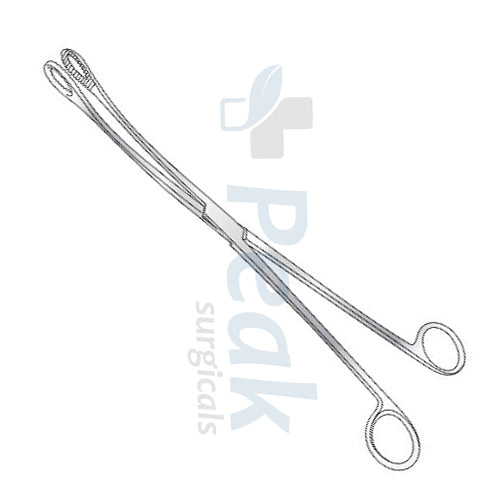
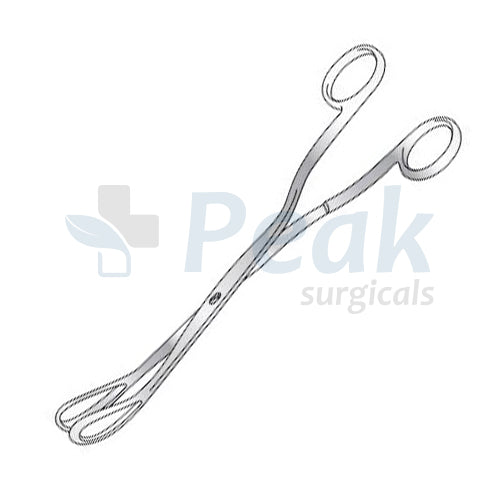
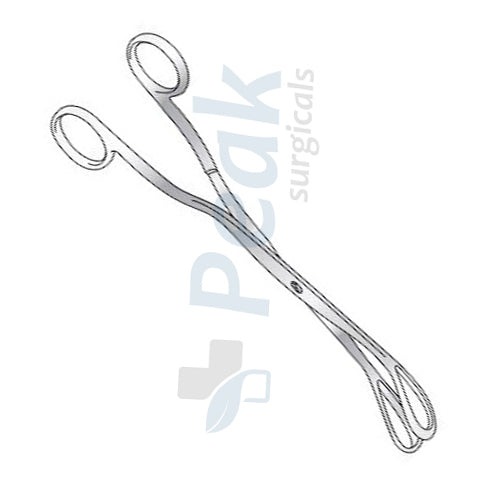
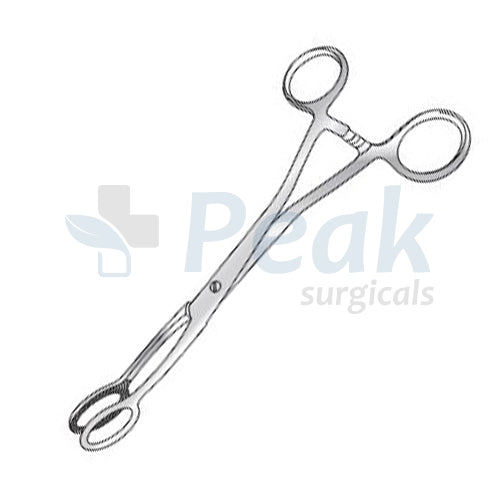
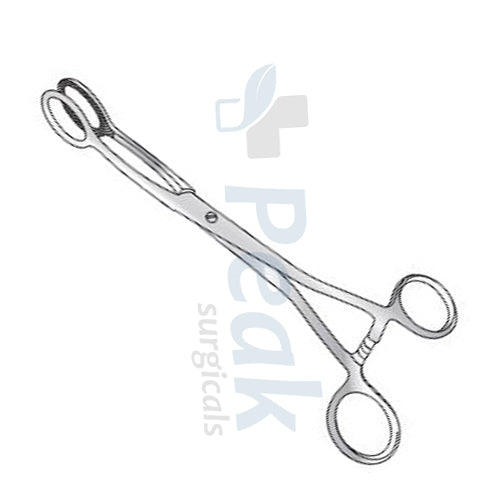
Ovum forceps grasp and withdraw placental tissue and retained products of conception from the uterus, fenestrated, serrated jaws on long shanks that reach the fundus without the handle entering the vaginal canal. Peak Surgicals supplies five patterns McClintock, Kelly, Greenhalgh and Doyen ovarian, in German stainless steel, from $15.40 to $27.50, each carrying a model number. Every pattern is CE marked and built under ISO 13485. Compare all five patterns in the grid below.
Ovum Forceps or Sponge Holding Forceps?
Ovum forceps carry fenestrated, serrated jaws designed to grip and rotate soft placental tissue for removal, while sponge holding forceps grip gauze and swabs — the jaw serration pattern and the fenestration size differ, and substituting one for the other either tears tissue or drops the swab. They look similar on a tray, which is why the substitution happens.
The distinction is in the jaw. Ovum forceps use oval fenestrations with horizontal serrations across the inner faces, sized so placental tissue is held firmly enough to survive the circular detaching movement that separates it from the uterine wall. McClintock Ovum Forceps (PS-MOF-00179, $16.50) is the pattern named after Dr. John McClintock and the one most obstetric trays carry, with a screw-lock joint and shanks that curve after the ring handles. Kelly Ovum Forceps (PS-KOF-00178, $15.40) and Greenhalgh Ovum Forceps (PS-GOF-00177, $17.60) cover the same work at different shank profiles. We supply every pattern at MOQ 1.
Where Doyen Ovarian Forceps Differ
Two of the five patterns here are not ovum forceps at all, and the difference is worth stating plainly. Doyen Ovarian Forceps (PS-DOF-00176, $27.50) and the second Doyen pattern (PS-DOF-00180, $22.00) are designed to grasp and manipulate the ovary itself during oophorectomy and adnexal surgery — not to retrieve tissue from the uterine cavity.
That changes the jaw. An ovarian forceps must hold a solid, mobile organ under traction without crushing it, so the jaw profile is built for atraumatic grip across a broader surface rather than for gripping loose tissue through fenestrations. Ovum forceps work blind, by feel, inside a cavity; ovarian forceps work under direct vision in an open or laparoscopic field.
Both share the long shank and ring handle that let the surgeon's hand stay clear of the working end, and both are supplied here because obstetric and gynaecological trays are assembled together. For placenta-specific and general grasping patterns, see placenta and ovum forceps.
Reprocessing, Jaw Integrity and Certification
Fenestrated jaws are the reprocessing point on these instruments. Tissue lodges in the fenestrations and along the serration rows, and immersion alone does not clear it — brush the fenestrations and ultrasonic-clean before autoclaving. The screw-lock joint needs the same attention, since residue there stiffens the action across cycles and a lock that no longer closes cleanly releases under traction.
Check that opposing jaws meet flat each cycle. A forceps whose jaws have splayed grips at the tips only, which tears placental tissue instead of holding it — the failure that leaves fragments behind. Every instrument is Class I, reusable, CE marked and built under ISO 13485, the documentation a hospital supply team verifies before qualifying a vendor. Warranty is one year with return-and-replacement, MOQ is 1 piece, orders over $99 ship free in carton box packing, and OEM marking is available. See also uterine forceps and tenaculum forceps, or browse all gynecology instruments. Talk to us about OEM and volume terms.