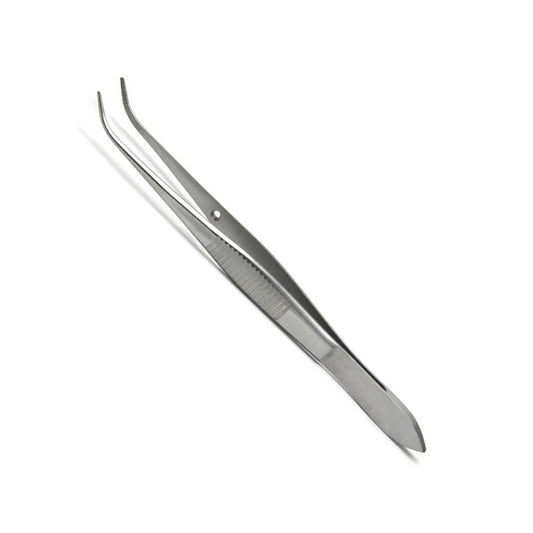
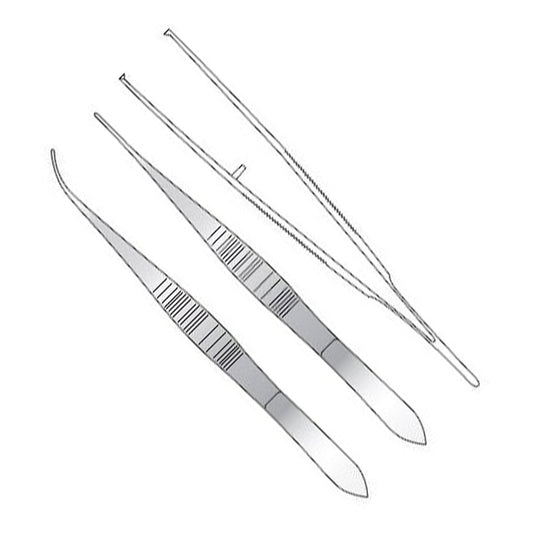
Iris forceps do not grip. They guide, and the difference is what these instruments are built around. The iris is thinner than a millimetre, has almost no tensile strength, and once torn it does not heal back to its original shape: the pupil stays distorted, permanently and visibly. Peak Surgicals stocks Iris Fixation Forceps (PS-S-00015, $27.50) and Iris Forceps 114mm ($27.50) in German stainless steel, CE marked and built under ISO 13485. Compare both patterns in the grid below.
Why the Teeth Are Many and Small
That fragility explains why iris forceps carry many fine teeth rather than a few strong ones. Teeth on a tissue forceps normally exist to bite, and a 1×2 tooth pattern concentrates the whole grip on two points because the tissue can take it. Iris tissue cannot. Multiple small interdigitating teeth spread the same holding force across a wider area, so the forceps holds position without any single point carrying enough load to tear through.
The rest of the instrument follows. Shafts are fine because the working space is a few millimetres behind a corneal incision, and the spring is light because the surgeon needs to feel the tissue rather than clamp it. The instrument is being used to lift an iris edge clear, to hold it while a suture passes, or to reposit prolapsed tissue back through a wound. None of those tasks requires strength, and all of them punish it.
Fixation or Tissue Handling?
Fixation forceps and tissue forceps differ in what they hold on to. Iris Fixation Forceps (PS-S-00015, $27.50) is built to take a fixed purchase and hold it while another instrument works, which is what iris fixation, pupilloplasty and suture placement need. Iris Forceps 114mm ($27.50) is the general tissue pattern for lifting, repositing and handling.
Two specifications decide the choice and should be confirmed against the catalogue, since neither is visible from an image. The first is tooth configuration, because the number and arrangement of teeth is the single variable that determines how the forceps distributes load. The second is whether the tips are straight or curved, which sets the angle at which they meet tissue through a corneal or limbal incision. We supply both patterns at MOQ 1, reusable rather than single-use.
Material, Reprocessing and Certification
Both patterns are forged from German stainless steel and passivated for corrosion resistance across repeated cycles. The inspection point is the tips under magnification, and on iris instruments it is the whole inspection: hold the tips closed against light and confirm the teeth interdigitate fully with no daylight and no lateral offset, then check every tooth is present and unblunted, because a forceps that has lost a tooth concentrates its grip on the remainder and that is exactly the load iris tissue cannot take. Confirm the spring returns the tips to their original gap when released, since a fatigued spring changes how much pressure the hand is actually applying. Clean immediately with a neutral-pH enzymatic solution, brushing between the teeth, then rinse with deionised water and dry fully, following the reprocessing instructions supplied.
These are Class I reusable devices, supplied non-sterile, CE marked and built under ISO 13485, with a one-year warranty. We ship at MOQ 1 with free shipping over $99. See Ophthalmic Forceps for the wider range.