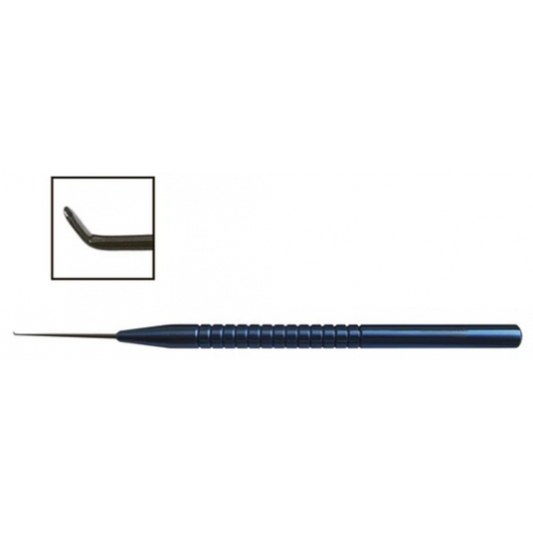
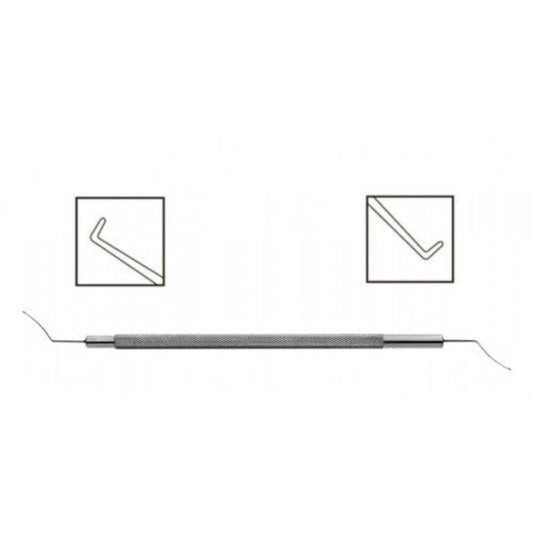
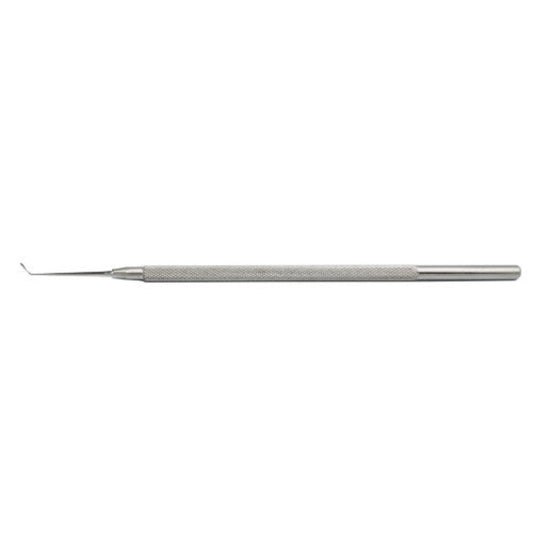
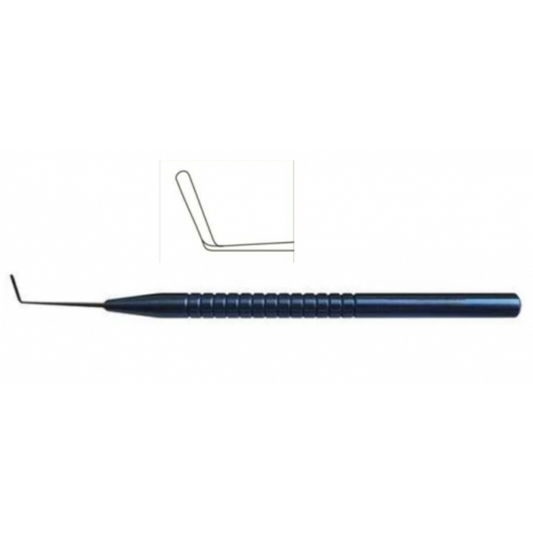
Intrastromal corneal ring segments reshape a cornea without removing any of it. Two small arcs of plastic are placed inside the corneal stroma, and their presence flattens the cone of a keratoconic eye by shortening the arc length of the tissue around them. Nothing is excised, which is why the procedure can be reversed. Peak Surgicals stocks four instruments for that sequence, from $31.49, in German stainless steel and CE marked and built under ISO 13485. Compare all four patterns in the grid below.
Working Inside Half a Millimetre
The whole operation happens inside the thickness of the cornea, which is around half a millimetre. A channel is created at a set depth within the stroma, and the segment is advanced into it. Too shallow and the segment sits under thin tissue that will thin further and eventually extrude it; too deep and the dissection approaches Descemet's membrane and the endothelium behind it. The working margin is measured in tens of microns.
That is why the instruments here are guides and spreaders rather than cutting tools. Bicalho Guide ($38.50) sets the geometry of the channel, controlling where it starts and how it runs, and Suarez Spreader ($38.50) opens the stromal plane itself, separating lamellae along their natural cleavage rather than cutting across them. Neither instrument removes tissue. They create a space that closes again if the segment is later withdrawn.
Insertion, Then Rotation
Insertion and positioning are separate steps with separate instruments. Corneal Ring Pusher ($31.49) advances the segment along the prepared channel, which has to be done without letting the leading edge lift out of the plane or press against the channel roof. Double Ended Sinskey Hook ($34.10) then engages the segment's positioning hole to rotate it into its final position, since segment orientation relative to the cone determines how much flattening is achieved.
That final adjustment is what makes the procedure titratable. The refractive effect depends on segment thickness, arc length and where it sits relative to the steep axis, and the last of those is set by hand at the end of the operation. We supply every pattern at MOQ 1.
Material, Reprocessing and Certification
Every pattern is forged from German stainless steel and passivated for corrosion resistance across repeated cycles. The inspection point on corneal instruments is the working tip under magnification, and here it is the entire inspection: check the spreader and guide tips for any burr, raised edge or loss of profile, because these instruments separate corneal lamellae along a plane and a rough tip tears across it instead; check the pusher tip is smooth and unmarked, since it presses directly against a segment that must not be scored; and confirm the Sinskey hook tip is blunt and unbent. Clean immediately with a neutral-pH enzymatic solution, then rinse with deionised water and dry fully, following the reprocessing instructions supplied.
These are Class I reusable devices, supplied non-sterile, CE marked and built under ISO 13485, with a one-year warranty. We ship at MOQ 1 with free shipping over $99. Browse all Ophthalmology Instruments.