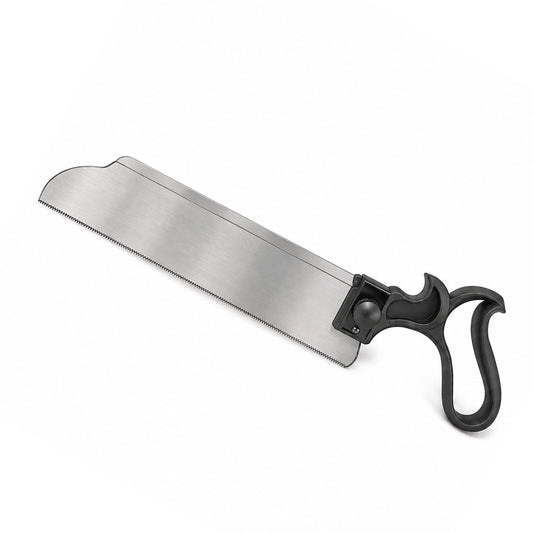
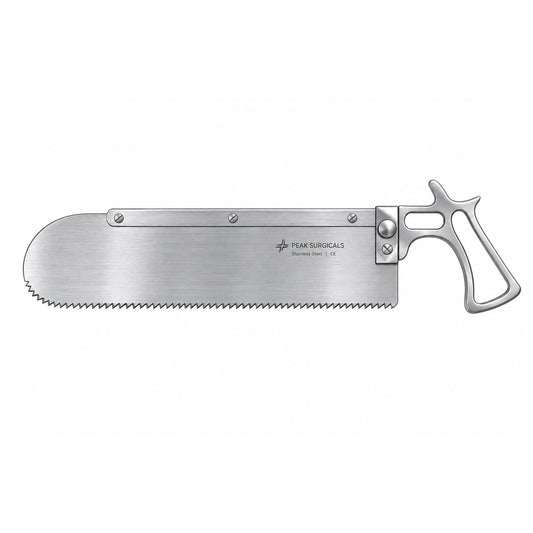
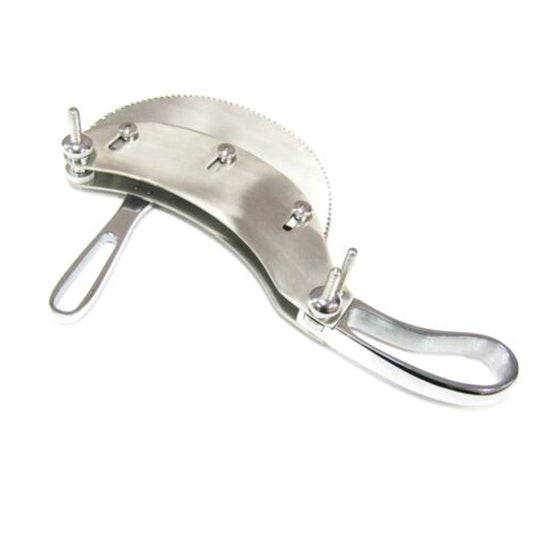
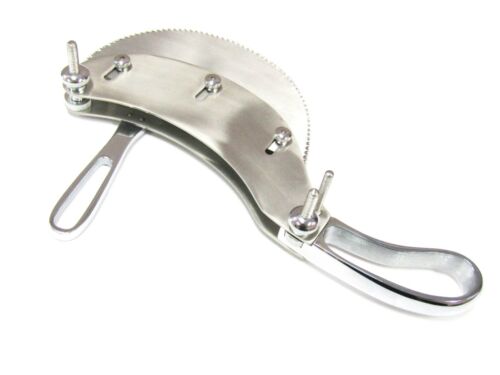
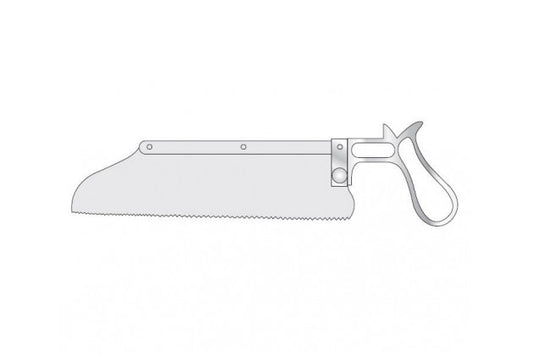
Post mortem bone saws section bone during autopsy the calvarium, the vertebral column, and the limbs each demanding a different blade and back. Peak Surgicals supplies four hand patterns hinged back, fixed back, double-bladed spinal and amputation with 14 teeth-per-inch blades in stainless steel, from $27.50 to $137.50. Each is CE marked and built under ISO 13485. Compare all four saws in the grid below.
Which Saw: Hinged, Fixed, Spinal or Amputation?
The hinged-back saw tensions its blade for controlled straight cuts, the fixed-back saw holds the blade rigid for heavier sectioning, the double-bladed spinal saw cuts the vertebral column, and the amputation saw carries a shaped blade for limbs, the back type and blade shape follow the bone being cut. Each answers a distinct autopsy task.
The back is what sets blade behaviour. The Saw Hinged Back 14 TPI (PS-P-00021, $27.50) carries a hinged spine that tensions the blade, giving a controlled cut where the blade must track straight through cranial or flat bone. The Saw Fixed Back 14 TPI 228mm (PS-P-00020, $27.50) holds the blade rigid against the back for heavier, more forceful sectioning where flex would waste the stroke. The Double Bladed Adjustable Spinal Saw (PS-P-00022, $137.50) is purpose-built for the vertebral column two parallel blades cut both sides of the spinal canal at a set width, adjustable for the section required. The Post Mortem Amputation Saw 10"/254mm (PS-P-00019, $33.00) carries a shaped blade for sectioning limbs. We supply each at MOQ 1.
Blade, Teeth-Per-Inch and Back Type
Two specifications define a bone saw's cut, and the first is teeth per inch. A 14 TPI blade balances speed against control, coarser blades cut faster but rougher, finer blades slower but cleaner, and 14 TPI is the standard for post-mortem bone sectioning where the cut must be efficient without shattering the bone edge. The blade holds that pitch across its length so the cut stays consistent.
The second is the back. A hinged back lets the blade tension be adjusted and the blade be changed, and it allows a degree of flex that helps a straight tracking cut; a fixed back holds the blade immovable against a rigid spine, transmitting the full force of the stroke into the bone for dense sectioning. The double-bladed spinal saw applies the same logic to a specific task, holding two blades at an adjustable separation to open the vertebral canal in one pass. Blade sharpness and set are the inspection points, a dull or unevenly set blade binds in the cut rather than clearing it. We supply blades matched to each saw pattern.
Reprocessing, Blade Care and Certification
These saws are built for the reprocessing a mortuary instrument sees, stainless steel that withstands repeated disinfection and autoclaving without degradation. The blade is the wear item: bone dust packs the teeth and dulls the set, so brush the blade clear before it dries and inspect the teeth for damage before each use. A blade that has lost its set binds in the cut and forces the operator to work harder, which reduces control. Blades are replaced rather than resharpened where the set cannot be restored.
Every saw is Class I, reusable, CE marked and built under ISO 13485, the documentation a supply team verifies before qualifying a vendor. Warranty is one year with return-and-replacement, MOQ is 1 piece, orders over $99 ship free in carton box packing, and OEM marking is available for distributors. For the full autopsy range see post mortem instruments; related patterns sit in post mortem probes. Talk to us about OEM and volume terms.
Our Top Selling Products
Safety Lock Screw Ø3.5mm Self Tapping and Self Drilling | Austin Moore Hip Prosthesis Excel Stainless Steel | Russian Tissue Forceps Instrument | Gruber Ear Specula for Infant and Standard Ear Canal Visualization | UNC15 Periodontal Probe for 1-15mm Periodontal Pocket Charting | Safety Lock Screw Ø 2.4mm Star Like Self Tapping | Cancellous Safety Lock Screw Ø5.0mm | Cancellous Safety Lock Screw Ø3.5mm Self Tapping | Blake Blade Holder | Cortex Bone Screw 3.5mm Length Self-Tapping Hex Head Titanium