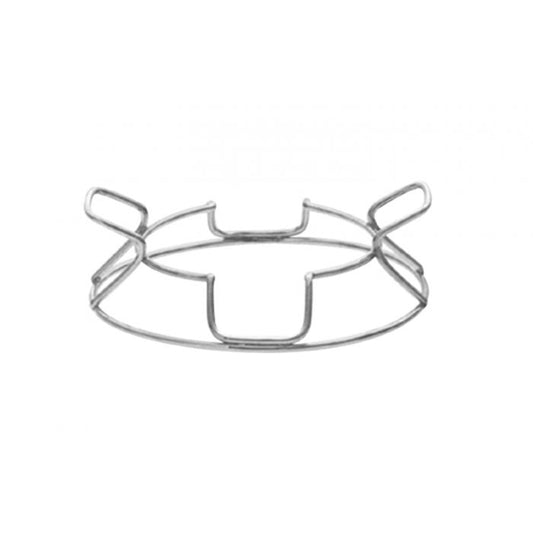
When the cornea is removed, the eye loses the structure that was holding its shape. An ophthalmic fixation ring is what replaces it. Sutured to the sclera before the trephine cuts, the ring holds the globe to its natural contour so the eye does not collapse once it is open. Peak Surgicals supplies the McNeill-Goldman Fixation Ring (PS-J-131, $99.00) in German stainless steel, CE marked and built under ISO 13485. See the full specification in the grid below.
Why an Open Globe Needs Holding
The problem is structural rather than surgical. A closed eye holds its shape through internal pressure acting against an intact corneoscleral shell. Open that shell and the pressure is gone, the sclera collapses inward under the pull of the extraocular muscles, and the corneal opening distorts. A donor button cut to fit a round bed will not fit a bed that has gone oval.
A fixation ring is sutured to the sclera around the intended trephination before any cut is made, and it holds that geometry through the open phase of the operation. It is doing two things at once: resisting the inward collapse that would distort the bed, and giving the surgeon a fixed reference so the recipient opening stays where it was planned. The eye is being held to its own shape, not to the instrument's.
The McNeill-Goldman Pattern
The McNeill-Goldman pattern combines that ring with a blepharostat, so lid retraction and scleral fixation are handled by one device instead of two competing for space around a field that is already crowded. That matters in keratoplasty, where the microscope, the trephine and the surgeon's hands all occupy the same few centimetres above an open eye.
Ring diameter is the specification to confirm before ordering. The ring has to sit outside the intended trephination with enough sclera between the two for the sutures to hold, so a ring sized for one trephine diameter will not serve every case. Confirm the ring's internal diameter, the suture points and the blepharostat opening range against the catalogue, since none of these is visible from a product image. We supply at MOQ 1.
Material, Reprocessing and Certification
The ring is forged from German stainless steel and passivated for corrosion resistance across repeated cycles. The inspection point is the scleral face and the suture points: run a gloved finger around the surface that will contact sclera and confirm it is smooth and unpitted, because this instrument sits sutured against tissue for the length of an open-globe procedure, and check the suture holes or eyelets are clear, unburred and undeformed. Confirm the ring is flat and has not been sprung out of plane, since a ring that no longer sits true holds the globe to a shape it was not meant to hold. Clean immediately with a neutral-pH enzymatic solution, working around the suture points, then rinse with deionised water and dry fully, following the reprocessing instructions supplied.
This is a Class I reusable device, supplied non-sterile, CE marked and built under ISO 13485, with a one-year warranty. We ship at MOQ 1 with free shipping over $99. Browse all Ophthalmology Instruments.