The lacrimal system is a drainage pipe, and lacrimal instruments answer two opposite complaints: the pipe is blocked, or the pipe drains too well. Peak Surgicals stocks three patterns covering both, from $9.90, in German stainless steel and CE marked and built under ISO 13485. Compare all three in the grid below.
When the Pipe Is Blocked
A blocked lacrimal system produces a watering eye that will not resolve, and when probing and irrigation fail the answer is surgical. Dacryocystorhinostomy creates a new drainage route from the lacrimal sac directly into the nasal cavity, bypassing the obstruction entirely. The sac itself sits in a bony fossa at the medial orbital wall, and reaching it means holding soft tissue clear of a small, deep pocket rather than a broad surface.
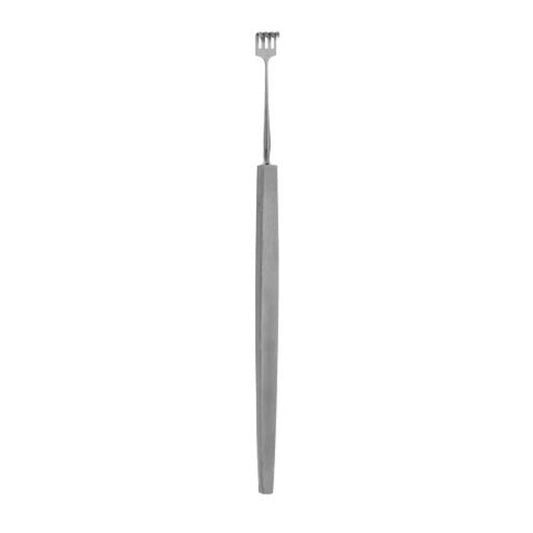
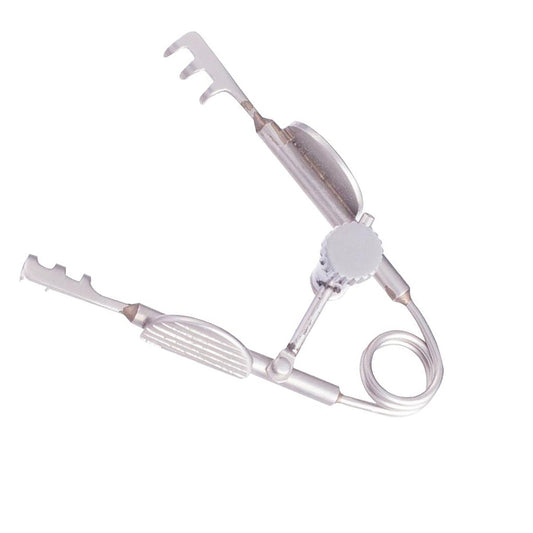
That is what these retractors are for. Knapp Lacrimal Sac Retractors (PS-7420, $9.90) and Agrikola Lacrimal Sac Retractor (PS-7421, $33.00) are shaped for that fossa, holding the wound open around a working space measured in millimetres while the surgeon works on the sac and the bone behind it. The blade profile matters more than the length here, because the depth is fixed by anatomy and the width is fixed by the incision.
When the Pipe Drains Too Well
The opposite problem needs a different instrument entirely. In dry eye, the drainage system works normally but there is not enough tear film to lose, so the punctum is deliberately occluded with a plug to keep what tears there are on the ocular surface.
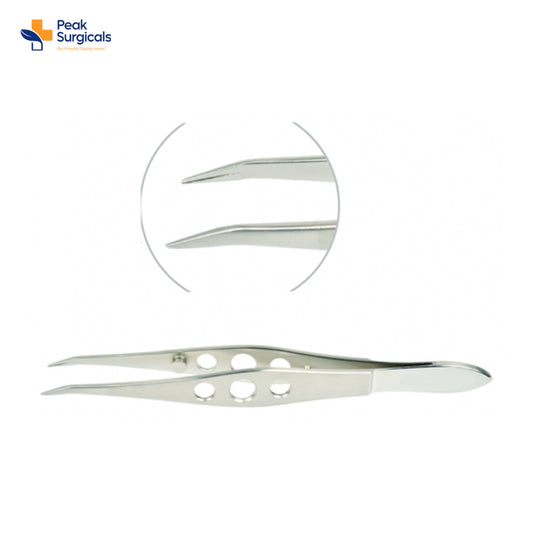
That is a placement task carried out at a slit lamp, and the constraint is scale. The punctum is around 0.3mm across, and the plug that goes into it is smaller still. Punctal Plug Forceps (PS-J-143, $20.61) carries tips fine enough to hold a plug of that size securely and release it cleanly once it is seated, which is harder than it sounds: a plug dropped at the punctum is difficult to retrieve, and a plug gripped too firmly can be deformed before it is placed. We supply every pattern at MOQ 1.
Material, Reprocessing and Certification
Every pattern is forged from German stainless steel and passivated for corrosion resistance across repeated cycles. The inspection point differs by instrument: on the retractors check the blade faces and edges are smooth and unburred, because these blades sit against periorbital soft tissue for the length of a procedure, and confirm the blades are flat with no warp that would make them rock rather than seat. On the punctal plug forceps the tips are the whole inspection, and they should be checked under magnification: confirm they meet flush along their full length with no daylight and no lateral offset, since tips that meet unevenly grip a plug at one corner and release it unpredictably. Clean immediately with a neutral-pH enzymatic solution, then rinse with deionised water and dry fully, following the reprocessing instructions supplied.
These are Class I reusable devices, supplied non-sterile, CE marked and built under ISO 13485, with a one-year warranty. We ship at MOQ 1 with free shipping over $99. See Eye Retractors and Speculum for the wider retractor range, or browse all Ophthalmology Instruments.