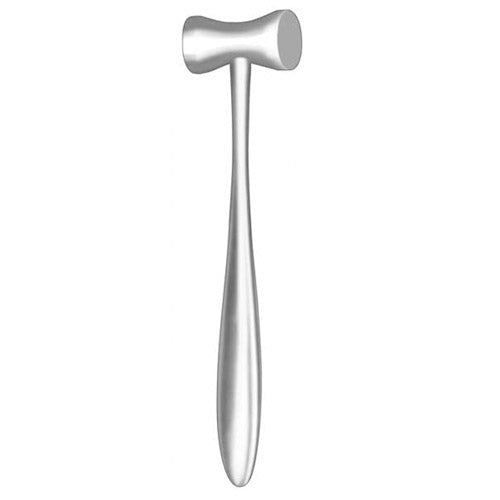
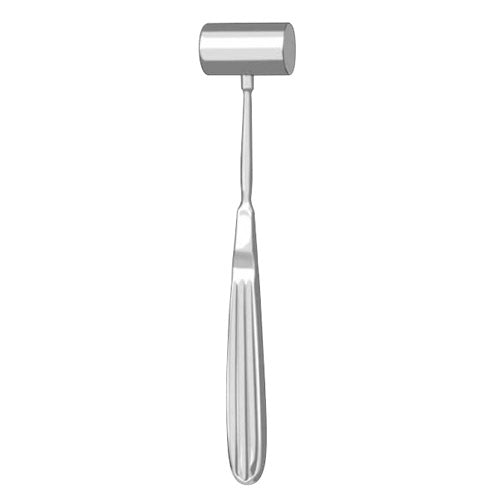
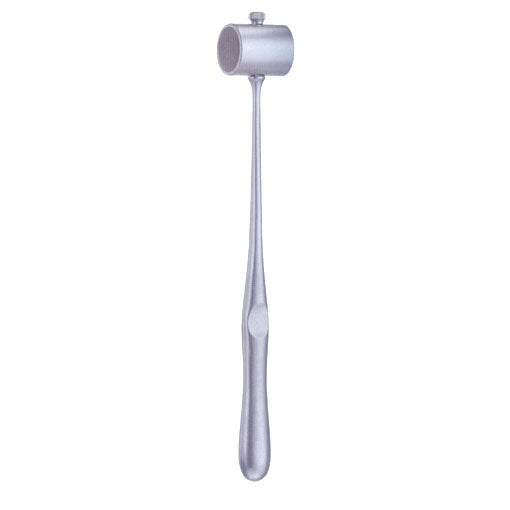
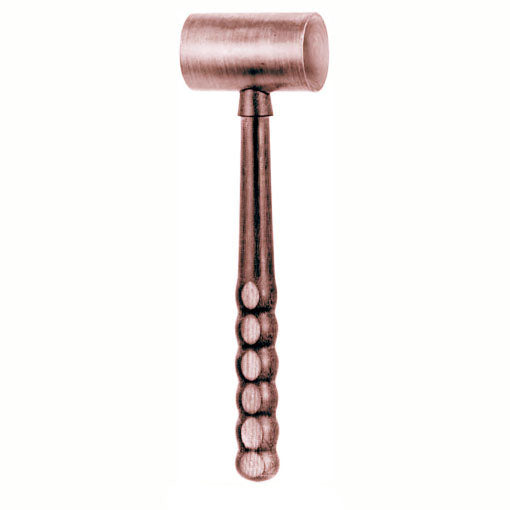
What a surgical mallet is made of decides what happens when it lands. Solid steel transmits the strike straight through; a weighted head absorbs the rebound so the force arrives once instead of twice; a polymer face softens it. Peak Surgicals stocks four mallet patterns across those behaviours, from $27.50, in German stainless steel and CE marked and built under ISO 13485. Compare all four in the grid below.
Why a Weighted Head Does Not Bounce
A solid head is the direct option. The strike goes into the osteotome with very little lost, which is what dense bone needs, and the operator feels exactly what the edge is doing. It also rebounds, and that rebound is what a weighted head is designed to remove. Filling the head with a loose mass means the mass keeps moving forward for a fraction of a second after the head has stopped, cancelling the bounce and delivering a single controlled strike instead of a strike and a recoil.
That matters in facial and cartilage work more than anywhere else. An osteotome positioned against nasal bone is somewhere precise, and a mallet that bounces moves it. Williger Bone Mallet with weighted head ($35.92) carries that construction, and Mallet Novotex Plastic ($39.11) takes a different route to the same end, using a polymer face to damp the strike at the point of contact rather than inside the head.
Why Facial Mallets Stay Light
Size is the second variable, and in plastic surgery it works against the usual assumption. Orthopedic mallets get heavier as the bone gets denser; facial mallets stay light because the operator needs many small controlled taps rather than few heavy ones, and because the working space around a nose does not accommodate a full swing.
Mini Mallet 7 inch, 178mm ($34.83) sits at the light end for that reason, and Lucae Bone Mallet 7½ inch, 191mm ($27.50) adds a little reach and mass while staying within the range that rhinoplasty and cartilage work require. Both are short enough to be used with the wrist rather than the arm, which is what keeps a strike repeatable. We supply every pattern at MOQ1.
Material, Reprocessing and Certification
Every pattern is manufactured from German stainless steel, with polymer faces on the patterns supplied that way, and passivated for corrosion resistance across repeated cycles. The inspection point is the striking face and the head-to-handle junction: check the face for mushrooming or spread at the rim, because a deformed face throws the strike off axis and no longer meets an osteotome squarely; on faced patterns check the polymer for cracking, flattening or looseness in its seat, since a hardened face no longer damps and starts behaving like a solid one; and on weighted patterns confirm the head is sealed with no movement suggesting the fill has shifted. Grip the head and twist against the handle to confirm the junction is solid. Clean immediately with a neutral-pH enzymatic solution, then rinse with deionised water and dry fully, following the reprocessing instructions supplied for each pattern.
These are Class I reusable devices, supplied non-sterile, CE marked and built under ISO 13485, with a one-year warranty. We ship at MOQ 1 with free shipping over $99. See Cartilage and Bone Instruments for crushers and abraders, or browse all Plastic Surgery Instruments.
Top search Results: | PLASTIC SURGERY INSTRUMENTS | BLEPHAROPLASTY SURGERY SETS | BREAST DISSECTORS | BREAST MARKERS | BREAST RETRACTORS | BREAST SURGERY INSTRUMENTS | BREAST SURGERY SETS | DISSECTOR AND ELEVATORS | ENDOSCOPIC FACE AND FOREHEAD LIFT | ENT PLASTIC SURGERY SETS | FACELIFT SURGERY SETS | HOOKS AND RETRACTORS | LIPOSUCTION CANNULAS | MALLETS AND CARTILAGE INSTRUMENTS | MALLETS AND CARTILAGE INSTRUMENTS| MAMMOPLASTY RETRACTORS | MEASURING AND MARKING INSTRUMENTS | NASAL FORCEPS | NASAL RETRACTORS | PLASTIC SURGERY SET | RAKE RETRACTORS | RHINOPLASTY SETS | RHINOPLASTY SURGERY INSTRUMENTS | RING FORCEPS CLAMPS | SCISSORS | SKIN GRAFT KNIVES HANDLE | SPECIALTY INSTRUMENTS FOR PLASTIC SURGERY | THUMB FORCEPS