
Featured Collection
Your cart
Featured Collection

PEAK SURGICALS
SKU:PS-OP-5573
Couldn't load pickup availability


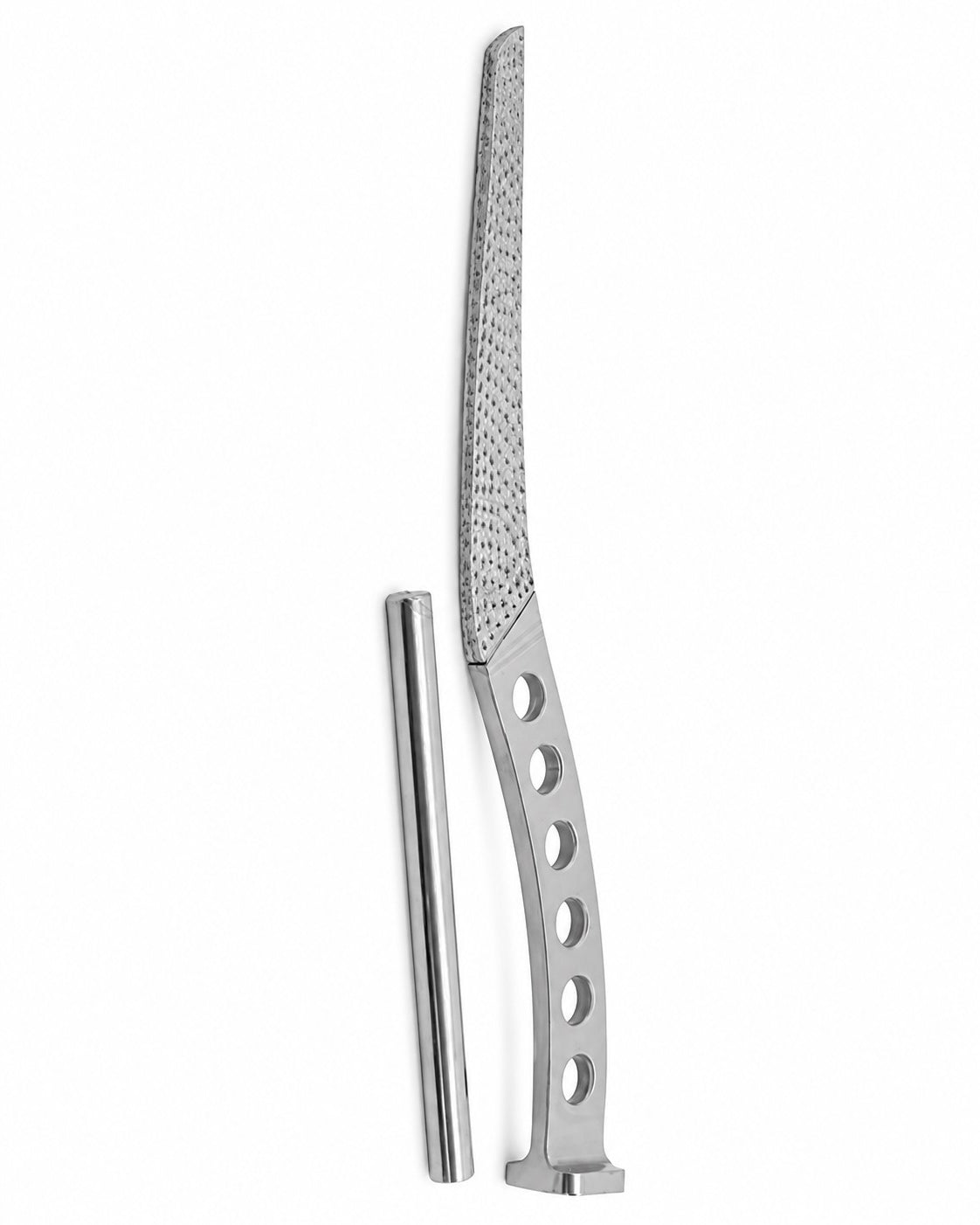
Rasp for Thompson, SKUs PS-OP-5573 and PS-OP-5574, is a reusable German stainless steel femoral broach designed for canal preparation before Thompson prosthesis implantation. The Standard Stem model PS-OP-5573 provides the regular broach profile, while Narrow Stem PS-OP-5574 addresses a constricted intramedullary canal compatible with the corresponding implant geometry. Longitudinal cutting teeth remove cancellous bone during sequential insertion and extraction, creating the intended pathway for femoral stem placement while providing tactile feedback regarding resistance, depth, and alignment. The instrument is used during hip hemiarthroplasty for displaced intracapsular femoral-neck fractures, selected nonunion or avascular necrosis reconstructions, and revision procedures involving a compatible Thompson stem. Following femoral-head removal and neck osteotomy, the surgeon opens the proximal canal, establishes the femoral axis, and advances the selected broach under controlled axial force. Orthopedic trauma surgeons, hip arthroplasty specialists, hospitals, fracture units, and ambulatory surgical facilities use the rasp as part of a system-matched femoral preparation sequence. Stem selection, broach profile, implant fixation method, canal morphology, and operative technique must correspond before definitive preparation begins.
The working body incorporates longitudinally arranged cutting teeth that engage cancellous bone during axial advancement through the proximal femoral canal. Tooth orientation permits progressive material removal while the surgeon alternates controlled impaction, withdrawal, and inspection. The rasp profile reproduces the preparation envelope required for its corresponding Thompson stem rather than creating a generic cylindrical cavity. Its tapered distal geometry follows the intramedullary axis, while the broader proximal region prepares space beneath the femoral neck osteotomy. The Standard and Narrow versions differ in body profile so the cutting envelope can correspond with regular or restricted canal anatomy. A proximal connection receives the compatible rasp handle or introducer, transferring insertion and extraction force along the instrument axis. The coupling must remain fully seated because an unstable connection can alter alignment or disengage during withdrawal. Tactile resistance provides intraoperative information regarding cancellous engagement, cortical proximity, and progression, but it does not replace visual alignment or preoperative templating. The surgeon maintains the planned anteversion and coronal orientation throughout broaching. Excessive force, unintended varus positioning, or advancing beyond the prepared pathway can damage bone or distort the canal.
Clinical use begins after exposure of the hip, femoral-head extraction, and neck resection at the planned level. The proximal femur is presented, and an opening instrument establishes access near the femoral canal axis. Rasp for Thompson is then connected to its system-compatible handle and introduced in the intended anteversion. Controlled blows advance the cutting profile while cancellous bone is removed from the metaphyseal and proximal diaphyseal pathway. The instrument is withdrawn periodically so the teeth can be cleared and the canal inspected for direction, depth, cortical integrity, and remaining bone. In hemiarthroplasty for a displaced femoral-neck fracture, preparation continues until the selected broach corresponds with the planned Thompson prosthesis and operative fixation technique. Trial or sizing assessment follows according to the implant system before opening or inserting the definitive component. The broach should not be used to force correction of an incorrectly placed canal entry point. If resistance becomes eccentric or increases abruptly, alignment and cortical proximity require reassessment. After preparation, the surgeon evaluates stem seating, version, neck level, limb length, offset, and hip stability through the subsequent trial and implantation stages.
Standard Stem model PS-OP-5573 provides the regular Thompson-pattern broaching envelope for a femoral canal that accepts the corresponding standard prosthesis. It is selected after radiographic templating and proximal canal assessment indicate adequate mediolateral and anteroposterior space for the planned stem. Narrow Stem PS-OP-5574 uses a reduced working profile for restricted intramedullary anatomy or a compatible narrow Thompson implant. The narrow option does not represent an earlier procedural stage that must always precede the regular version. Each instrument corresponds with a different definitive stem profile, so selection is based on implant planning rather than an assumption that both broaches form one sequential series. Preoperative evaluation includes canal width, proximal femoral morphology, neck resection level, bone quality, and the anticipated fixation method. Intraoperative assessment considers canal entry, cortical resistance, axial alignment, broach stability, and trial seating. A standard rasp should not be forced into a canal prepared for a narrow implant, while the reduced profile should not be used when it produces inadequate preparation for the selected prosthesis. Hospitals stocking both stem configurations should maintain clear tray labeling and separate component identification to prevent mismatch during surgery.
German stainless steel provides the hardness, corrosion resistance, and dimensional stability needed for a reusable bone-cutting instrument exposed to repeated impaction and sterilization. The cutting teeth require close inspection after each procedure because retained bone, rounded edges, bending, corrosion, or impact damage can affect preparation geometry. Cleaning should begin promptly after use so blood and osseous debris do not dry between the longitudinal teeth or within the handle connection. The rasp should be separated from its detachable handle where the validated design permits, then cleaned, rinsed, inspected, dried, packaged, and steam sterilized under the healthcare facility’s approved protocol and manufacturer instructions. Specific cycle parameters must follow the validated reprocessing documentation used by the institution. CE documentation concerns conformity with applicable European medical-device requirements, while ISO 13485 addresses the manufacturer’s quality management system. FDA procurement depends on the establishment, listing, labeling, importer, and market-access records applicable to the destination. Hospitals should maintain the SKU, variant, inspection history, repair status, and sterilization traceability. An instrument with damaged teeth, a distorted body, cracked metal, or an insecure coupling must be removed from the operative tray.
| SKU | PS-OP-5573 Standard Stem; PS-OP-5574 Narrow Stem |
|---|---|
| Product Name | Rasp for Thompson |
| Price | $66.99 USD |
| Size/Gauge Variants | Standard Stem and Narrow Stem profiles |
| Instrument Category | Orthopedic femoral canal preparation instrument |
| Procedure | Thompson hip hemiarthroplasty and system-compatible femoral reconstruction |
| Material | German stainless steel |
| Finish | Satin orthopedic finish with machined cutting teeth |
| Sterilization | Reusable instrument for validated hospital cleaning and steam sterilization |
| Instrument Classification | Reusable orthopedic bone rasp and femoral broach |
| Reusable | Yes |
| Certifications | CE and ISO 13485 documentation; FDA procurement documentation according to destination-market requirements |
| Warranty | 1 year |
| MOQ | 1 instrument |
| OEM / Custom Orders | Available for documented pattern, labeling, packaging, and quantity requirements |
| After-Sale Service | Order, replacement, documentation, return, and maintenance support |
How does a Thompson rasp differ from an Austin Moore rasp?
Rasp for Thompson reproduces the preparation profile required for a compatible Thompson femoral prosthesis. An Austin Moore rasp follows the stem geometry and canal envelope of an Austin Moore implant. Differences can involve proximal contour, stem width, taper, fenestration relationship, and intended seating depth. Similar overall appearance does not make the two patterns interchangeable. Using the wrong broach can produce a cavity that does not correspond with the definitive stem. The instrument must therefore match the implant manufacturer, stem pattern, size, and operative technique.
When should the Standard or Narrow Stem rasp be selected?
Rasp for Thompson is available in regular and reduced-profile configurations. Standard Stem PS-OP-5573 is used when templating and canal preparation correspond with the regular Thompson prosthesis. Narrow Stem PS-OP-5574 supports a restricted canal and its matching narrow implant. Selection considers femoral canal width, metaphyseal morphology, cortical proximity, bone quality, and planned fixation. The narrow version is not automatically used before the standard model as part of sequential broaching. The selected instrument must reproduce the geometry of the definitive stem intended for implantation.
What do CE, ISO 13485, and FDA references mean for procurement?
CE documentation concerns conformity with applicable European medical-device requirements. ISO 13485 addresses the quality management system used for medical-device manufacturing, documentation, and traceability. Neither term independently means that Rasp for Thompson has received FDA approval. United States procurement requires the applicable establishment, listing, labeling, importer, and market-access documentation. Hospitals should retain the supplier records together with the SKU, instrument pattern, and purchase history. These details support vendor qualification, inventory control, maintenance, and complaint handling.
How does the handle connection control the rasp during broaching?
The proximal coupling connects Rasp for Thompson to a compatible handle or introducer. Once fully seated, the connection transfers axial impaction and extraction force through the centerline of the broach. The surgeon uses the handle to maintain anteversion, coronal alignment, and rotational control during advancement. Tactile resistance helps identify changing cancellous engagement and possible cortical contact. The coupling should be checked before each insertion because looseness can impair directional control or cause disengagement during withdrawal. Worn, deformed, contaminated, or unstable connections must be removed from service.
How should the cutting teeth be cleaned and inspected?
Visible bone and biological residue should be removed before material dries within the rasp teeth. Rasp for Thompson should be detached from its handle where permitted and processed under the facility’s validated cleaning procedure. Each flute requires inspection for retained debris, rounding, chipping, bending, corrosion, and surface damage. The coupling and instrument body should also be examined for deformation or impact-related defects. After cleaning and drying, the instrument can be packaged and steam sterilized according to validated institutional and manufacturer instructions. A damaged or incompletely cleaned rasp should not be returned to the operative tray.


