
Featured Collection
Your cart
Featured Collection

PEAK SURGICALS
SKU:PS-OP-5360
Couldn't load pickup availability


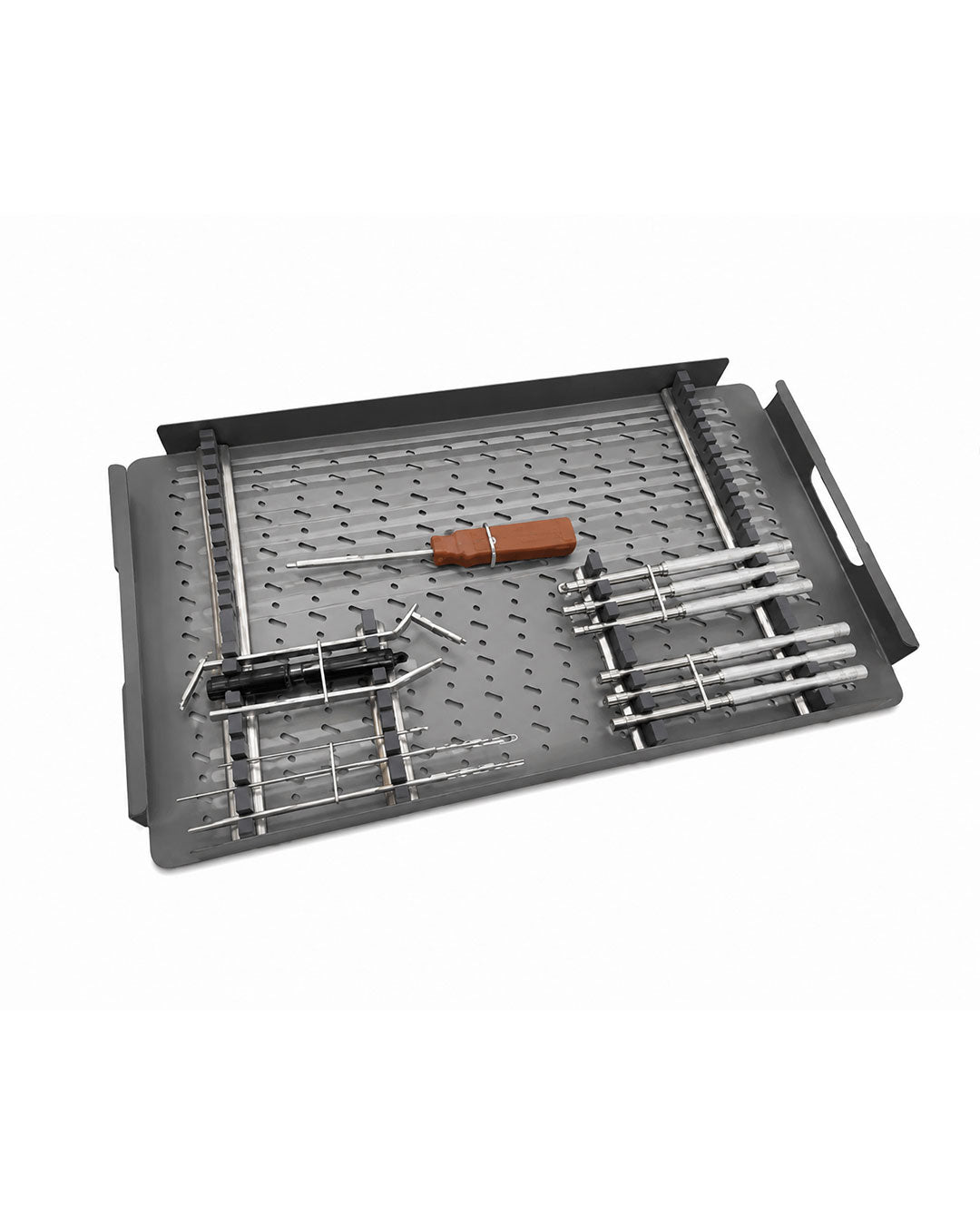
TENS Nails Instruments Set, SKU PS-OP-5360, is a 17-instrument German-forged stainless steel orthopedic system supplied with a container for elastic stable intramedullary nailing. The composition includes a straight impactor, bevelled impactor, nail inserter, extraction plier, standard awl, hammer guide, 4.5 mm × 120 mm pin wrench, small F reduction tool, 2.7 mm × 130 mm drill bit, 3.2 mm × 200 mm drill bit, 4.5 mm × 200 mm drill bit, 4.5/3.2 mm double drill guide, 500 g hammer, 400 g slide hammer, 180 mm curved awl for clavicular fractures, rod cutter accepting diameters through 6 mm, and flat-nosed pliers. Pediatric orthopedic and trauma surgeons use these components for Titanium Elastic Nail System and elastic stable intramedullary nailing procedures involving selected diaphyseal fractures of the femur, tibia, humerus, radius, and ulna, as well as elastic intramedullary fixation of clavicular fractures. The set supports fracture reduction, cortical entry preparation, nail introduction, advancement, rotational control, terminal trimming, end positioning, and implant extraction in pediatric trauma centers, general hospitals, ambulatory operating rooms, and specialist orthopedic units.
The inserter captures the elastic nail so the surgeon can control its axial progression and rotational orientation as the prebent implant advances within the medullary canal. The straight impactor transmits force along the nail axis when the exposed end remains accessible, whereas the bevelled impactor approaches the terminal segment at an offset and seats it closer to the cortical entry without directing the striking face against adjacent soft tissue. A 500 g hammer supplies deliberate insertion blows through the selected impactor. The hammer guide constrains the striking pathway and transfers force to the coupled implant-control assembly. For removal, the extraction plier clamps the protruding nail end through its pivoted jaws, and the 400 g slide hammer converts travel of the sliding mass into repeated axial extraction impulses. The 4.5 mm pin wrench provides leverage for controlled rotational adjustment when an instrument interface must be turned without losing alignment. Flat-nosed pliers grasp and contour the external nail segment, while the rod cutter shears material through 6 mm after depth and end position have been established. The small F reduction tool applies localized corrective leverage across a displaced fragment. Standard and curved awls create directed cortical access, and the double drill guide stabilizes the selected drill trajectory while shielding the approach from lateral skiving.
In pediatric femoral or tibial shaft fixation, closed reduction is obtained under fluoroscopy before paired entry sites are prepared away from the physis. The small F tool assists correction when translation or angulation persists, while the awl or guided drill establishes each cortical portal. The inserter then advances the prebent elastic nails across the fracture with alternating progression to maintain balanced three-point fixation. Straight impaction controls axial advancement through the canal; the bevelled pattern is used near final seating when the remaining external segment lies close to the cortex. For humeral diaphyseal fractures, the same sequence is adapted to the selected antegrade or retrograde approach with protection of the radial nerve and growth plate. Radius and ulna shaft procedures use narrower access and careful rotational control to cross each fracture without violating the distal or proximal physis. The 180 mm curved awl follows the clavicular contour during elastic intramedullary fixation of selected displaced midshaft clavicle fractures. Once length, alignment, rotation, and fluoroscopic position are accepted, the cutter shortens the nail and pliers direct the terminal segment. At implant removal after union, the extraction plier secures the exposed end and the slide hammer applies controlled axial withdrawal rather than uncontrolled levering against the cortex.
The 2.7 mm × 130 mm drill bit provides a short, narrow option for cortical access in smaller pediatric long bones such as the radius, ulna, or humerus. The 3.2 mm × 200 mm bit offers additional reach for intermediate entry preparation in the femur or tibia, while the 4.5 mm × 200 mm diameter creates a broader portal when required by the selected nail and patient anatomy. The 4.5/3.2 mm double guide centers either matching drill, limits surface migration, and helps preserve the planned entry angle. The standard awl provides direct manual opening for accessible long-bone cortices; the 180 mm curved pattern follows the clavicle’s S-shaped course where a straight instrument would not align with the intramedullary trajectory. The small F tool is selected for focused reduction leverage, and the 4.5 mm × 120 mm pin wrench supports rotational adjustment. Straight and bevelled impactors are chosen according to exposed nail-end orientation and proximity to the cortex. The 500 g hammer drives advancement, whereas the 400 g slide hammer produces reverse axial force during retrieval. Flat-nosed pliers control bending and terminal orientation, the extraction plier secures the nail for removal, and the 6 mm-capacity cutter accommodates the supplied system’s trimming workflow. The container maintains code-based separation for setup, reconciliation, and reprocessing.
German-forged stainless steel gives the awls, drills, impactors, pliers, guides, and cutting surfaces the hardness and torsional strength required for repeated manual orthopedic use. Its corrosion resistance supports validated cycles of point-of-use soil removal, cleaning, rinsing, drying, inspection, packaging, and steam sterilization. A satin finish reduces reflected operating-light glare and helps sterile-processing personnel identify retained soil, corrosion, bent shafts, blunted awl points, damaged drill flutes, and deformed gripping surfaces. Hinged pliers and the rod cutter are opened during cleaning so detergent and rinse water reach the pivot and working faces. Detachable interfaces, guide channels, and the slide-hammer assembly require flushing and direct visual inspection before the set is reassembled. The instruments are supplied non-sterile and are reprocessed before initial use and after each procedure under the healthcare facility’s validated reusable-instrument protocol. Components are arranged in the container without contact that could blunt points or cutting geometry, then counted against the PS-149 composition record. CE documentation supports applicable European conformity assessment, while ISO 13485 identifies manufacture within a medical-device quality management system. United States procurement teams assess FDA device classification, registration, listing, labeling, and importer documentation separately because CE marking and ISO certification are not FDA approval.
| Code | PS-149 Instruments Set for TENS Nails | Units |
|---|---|---|
| PS-149.001 | Impactor for TENS Nail, Straight | 1 |
| PS-149.003 | Impactor for TENS Nail, Bevelled | 1 |
| PS-149.005 | Inserter for TENS Nail | 1 |
| PS-149.007 | Extraction Plier for TENS Nail | 1 |
| PS-149.009 | Awl for TENS Nail | 1 |
| PS-149.011 | Hammer Guide for TENS Nail | 1 |
| PS-149.013 | Pin Wrench, 4.5 mm Diameter, 120 mm Length | 1 |
| PS-149.015 | F Tool for Reduction, Small | 1 |
| 261.627 | Drill Bit, 2.7 mm Diameter, 130 mm Total Length | 1 |
| 261.633 | Drill Bit, 3.2 mm Diameter, 200 mm Total Length | 1 |
| 261.646 | Drill Bit, 4.5 mm Diameter, 200 mm Total Length | 1 |
| PS-149.023 | Double Drill Guide, 4.5/3.2 mm | 1 |
| PS-149.025 | Hammer, 500 g | 1 |
| PS-149.027 | Slide Hammer, 400 g | 1 |
| PS-149.029 | Curved Awl, 180 mm, for Clavicular Fractures | 1 |
| PS-149.031 | Rod Cutter, Capacity up to 6 mm | 1 |
| PS-149.033 | Flat-Nosed Pliers | 1 |
| PS-149.035 | Empty Container | 1 |
| Specification | Details |
|---|---|
| SKU | PS-OP-5360 |
| Product Name | TENS Nails Instruments Set |
| Price | $936.09 USD |
| Size/Gauge Variants | Drill bits: 2.7 × 130 mm, 3.2 × 200 mm, and 4.5 × 200 mm; double drill guide: 4.5/3.2 mm; curved awl: 180 mm; rod cutter capacity: up to 6 mm |
| Instrument Category | Pediatric orthopedic intramedullary fixation instrumentation |
| Procedure | Titanium Elastic Nail System and elastic stable intramedullary nailing for selected pediatric long-bone and clavicular fractures |
| Material | German-forged stainless steel |
| Finish | Satin, low-reflection finish |
| Sterilization | Supplied non-sterile; clean and steam sterilize under the healthcare facility’s validated reusable-instrument protocol |
| Instrument Classification | Reusable manual orthopedic surgical instrument set |
| Reusable | Yes |
| Certifications | CE & ISO 13485; FDA-compliant procurement documentation |
| Warranty | 1-year warranty against manufacturing defects |
| MOQ | 1 set |
| OEM / Custom Orders | Available for instrument marking, set configuration, packaging, and distributor orders |
| After-Sale Service | Technical support, replacement coordination, and warranty assistance |
How does this set differ from a rigid intramedullary nail instrument set?
The TENS Nails Instruments Set is configured for flexible elastic nails used in pediatric and selected clavicular fixation. A rigid locked intramedullary nail instrument set typically includes canal reamers, targeting arms, locking sleeves, depth gauges, and interlocking screw instruments. This system instead emphasizes small cortical entry preparation, prebent nail control, paired advancement, end trimming, and later extraction. Its straight and bevelled impactors address flexible nail ends rather than a rigid nail-driving interface. The small F reduction tool and compact drill options suit narrower pediatric canals and minimally invasive entry sites. The two systems are not interchangeable because their implant geometry, locking method, access pathway, and extraction mechanisms are different.
How are the 2.7, 3.2, and 4.5 mm drill bits selected?
Drill selection follows cortical thickness, entry-site anatomy, planned nail diameter, patient size, and the operative technique. The 2.7 mm × 130 mm bit provides narrow access for smaller pediatric radius, ulna, or humeral procedures. The 3.2 mm × 200 mm option offers greater reach for intermediate femoral or tibial entry preparation. The 4.5 mm × 200 mm bit creates a broader portal for larger adolescent long bones or when required by the selected elastic nail construct. The 4.5/3.2 mm double guide keeps either matching drill centered and aligned away from the physis. Within the TENS Nails Instruments Set, final selection remains linked to the planned entry trajectory and the implant system’s operative technique.
What do CE, ISO 13485, and FDA requirements mean for procurement?
CE documentation addresses applicable European medical-device conformity requirements for the TENS Nails Instruments Set. ISO 13485 identifies the quality management system used for medical-device manufacturing, traceability, controlled records, and corrective action. Neither designation represents United States FDA approval. US hospitals and distributors review the relevant device classification, establishment registration, listing, labeling, importer, and shipment documentation. Procurement files should retain the quotation, SKU, supplied instructions, lot or batch identification, and applicable conformity records. This separation enables accurate credentialing across European, US, Pakistani, Vietnamese, and international purchasing pathways.
How are the hammer guide, slide hammer, and hinged controls used?
The hammer guide directs axial striking force toward the nail-control assembly during advancement. The 500 g hammer delivers measured blows through the impactor while the inserter maintains rotational orientation. During extraction, the pivoted plier jaws clamp the accessible nail end and preserve the pulling axis. The 400 g slide hammer travels along its guide and stops against the terminal shoulder, converting each stroke into a controlled reverse impulse. Flat-nosed pliers adjust the external segment, and the pin wrench supplies rotational leverage where the coupled interface permits it. These controls allow the TENS Nails Instruments Set to progress from insertion and seating to terminal positioning and later removal without substituting uncontrolled levering.
How should hospitals reprocess and manage the complete set?
The TENS Nails Instruments Set is supplied non-sterile and requires reprocessing before first use and after every procedure. Staff separate detachable parts, open hinged instruments, and remove gross soil before residue dries in pivots, guide channels, drill flutes, or gripping surfaces. Cleaning is followed by rinsing, complete drying, and inspection of each point, shaft, cutting face, coupling, and sliding mechanism. All 17 instruments and the container are reconciled against the composition table before packaging. The organized case is then processed under the facility’s validated steam-sterilization cycle for reusable stainless steel instrumentation. Operating-room supply teams and distributors can use the individual PS-149 and 261-series codes for set control, service requests, and component replenishment.


