
Featured Collection
Your cart
Featured Collection

PEAK SURGICALS
SKU:PS-OP-001
Couldn't load pickup availability
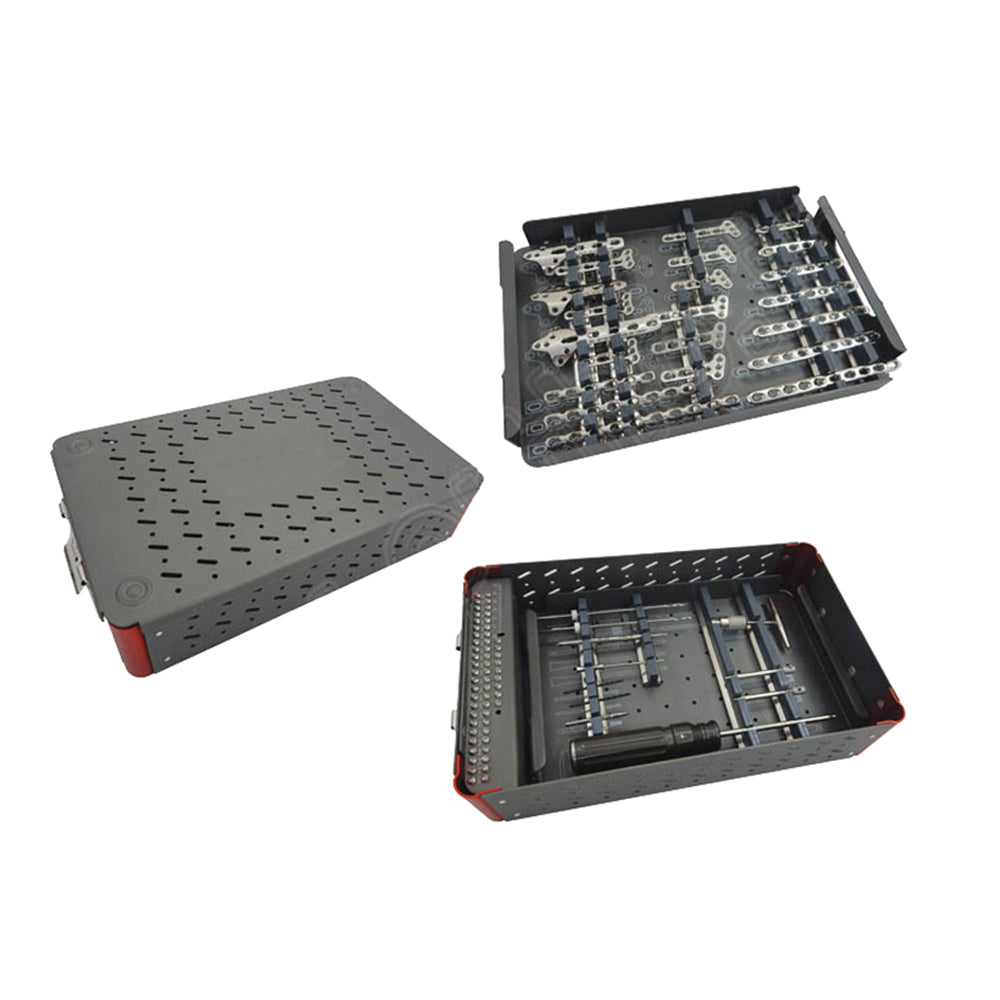
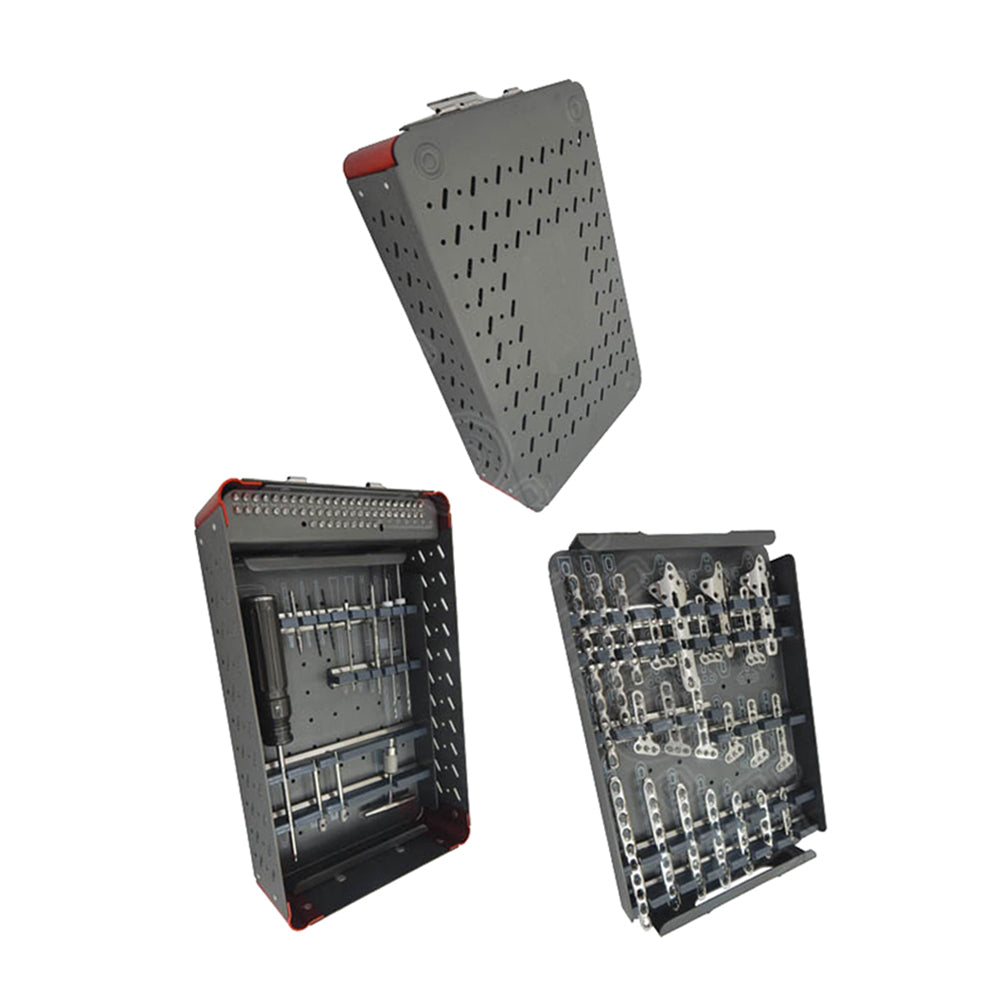
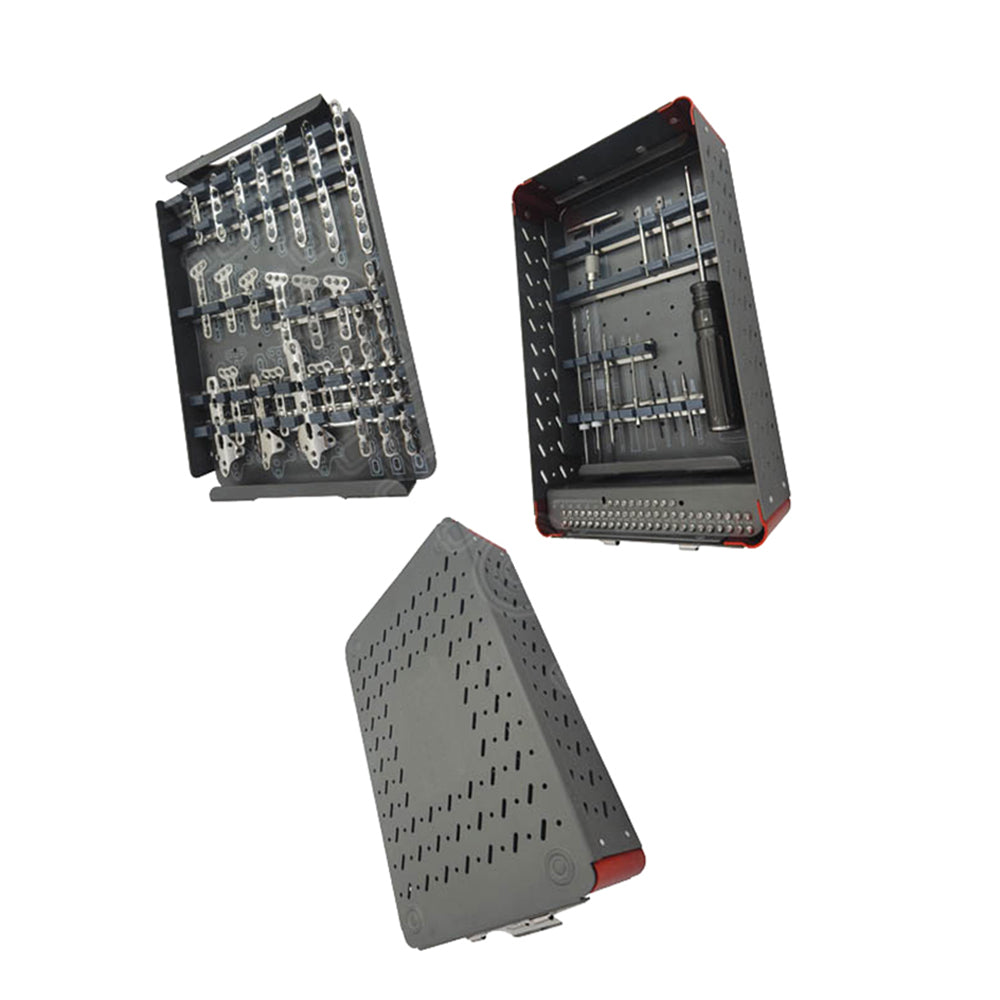
The Small Fragment Safety Lock Plates & Screws Set from Peak Surgicals is a comprehensive stainless steel small fragment locking plate and screw implant system covering four plate designs — LC-DCP, oblique-angled T-Plate (left and right), Reconstruction Straight, and Cloverleaf — together with 57 Safety Lock Screws Ø3.5mm across lengths from 10mm to 60mm, and a dedicated instrument set including a Quick Coupling T-Handle, calibrated drill bits, drill sleeves, a torque-limiting screwdriver, an extraction screw for stripped or broken screws, and a centering sleeve for Kirschner wire use. It is used by orthopedic and trauma surgeons in hospital operating theatres performing open reduction and internal fixation (ORIF) of small fragment fractures of the forearm, clavicle, fibula, hand, and foot, as well as periarticular fractures of the wrist, ankle, and elbow requiring locking plate fixation.
The screw inventory covers the complete length range required for small fragment locking fixation across all anatomical sites served by 3.5mm locking plates. Lengths 10–24mm (PS-102.210 to .224, 2 each × 8 lengths = 16 screws) address the thin cortical bone of the distal radius, distal ulna, fibula, and metacarpal/metatarsal diaphyses. Lengths 26–42mm (PS-102.226 to .242, 3 each × 9 lengths = 27 screws) cover the intermediate range used in forearm, clavicle, and periarticular screw trajectories where longer purchase across medullary bone or the opposite cortex is required. Lengths 44–60mm (PS-102.244 to .260, 2 each × 7 lengths = 14 screws) provide extended reach for thick cortical segments or bridge plating configurations where the screw must span a gap or comminuted zone to reach intact bone. All screws are stainless steel, self-tapping, and threaded to the Safety Lock Plate locking hole geometry — the screw threads lock into the plate hole threads when fully tightened, creating a fixed-angle construct that resists axial pullout and screw back-out independently of bone quality at the plate-bone interface.
The four plate designs address the distinct anatomical and biomechanical requirements of small fragment fixation across different fracture locations. The LC-DCP Safety Lock Plates 3.5 (PS-147.104 to .110, 4 to 10 holes, 1 each = 7 plates) are straight dynamic compression plates with limited contact geometry on the bone-facing surface, suited for diaphyseal fractures of the forearm, fibula, and clavicle where axial compression combined with locking fixation is desired. The Safety Lock T-Plates 3.5 Oblique-Angled in Left (PS-142.103L to .105L, 3/4/5 holes, 1 each = 3 plates) and Right (PS-142.103R to .105R, 3/4/5 holes, 1 each = 3 plates) configurations provide the angled head geometry needed for periarticular fixation at the distal radius, distal tibia, or metacarpal head, where a transverse plate head must be positioned at an angle to the shaft. The Reconstruction Safety Lock Plates 3.5 Straight (PS-144.106 to .110, 6/8/10 holes, 1 each = 3 plates) are contourable straight plates suited for complex periarticular fractures and bridge plating where plate bending and contouring to the bone surface is required. The Cloverleaf Safety Lock Plates 3.5 (PS-146.104 to .106, 4/5/6 holes, 1 each = 3 plates) have a three-armed distal cloverleaf head that provides multi-directional screw trajectories into the distal metaphysis, classically used at the distal radius or distal fibula.
The Quick Coupling Handle T-Type (306.010) provides the manual drive for the drill bits and screwdriver shaft using a quick-release coupling mechanism, allowing rapid interchange between drilling and screw insertion without tool changes. The Screwdriver Shaft QC End 2.5mm Tip (301.060) engages the 2.5mm hex recess of the Safety Lock Screws for insertion and tightening. The Drill Bits Ø2.8mm Calibrated 2-Flute for Quick Coupling (PS-432.001, ×2) prepare the pilot hole for the Ø3.5mm Safety Lock Screws — the 2.8mm drill diameter leaves sufficient bone wall for the screw threads to achieve cortical purchase when a self-tapping screw is inserted. The 2.8mm Drill Sleeves for 3.5mm Safety Lock Screws (PS-432.005, ×2) protect soft tissue during drilling and ensure the drill remains in the correct plate hole axis. The Torque Limiting Screwdriver 2.5mm Tip (PS-432.009) controls the final seating torque of the locking screw — locking screws that are over-torqued can strip the plate locking hole threads or fracture the screw head, and the torque-limiting mechanism prevents this by disengaging at the preset maximum torque. The HSS Drill Bits Ø2.5mm (PS-432.017, ×2) provide the smaller pilot hole diameter for cortex screw applications. The Extraction Screw Left-Hand Thread Conical for Screws Ø3.5mm (PS-432.021) addresses the situation where a locking screw becomes stripped or cannot be reversed using the standard screwdriver — the left-hand thread bites into the stripped screw recess and allows counter-clockwise removal. The Centering Sleeve for Kirschner Wire Ø1.2mm (PS-432.025) enables temporary Kirschner wire fixation through a plate hole to hold the plate in position before definitive screw fixation.
All plates and screws in the set are manufactured from surgical-grade stainless steel, providing the mechanical strength, corrosion resistance, and dimensional accuracy required for implanted orthopedic fixation devices. The Safety Lock design creates a fixed-angle construct between each screw and its plate hole — the screw's head threads engage the matching threads in the plate locking hole when tightened, locking the screw at a defined angle relative to the plate. This fixed-angle mechanism means the plate acts as an internal fixator rather than a compression device: the construct maintains fracture reduction through the plate-screw unit rather than relying on friction between the plate and bone, making it particularly effective in osteoporotic bone, comminuted fractures, and periarticular fractures close to the joint surface where standard non-locking screws have inadequate purchase.
The Small Fragment Safety Lock Plates & Screws Set is manufactured under CE Mark, ISO 13485, and FDA compliant quality standards. ISO 13485 certification confirms Peak Surgicals operates a documented quality management system covering design control, material traceability, and production consistency for orthopedic implants and surgical instruments. CE Mark confirms conformity with European medical device regulations, and FDA compliance supports procurement for US-based hospitals, surgical centers, and orthopedic departments requiring verified regulatory documentation for implant and instrument set purchases.
| SKU | — (verify in Shopify admin) |
|---|---|
| Product Name | Small Fragment Safety Lock Plates & Screws Set |
| Price | $1,705.00 USD |
| Instrument Category | Orthopedic — Small Fragment Locking Plate and Screw Implant System |
| Screw Diameter | Ø3.5mm Safety Lock, Self-Tapping, Stainless Steel |
| Screw Lengths 10–24mm | PS-102.210–.224, ×2 each, 8 lengths = 16 screws |
| Screw Lengths 26–42mm | PS-102.226–.242, ×3 each, 9 lengths = 27 screws |
| Screw Lengths 44–60mm | PS-102.244–.260, ×2 each, 7 lengths = 14 screws |
| Total Screws | 57 screws across 24 lengths (10–60mm) |
| LC-DCP Plates | PS-147.104–.110, 4/5/6/7/8/9/10 holes, ×1 each = 7 plates |
| T-Plates Oblique Left | PS-142.103L–.105L, 3/4/5 holes, ×1 each = 3 plates |
| T-Plates Oblique Right | PS-142.103R–.105R, 3/4/5 holes, ×1 each = 3 plates |
| Reconstruction Straight Plates | PS-144.106–.110, 6/8/10 holes, ×1 each = 3 plates |
| Cloverleaf Plates | PS-146.104–.106, 4/5/6 holes, ×1 each = 3 plates |
| Total Plates | 19 plates across 4 designs |
| Instruments | Quick Coupling Handle T-Type, Screwdriver Shaft 2.5mm QC, Drill Bits Ø2.8mm ×2, Drill Sleeves 2.8mm ×2, Torque Limiting Screwdriver 2.5mm, HSS Drill Bits Ø2.5mm ×2, Extraction Screw left-hand thread Ø3.5mm, Centering Sleeve K-wire Ø1.2mm |
| Container | Empty Container (906.001) |
| Material | Surgical-Grade Stainless Steel |
| Certifications | CE Mark, ISO 13485, FDA |
| Warranty | 1 Year |
| MOQ | 1 Set |
| OEM / Custom Orders | Available |
| After-Sale Service | Return and Replacement |
What fractures and anatomical locations is this small fragment locking plate set used for?
The 3.5mm Safety Lock Plates & Screws Set is used for ORIF of small fragment fractures across multiple anatomical sites. Common upper limb indications include diaphyseal and metaphyseal fractures of the radius and ulna (forearm fractures), distal radius fractures requiring straight or T-plate fixation, clavicle fractures, and metacarpal and phalangeal fractures where locking plate stability is required. Lower limb indications include fibula fractures from ankle injuries, metatarsal fractures, and selected calcaneal fractures. The plate type selection within the set — LC-DCP for diaphyseal, T-Plate for periarticular, Reconstruction for complex and bridge plating, Cloverleaf for distal metaphyseal — provides the orthopedic surgeon with the full range of plate geometries required for small fragment fixation across all these locations from a single implant set.
What is the difference between Safety Lock (locking) screws and standard cortex screws in small fragment fixation?
Standard cortex screws achieve fixation by generating friction between the plate and the bone surface as the screw is tightened — the screw compresses the plate against the bone, and the construct relies on that friction for stability. If bone quality is poor or the fracture is near a joint where the bone is thin and cancellous, standard screws may not generate enough purchase to maintain reduction. Safety Lock screws engage threaded holes in the plate head and lock at a fixed angle, creating a screw-plate interface that transmits load through the construct mechanically rather than through bone-plate friction. This fixed-angle locking mechanism maintains fixation even in osteoporotic bone, allows the plate to be used as a bridging construct in comminuted fractures without direct bone contact, and reduces the risk of screw back-out during healing in periarticular locations.
Why are four different plate designs included in this set?
Each plate design serves a different anatomical or biomechanical requirement. The LC-DCP is a straight plate suited for diaphyseal fractures where axial compression between fragments is desired. The T-Plate Oblique-Angled in Left and Right orientations is designed for periarticular metaphyseal fractures where the plate needs a transverse head angled relative to the shaft — the left/right versions accommodate the different orientations encountered on opposite sides or different limb segments. The Reconstruction Straight Plate has notches that allow it to be bent and contoured intraoperatively to complex bone surfaces, suited for irregular periarticular fractures and bridge plating. The Cloverleaf Plate has a three-armed head providing multiple screw trajectories into the distal metaphysis, suited for fractures at the distal radius or distal fibula where multidirectional subchondral fixation is needed.
What is the purpose of the Extraction Screw in this set?
The Extraction Screw (PS-432.021) has a left-hand (reverse) thread and a conical tip. It is used when a 3.5mm locking screw has become stripped — the 2.5mm hex recess in the screw head has been damaged and the standard screwdriver can no longer grip it for removal. The extraction screw is inserted into the stripped hex recess; its conical tip bites into the residual metal as counter-clockwise rotation is applied. Because the extraction screw's left-hand thread advances with counter-clockwise rotation, the same rotation that removes a standard right-hand screw simultaneously drives the extractor deeper into the stripped recess, increasing grip and allowing the stripped locking screw to be removed without requiring more destructive extraction techniques.
What certifications does this set carry?
The Small Fragment Safety Lock Plates & Screws Set is manufactured under CE Mark, ISO 13485, and FDA compliant quality standards. ISO 13485 certification confirms Peak Surgicals operates a documented quality management system covering design control, material traceability, and manufacturing consistency for orthopedic implants and instruments. CE Mark confirms conformity with European medical device regulations, and FDA compliance supports procurement for US hospitals, surgical centers, and orthopedic departments requiring verified regulatory documentation.
Can individual plates or screws be ordered as replacements?
Individual plates by reference number (PS-147, PS-142L, PS-142R, PS-144, PS-146 series) and individual screw lengths (PS-102 series, 10–60mm) are available from Peak Surgicals as replacement items. OEM manufacturing and custom set configurations are available for hospital procurement departments and orthopedic distributors requiring specific plate designs, extended screw length ranges, titanium material alternatives, or custom packaging. Contact Peak Surgicals directly for replacement implant pricing, OEM specifications, or institutional procurement arrangements.
