
Featured Collection
Your cart
Featured Collection

PEAK SURGICALS
SKU:
Couldn't load pickup availability


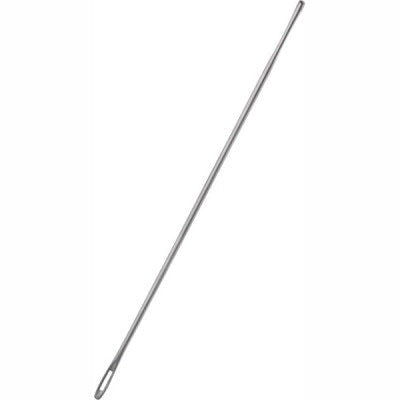
The clinical standard for atraumatic tissue exploration and guided procedural routing. The Probe with Eye is a versatile surgical instrument meticulously engineered for both veterinary and human medical applications. Characterized by its slender, malleable shaft and a distinctive bulbous tip, this tool acts as a mechanical necessity for clinicians who require the ability to safely explore fistulas, track sinus tracts, or guide suture material through narrow anatomical passages. Its design is specifically optimized to provide maximum tactile feedback while ensuring the safety of surrounding delicate structures.
The Surgical Probe with Eye represents a pinnacle of clinical ergonomics, designed to solve the problem of "blind exploration" in complex wounds or anatomical passages. In any surgical environment—from a veterinary trauma case to a general surgical suite—the ability to map the depth and direction of a tract without causing further trauma is a critical safety factor. This probe acts as a high-sensitivity extension of the surgeon’s touch, providing immediate feedback on tissue density and cavity boundaries.
At its core, the instrument is built for professional-grade durability. The seamless transition from the shaft to the bulbous tip is engineered to ensure there are no snag points, while the eyelet is deburred to prevent fraying of suture materials. This mechanical reliability is essential for maintaining workflow efficiency in hospitals, outpatient centers, and specialized veterinary practices.
Built to exceed the most rigorous hygiene standards of modern medicine, these probes are fully autoclavable and reusable. Their robust construction and specialized "guide" capability make them an indispensable asset for ensuring safe, organized, and effective surgical exploration.
Feature Details
Material Premium Surgical-Grade Stainless Steel
Tip Style Bulbous (Blunt) with Integrated Eyelet
Shaft Style Slim / Slightly Malleable
Maintenance Fully Autoclavable / Reusable
Finish Smooth High-Polish
Primary Use Cases:
Q: What is the primary purpose of the "Eye" on the probe?
A: The eyelet is used to thread suture material or narrow gauze. This allows the probe to act as a "needle" of sorts, pulling material through a tract after it has been explored, which is useful for placing drains or ligatures.
Q: Is this probe flexible or rigid?
A: These probes are generally made to be slightly malleable. While they are rigid enough for controlled probing, they can be gently bent to follow the specific path of a wound or anatomical curve.
Q: Can this be used for both human and veterinary medicine?
A: Yes. The Probe with Eye is a standard instrument in both fields, particularly valued in veterinary medicine for exploring complex puncture wounds.
Q: How do I clean the eyelet effectively?
A: It is recommended to use an enzymatic soak and a small interdental-style brush to ensure the inside of the eyelet is free of bioburden before placing it in an autoclave.
Q: Will the bulbous tip snag on tissues?
A: No, the tip is specifically designed and polished to be "atraumatic," meaning it should glide smoothly over and through tissue surfaces without catching.


