
Featured Collection
Your cart
Featured Collection

PEAK SURGICALS
SKU:
Couldn't load pickup availability
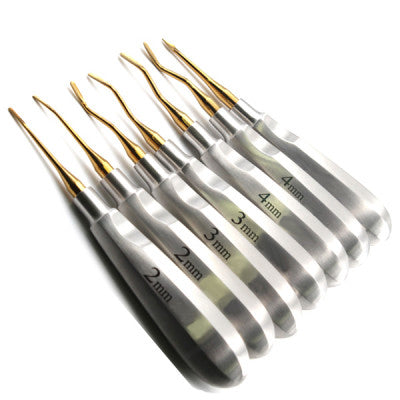
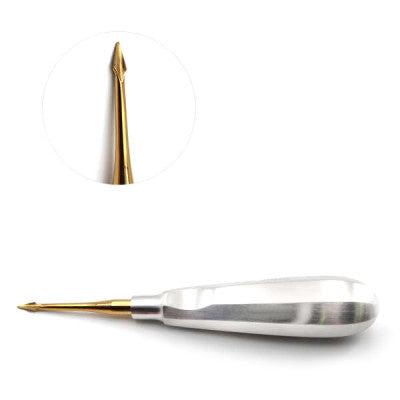
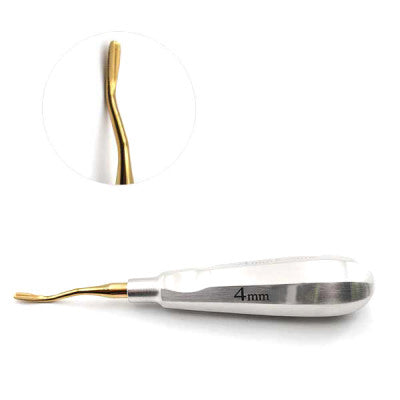
The Luxating Elevator Micro Serrated Standard Handle is a veterinary dental extraction instrument designed for controlled periodontal ligament separation and tooth luxation before extraction. Its narrow working tip is designed to enter the periodontal ligament space, while micro serrations provide additional surface engagement during controlled advancement around the tooth root.
The current Peak Surgicals range includes six tip configurations from 2 mm to 4 mm, including straight, curved, forward-angle, and backward-angle patterns. Each configuration is supplied with a standard handle, allowing veterinary dental professionals to select the working-end geometry according to tooth position, root access, and extraction technique.
The defining feature of this luxating elevator is its micro-serrated tip. The textured working surface is designed to provide controlled engagement while the blade is advanced into the periodontal ligament space during tooth luxation.
The serrated tip should be used with controlled apical movements rather than excessive levering force. Instrument selection and technique should be based on the tooth, root anatomy, access, and veterinary dental procedure being performed.
Luxating elevators are used to assist with periodontal ligament separation and progressive tooth loosening before forceps delivery. The narrow working end is introduced along the root surface and advanced within the periodontal ligament space according to the extraction technique.
Progressive luxation can help create controlled mobility before the tooth or root fragment is removed with the appropriate extraction instrument.
All currently listed variants use a standard handle. The handle provides the gripping surface through which the veterinary dental professional controls blade orientation, advancement, and rotational movement during luxation.
Correct hand positioning is particularly important when using narrow 2–4 mm tips because controlled movement helps maintain the working end within the intended tissue plane.
The range includes a straight 2 mm micro-serrated tip. Its narrow straight configuration provides direct access along the long axis of selected roots where a compact working tip is required.
This configuration should be selected according to root width, access, and the operator's extraction technique rather than treating all tip patterns as interchangeable.
A curved 2 mm micro-serrated version is also available. The curved profile provides an alternative approach to the root and periodontal ligament where straight-line access is less suitable.
The narrow 2 mm tip is particularly useful where a smaller working profile is required, while final selection should remain based on the tooth and root anatomy.
The current range includes forward-angle 3 mm and 4 mm micro-serrated tips. These angled configurations provide a different working orientation from straight and curved elevators and may assist access according to tooth position and operator approach.
The 3 mm and 4 mm widths provide two working-tip sizes for cases where a broader tip than the 2 mm configuration is preferred.
Peak Surgicals also lists backward-angle 3 mm and 4 mm micro-serrated variants. The reverse angle provides another approach direction for periodontal ligament access and controlled root luxation.
Forward- and backward-angle patterns should be selected according to the direction of access required within the oral cavity and the position of the tooth being treated.
Peak Surgicals lists this instrument within its Small Animal Dental Surgical Instruments and Luxation Elevators collections. It is therefore intended for veterinary dental settings where controlled tooth and root luxation forms part of the extraction procedure.
The instrument may be incorporated into veterinary dental extraction sets used in animal hospitals, specialist dental services, general veterinary practices, teaching facilities, and small-animal surgical environments.
The current Peak Surgicals product and collection information identify the instrument within the company's reusable medical-grade steel veterinary dental range. Following use, the instrument should be cleaned, inspected, and reprocessed according to applicable manufacturer instructions and the veterinary facility's validated procedures.
Particular attention should be given to the micro-serrated working tip. Before reuse, inspect the blade for retained debris, bending, surface damage, tip deterioration, or any condition that could affect controlled operation.
| Product Name | Luxating Elevator Micro Serrated Standard Handle |
| Instrument Type | Veterinary Dental Luxating Elevator |
| Handle Type | Standard Handle |
| Working Tip | Micro Serrated |
| Available Tip Widths | 2 mm, 3 mm and 4 mm |
| Available Tip Patterns | Straight, Curved, Forward Angle and Backward Angle |
| Primary Function | Periodontal Ligament Separation and Tooth / Root Luxation |
| Specialty | Veterinary Dentistry / Small Animal Dental Surgery |
| Backward Angle | 3 mm Micro Serrated Tip – Standard Handle |
| Backward Angle | 4 mm Micro Serrated Tip – Standard Handle |
| Curved | 2 mm Micro Serrated Tip – Standard Handle |
| Forward Angle | 3 mm Micro Serrated Tip – Standard Handle |
| Forward Angle | 4 mm Micro Serrated Tip – Standard Handle |
| Straight | 2 mm Micro Serrated Tip – Standard Handle |
The Luxating Elevator Micro Serrated Standard Handle is relevant for veterinary hospitals, small-animal dental clinics, veterinary oral surgery services, teaching facilities, instrument distributors, and procurement teams sourcing reusable dental extraction instruments.
For accurate ordering, buyers should specify both the required tip width and tip configuration. The current range includes 2 mm, 3 mm, and 4 mm micro-serrated working tips in straight, curved, forward-angle, and backward-angle patterns. Buyers requiring an exact overall length, confirmed SKU, steel alloy grade, or additional dimensional specifications should verify those details before ordering because they are not stated on the current accessible product page.
It is designed for controlled periodontal ligament separation and progressive tooth or root luxation before extraction in veterinary dentistry.
The current Peak Surgicals listing includes 2 mm, 3 mm, and 4 mm micro-serrated tips, depending on the selected configuration.
The six listed variants include straight, curved, forward-angle, and backward-angle working-tip designs.
The smallest currently listed width is 2 mm, available in both straight and curved configurations.
Yes. Peak Surgicals lists it within the Small Animal Dental Surgical Instruments and Luxation Elevators veterinary collections.
Yes. All six currently listed product variants are identified with a standard handle.
