
Featured Collection
Your cart
Featured Collection

PEAK SURGICALS
SKU:PS-VI-088
Couldn't load pickup availability


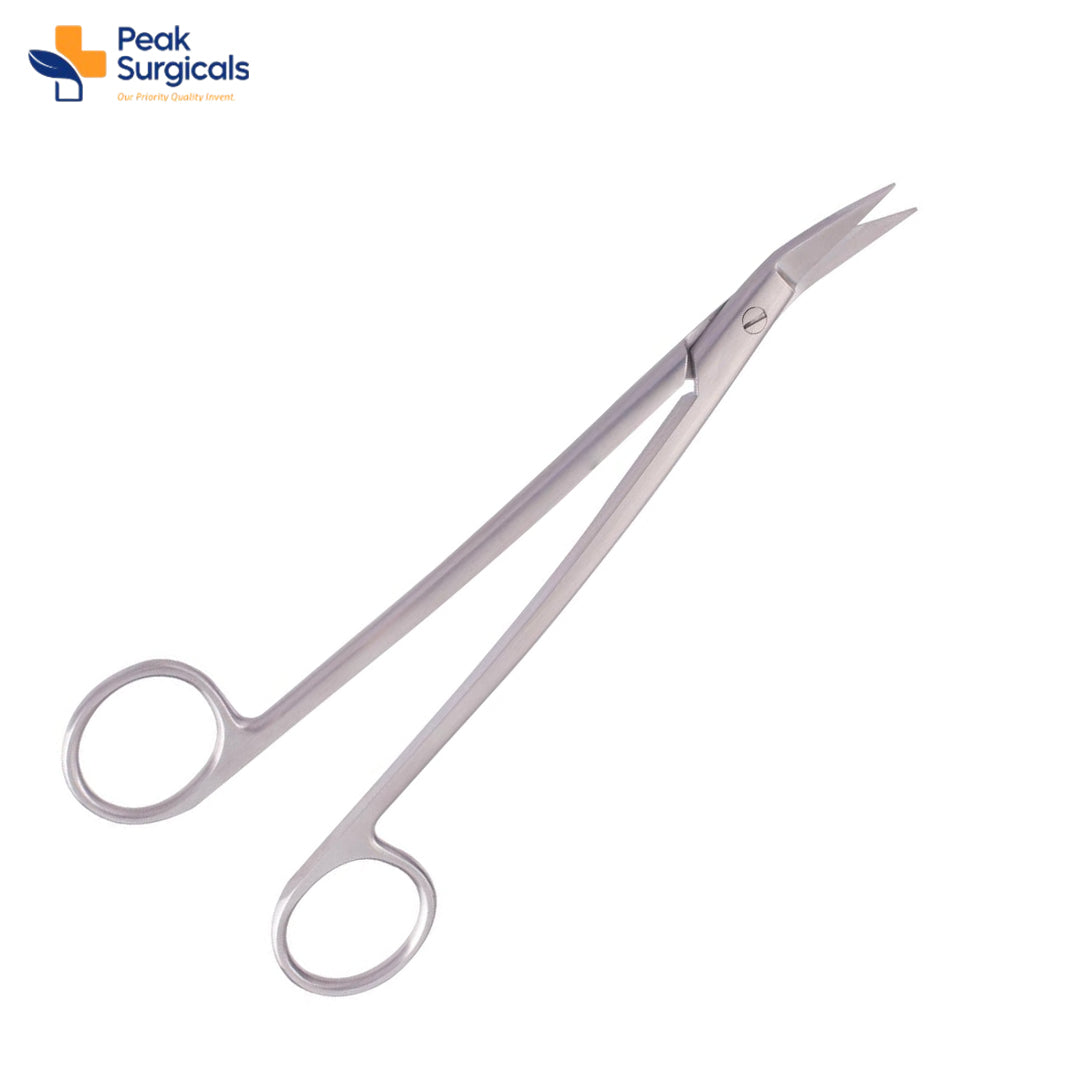
Locklin Gum Scissors (SKU: PS-VI-088) are German stainless steel dental scissors designed for gingival trimming, periodontal flap refinement, mucosal edge correction, interdental papilla shaping, and oral soft-tissue cutting during veterinary dental surgery and clinical dentistry. The available variants are Locklin Gum Scissors Curved Shanks One Serrated Blade 6 1/4 inch and Locklin Gum Scissors Straight Shanks One Serrated Blade 6 1/4 inch. The instrument has finger-ring handles, a box-lock pivot, slender shanks, pointed cutting blades, and one serrated blade that stabilizes mobile gingival tissue during precise closure-line preparation. It is used during gingivectomy, gingivoplasty, periodontal flap surgery, mucoperiosteal flap trimming, epulis excision, oral laceration repair, extraction socket margin refinement, frenectomy edge correction, and post-extraction mucosal contouring. Veterinary dentists, oral surgeons, general dentists, small animal practitioners, dental residents, teaching laboratories, and procurement teams use this pattern in dental operatories, oral surgery rooms, veterinary dental units, hospital dental departments, and minor procedure trays where controlled soft-tissue cutting is required around narrow oral access corridors.
The Locklin pattern works through a controlled scissor mechanism in which the finger rings guide thumb and ring-finger movement while the box-lock pivot converts handle closure into blade opposition. One blade has serrations that grip gingiva, mucosal flap edge, papilla, or fibrous oral tissue as the opposing sharp blade completes the cut. This prevents tissue from sliding forward during trimming, which is important when the margin is wet with saliva, blood, irrigation fluid, or local anesthetic solution. The pointed blade geometry allows entry into interdental spaces, sulcular edges, gingival collars, and narrow flap corners without excessive tissue capture. Slender shanks keep the surgeon’s fingers away from the immediate working site, improving visibility around premolars, molars, canine teeth, and extraction sockets. Curved shanks let the cutting line follow posterior mucosal contours, while straight shanks provide direct alignment for accessible anterior and premolar tissue. The 6 1/4 inch length gives reach without sacrificing fingertip control during short, deliberate cutting strokes.
Clinical use begins after examination, radiography, anesthesia, periodontal probing, flap planning, or extraction site preparation. During gingivectomy, the serrated blade stabilizes excess gingival tissue while the sharp opposing blade trims the marked margin to create a clean contour. During gingivoplasty, the pointed tips refine papilla shape, scalloped margins, and interdental tissue after initial tissue removal. In periodontal flap surgery, the scissors adjust mucoperiosteal flap edges before repositioning and suturing, especially after debridement or root-surface access. During extraction socket closure, the instrument trims ragged mucosal edges so the flap approximates without overlapping tissue or bulky corners. In veterinary dental surgery, it is used around canine and feline premolars, molars, mandibular incisors, oral masses, epulis margins, and traumatic laceration edges. Curved shanks are selected for posterior access and rounded flap paths. Straight shanks are selected for anterior access, direct gingival margin trimming, and linear mucosal cuts. This workflow supports controlled tissue preparation before needle holder use and final suture placement.
The 6 1/4 inch curved shank variant is selected when the surgeon needs the blades to follow the dental arch or approach tissue from an oblique angle. It is useful around caudal premolars, molars, distal flap margins, posterior gingival folds, and extraction sites where the cheek or adjacent teeth restrict a straight instrument path. The curvature keeps the handle away from the occlusal field while the cutting edge remains aligned with mucosa or gingiva. The 6 1/4 inch straight shank variant is selected for anterior gingival margins, accessible premolar sites, linear flap adjustment, incisional edge trimming, and direct tissue cutting where blade alignment follows the operator’s hand path. Both versions use one serrated blade for tissue stabilization and one sharp blade for clean division. The same 6 1/4 inch length maintains reach across the oral cavity while preserving ring-handle control. Keeping both patterns in the tray allows the clinician to move from direct anterior trimming to posterior curved access without changing cutting style.
German stainless steel construction gives the scissors rigidity at the shanks, consistent pivot alignment, and corrosion resistance through repeated clinical reprocessing. The satin and mirror-finished surfaces support visibility and cleaning, reducing glare around the handle while allowing blood, saliva, tissue residue, and debris to be removed from exposed metal areas before packaging. The reusable Class I profile fits manually operated dental scissors used for nonpowered oral soft-tissue cutting. Autoclave compatibility supports return to periodontal, extraction, oral surgery, and veterinary dental trays after decontamination, inspection, wrapping, sterilization, drying, and storage. The ring handles support repeated cutting strokes during flap preparation and gingival contouring. CE marking, ISO 13485 certification, and FDA compliance support procurement documentation for dental clinics, veterinary hospitals, distributors, and institutional buyers. The one-year warranty, return and replacement service, OEM availability, carton-box packing, rust-free specification, and one-piece MOQ support individual replacement, tray standardization, and distributor supply for dental scissors used in clinical and teaching environments.
| SKU | PS-VI-088 |
|---|---|
| Product Name | Locklin Gum Scissors |
| Price | $10.59 |
| Size/Gauge Variants | 6 1/4 inch Curved Shanks One Serrated Blade, 6 1/4 inch Straight Shanks One Serrated Blade |
| Instrument Category | Dental gum scissors |
| Procedure | Gingivectomy, gingivoplasty, periodontal flap refinement, mucoperiosteal flap trimming, oral laceration repair, extraction socket margin correction, epulis excision, frenectomy edge refinement |
| Material | German stainless steel |
| Finish | Satin and mirror polished stainless steel surfaces |
| Sterilization | Reusable and autoclavable after standard instrument cleaning |
| Instrument Classification | Class I reusable dental hand instrument |
| Reusable | Yes |
| Certifications | CE marked, ISO 13485 certified, FDA compliant |
| Warranty | 1 year |
| MOQ | 1 piece |
| OEM / Custom Orders | Available |
| After-Sale Service | Return and replacement support |
How do Locklin Gum Scissors compare with Goldman-Fox Gum Scissors?
Locklin Gum Scissors are selected for controlled gingival trimming where longer shanks and a 6 1/4 inch working length improve access across anterior and posterior oral fields. Goldman-Fox Gum Scissors are also used for gingival contouring, but their commonly recognized pattern has shorter, broader triangular cutting blades for direct periodontal tissue trimming. The Locklin design gives a slender access profile and one serrated blade that stabilizes wet gingiva during cutting. This makes it useful when refining mucosal flap edges, papilla margins, and posterior gingival contours. The curved Locklin variant improves reach around caudal teeth and rounded flap paths. Goldman-Fox scissors remain useful for gingivectomy work, but Locklin Gum Scissors provide stronger reach control when access depth and shank alignment are central to the procedure.
When should the curved or straight 6 1/4 inch variant be selected?
Locklin Gum Scissors in the curved shank pattern are selected for posterior premolar and molar access, distal flap trimming, rounded mucosal contours, and caudal oral sites where the handle must clear the cheek and adjacent teeth. The curved pattern lets the blade follow the dental arch while maintaining visibility at the cutting line. The straight shank version is selected for anterior gingival margins, accessible premolar tissue, linear mucosal trimming, and direct flap edge correction. Both variants have one serrated blade to hold tissue during the cut. Both share the same 6 1/4 inch length, so tray reach remains consistent while access angle changes. Selection follows tissue location, cutting path, visibility, and whether the surgeon needs direct or curved blade alignment.
How do CE, ISO 13485, and FDA compliance support procurement?
Locklin Gum Scissors support procurement programs that require documented sourcing for reusable dental and veterinary surgical instruments. CE marking supports international conformity records for regulated purchasing environments. ISO 13485 certification supports manufacturing control, traceability, inspection consistency, and quality-system documentation. FDA compliance language supports USA-facing procurement files where device sourcing and supplier records are reviewed. These credentials help clinics, hospitals, distributors, and institutional buyers standardize dental scissors across multiple operators and tray systems. The one-year warranty, OEM availability, MOQ of one piece, and return and replacement service support repeat purchasing and distributor planning.
How are the serrated blade, pivot, and ring handles used intraoperatively?
The surgeon places the tissue margin between the blades and closes the ring handles with controlled thumb and ring-finger movement. The serrated blade grips gingiva, mucosa, or flap edge so the tissue does not slide forward as the sharp blade completes the cut. The pivot keeps blade alignment stable during short trimming strokes around papillae, gingival margins, and flap corners. Curved shanks are rotated slightly to follow posterior contours, while straight shanks are aligned directly with the intended cut. The finger rings allow small opening and closing movements rather than wide hand motion in the oral cavity. On Locklin Gum Scissors, this control sequence supports clean soft-tissue trimming before irrigation, inspection, and suturing.
What role do these scissors serve in a dental or veterinary oral surgery tray?
Locklin Gum Scissors serve as oral soft-tissue cutting instruments in periodontal, extraction, restorative, and minor oral surgery trays. They are placed with dental elevators, luxators, extraction forceps, curettes, periodontal probes, mirrors, suction tips, scalpel handles, tissue forceps, and needle holders. During periodontal surgery, they refine gingival margins and flap edges after exposure and debridement. During extraction closure, they trim uneven mucosa before flap approximation and suture placement. During veterinary dental surgery, they support controlled trimming around feline and canine oral tissues where access is narrow. Reusable German stainless steel construction supports repeated tray cycling in clinics, hospitals, teaching laboratories, and distributor supply programs.


