
Featured Collection
Your cart
Featured Collection

PEAK SURGICALS
SKU:PS-000029
Couldn't load pickup availability


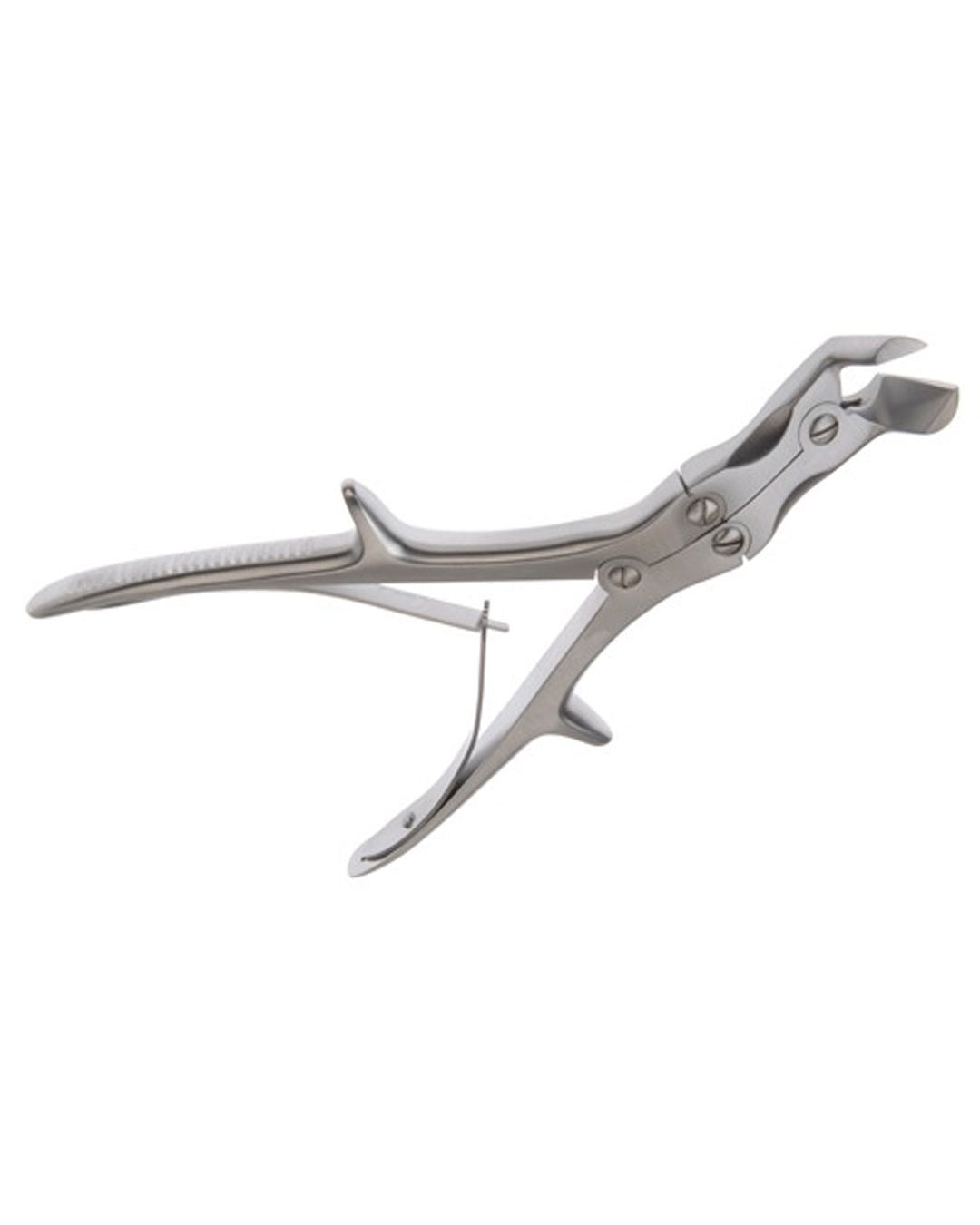
Liston-Key Bone Cutting Forceps, SKU PS-000029, are reusable orthopedic bone cutters designed for controlled division, trimming, and removal of exposed bone during reconstructive and trauma procedures. The instrument measures 250 mm overall and follows the characteristic Liston-Key S-shaped pattern, providing an offset working relationship between the cutting jaws and proximal handles. Established 250 mm Liston-Key configurations use double-action or compound-action leverage to multiply force generated at the handles before transferring it to the distal cutting edges. This mechanical advantage supports controlled cutting of cortical and cancellous bone while reducing the amount of direct hand force required compared with simple single-action cutters. The S-shaped geometry helps maintain access when surrounding anatomy, retractors, implants, or operative depth make straight-line bone cutting difficult. Liston-Key Bone Cutting Forceps are used during orthopedic fracture surgery, osteotomy, bone contouring, removal of accessible osseous projections, reconstructive procedures, and selected spine or neurosurgical bone work. Peak Surgicals lists PS-000029 as reusable, latex-free, and manufactured from medical-grade steel.
The defining mechanical features of the Liston-Key pattern are its S-shaped working profile and compound-action cutting mechanism. Handle closure is transferred through an additional linkage before reaching the cutting jaws, increasing mechanical advantage and generating greater distal cutting force than a simple single-pivot instrument. This allows the surgeon to perform controlled bone division with measured handle movement rather than relying entirely on grip strength. The S-shaped profile offsets the distal cutting end from the main handle axis, helping the operator approach exposed bone while keeping the hands away from the immediate cutting site. Sharp opposed cutting edges capture the selected osseous segment as the jaws are closed and should be positioned completely around the intended area before substantial compression is applied. The compound mechanism improves force efficiency but does not determine cutting depth automatically. Progress remains controlled through jaw placement, handle closure, tactile resistance, visualization, and repeated reassessment. Bone should generally be removed incrementally rather than by attempting to capture an excessively thick section in one closure, particularly where protected soft tissue or fixation hardware lies nearby.
During orthopedic fracture surgery, the Liston-Key Bone Cutting Forceps can be introduced after adequate exposure has provided direct visualization of the bone requiring modification. The surgeon positions the cutting jaws around an accessible projection, irregular fragment, cortical margin, or other section selected for removal and gradually closes the handles to activate the compound-action mechanism. The S-shaped configuration can be advantageous when a straight forceps would place the handles directly over the surgical target or interfere with retractors and fixation instruments. During reconstructive surgery, the instrument can assist bone contouring before plate positioning, graft placement, corrective osteotomy, or definitive fixation. Selected spine and neurosurgical procedures may also require manually controlled bone cutting where the Liston-Key geometry provides suitable access. The surgeon should confirm the intended cutting margins before each closure and protect adjacent nerves, vessels, dura, tendons, periosteum, and other soft tissues from the jaw pathway. After each cut, the remaining bone contour and operative objective should be reassessed before the forceps are repositioned for additional resection.
Peak Surgicals SKU PS-000029 identifies the Liston-Key Bone Cutting Forceps with an exact overall length of 250 mm and an S-shaped configuration. The 250 mm measurement equals approximately 9.8 inches and matches established Liston-Key-Horsley instruments manufactured specifically with offset jaws and compound or double-action leverage. Other Liston-Key patterns are available internationally around 255 to 270 mm, so those dimensions should not be substituted for the exact Peak listing. The 250 mm model provides useful working reach while remaining shorter than many heavy Stille-Liston bone cutters. Its S-shaped geometry is selected when the operative approach benefits from an offset relationship between the handles and bone-cutting site. A straight Liston cutter may be preferable where direct axial access is available, while a larger Stille-Liston configuration can provide greater leverage for heavier bone. PS-000029 should therefore be selected according to bone density, operative depth, required cutting force, surrounding instrumentation, and desired jaw approach. Hospitals should retain the SKU, 250 mm length, and S-shaped designation in procurement and orthopedic tray records.
Medical-grade steel provides the rigidity, cutting-edge stability, corrosion resistance, and mechanical strength required for reusable bone-cutting forceps subjected to repeated compound-action loading. Peak Surgicals identifies PS-000029 as reusable and latex-free. Reprocessing should begin promptly after surgery so blood, marrow, bone fragments, and tissue residue do not dry within the cutting jaws, compound-action joints, handle interfaces, or surface transitions. The instrument should remain sufficiently open during cleaning to permit access to the cutting edges and articulated components. Cleaning should be followed by thorough rinsing and complete drying before visual and functional inspection. Sterile-processing personnel should assess blade alignment, cutting-edge integrity, joint movement, cracks, corrosion, deformation, or excessive mechanical looseness. The compound linkage should operate smoothly without binding and moving interfaces should receive instrument-compatible maintenance when required by the validated facility protocol. Terminal sterilization should follow applicable reusable-instrument instructions and the healthcare facility's validated process. Peak Surgicals displays CE, FDA, and ISO-related information; ISO 13485 and other regulatory documentation should be retained through appropriate supplier qualification rather than interpreted as unsupported individual FDA approval.
| SKU | PS-000029 |
|---|---|
| Product Name | Liston-Key Bone Cutting Forceps |
| Price | $65.99 USD |
| Size/Gauge Variants | 250 mm overall length, approximately 9.8 in |
| Jaw Configuration | S-Shaped Bone Cutting Pattern |
| Mechanism | Compound / Double-Action Leverage |
| Instrument Category | Orthopedic Bone Cutting Forceps |
| Procedure | Fracture surgery, osteotomy, orthopedic bone resection, bone contouring, osseous fragment removal, reconstructive surgery, and selected spine bone work |
| Material | Medical-Grade Surgical Steel |
| Finish | Surgical Instrument Finish |
| Sterilization | Reusable; process according to validated healthcare-facility cleaning and sterilization protocols |
| Instrument Classification | Reusable Manual Orthopedic Bone Cutting Forceps |
| Reusable | Yes |
| Latex-Free | Yes |
| Certifications | CE and ISO 13485 procurement documentation; FDA-related records subject to exact manufacturer/device identification |
| Warranty | 30-Day Money-Back Guarantee on eligible purchases |
| MOQ | 1 Piece for standard online ordering |
| OEM / Custom Orders | Available for institutional, distributor, and custom procurement requirements |
| After-Sale Service | Return and replacement support under Peak Surgicals policy |
How do Liston-Key Bone Cutting Forceps differ from Stille-Liston Bone Cutting Forceps?
Liston-Key Bone Cutting Forceps use a characteristic S-shaped working profile with compound-action leverage for controlled bone cutting. Stille-Liston patterns are commonly larger and are available with straight or curved jaws for heavier orthopedic bone work. The S-shaped Liston-Key configuration offsets the cutting end from the handle axis and can improve access when surrounding anatomy limits a direct approach. Both designs use mechanical leverage to increase cutting force at the jaws. A Stille-Liston cutter may be preferable for larger or denser bone requiring greater overall cutting capacity. Selection should therefore reflect bone size, operative depth, required leverage, jaw approach, and available working clearance.
Why select the 250 mm S-shaped Liston-Key configuration?
The 250 mm length provides substantial working reach while remaining compact enough for controlled orthopedic handling. Its S-shaped profile allows the handles to remain offset from the bone-cutting site and can preserve space around retractors, plates, or other instruments. Exact 250 mm Liston-Key-Horsley patterns are also commercially documented with double-action leverage, supporting this configuration as an established surgical design. Longer 260 to 270 mm patterns provide additional reach but should not automatically be substituted for PS-000029. A straight cutter may be preferable when the target can be approached directly along the instrument axis. Selection should follow operative access, bone dimensions, density, surrounding structures, and the amount of cutting force required.
What do CE, ISO 13485 and FDA references mean for procurement?
Peak Surgicals displays CE, FDA, and ISO-related certification badges on the Liston-Key Bone Cutting Forceps listing. ISO 13485 concerns quality-management systems used for medical-device manufacturing and associated production controls. CE documentation supports applicable conformity-assessment requirements within relevant medical-device markets. Comparable 250 mm Liston-Key bone-cutting forceps are commercially documented by established medical-device manufacturers, but those records belong to their specific catalog numbers. They should not automatically be treated as the FDA identity of Peak SKU PS-000029. Hospitals and distributors should retain the Peak SKU, supplier certificates, exact manufacturer records where available, and purchasing documentation within their vendor-qualification files.
How does the compound-action mechanism improve bone cutting?
The compound-action mechanism uses an additional linkage between the handles and distal cutting jaws. As the surgeon closes the handles, this linkage increases mechanical advantage and generates greater cutting pressure at the working edges. This makes the Liston-Key Bone Cutting Forceps more mechanically efficient than a comparable simple single-action cutter. The surgeon can still control progression through gradual handle closure and tactile feedback. Increased leverage does not mean that excessively thick bone should be captured or forced through the jaws in one cycle. Correct positioning, direct visualization, incremental cutting, and protection of adjacent structures remain essential throughout use.
How should hospitals order and reprocess the Liston-Key Bone Cutting Forceps?
Hospitals should order this exact instrument using Peak Surgicals SKU PS-000029 together with the 250 mm overall length and S-shaped Liston-Key configuration. Peak Surgicals currently lists the product at $65.99 and displays a 30-day money-back guarantee. The instrument is documented as reusable and latex-free. Following surgery, blood, marrow, bone debris, and tissue residue should be removed promptly from the cutting jaws, compound joints, handles, and surrounding surfaces. Cleaning should be followed by thorough rinsing, complete drying, and inspection of blade alignment, cutting-edge condition, joint movement, corrosion, and structural integrity. Final sterilization should follow the healthcare facility's validated reusable surgical-instrument process before PS-000029 returns to the orthopedic bone-cutting tray.


