
Featured Collection
Your cart
Featured Collection

PEAK SURGICALS
SKU:PS-9803
Couldn't load pickup availability


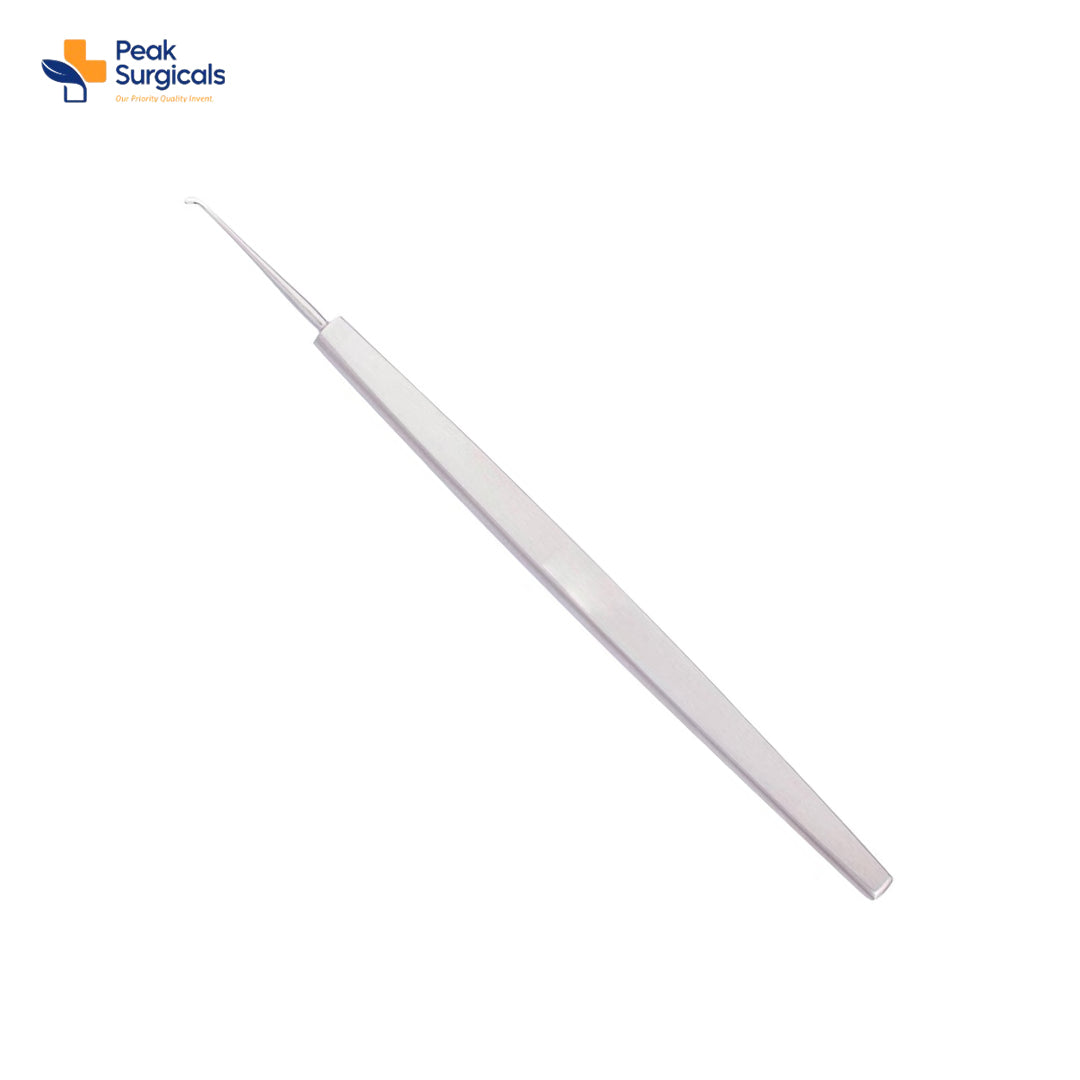
Laforce Golf Club Knife Spud, SKU PS-9803, is a reusable ophthalmic foreign body instrument manufactured from German stainless steel for controlled lifting and removal of superficial material from the corneal and conjunctival surface. The instrument measures 4.75 inches overall and follows the recognized LaForce golf-club pattern with a fine 2 mm round working end, slender straight shaft, slightly angled distal geometry, and flat manual handle. The compact blade allows the ophthalmic surgeon to approach a localized foreign body while preserving visualization through the slit lamp or operating microscope. It is used for removal of superficial metallic fragments, glass, grit, organic particles, and other accessible ocular-surface foreign bodies when direct mechanical elevation is clinically appropriate. The angled distal profile permits the working edge to be introduced tangentially rather than directing the shaft perpendicular to the cornea. Ophthalmologists, corneal surgeons, emergency ophthalmology clinicians, and eye-care physicians use this pattern in ophthalmic procedure rooms, emergency departments, eye clinics, ambulatory centers, and hospital settings where reusable precision instrumentation is required for ocular foreign body management.
The LaForce pattern works through a fixed 2 mm round blade positioned at the end of a narrow shaft rather than through a hinged or powered mechanism. Its distal working end resembles a small golf-club head, creating a compact surface that can be advanced beneath or against the edge of a superficial ocular foreign body. The slight angle between the shaft and working tip allows the clinician to maintain a relatively tangential approach to the corneal or conjunctival surface while keeping the handle outside the direct visual axis. This geometry is particularly useful under slit-lamp magnification, where instrument bulk can interfere with visualization and patient positioning. The slender shaft provides reach without placing a broad structure across the treatment field, while the flat handle gives rotational stability and tactile control during small lifting or scraping movements. There is no ratchet, spring, pivot, or mechanical depth stop. Working pressure is transmitted directly from the operator’s fingers through the rigid shaft to the distal blade. Small changes in wrist position therefore alter the angle of engagement immediately. The tip is intended for deliberate superficial manipulation, with controlled strokes directed at the foreign material rather than forceful penetration of underlying corneal tissue.
During ocular foreign body removal, the lesion is first localized under magnification and the surface is prepared according to the clinician’s established ophthalmic protocol. For a superficial corneal particle, the Laforce Golf Club Knife Spud can be brought toward the material from a shallow angle so the 2 mm working end engages its margin while the surgeon maintains continuous visualization. Metallic fragments can sometimes become embedded within the corneal epithelium or superficial stroma, requiring controlled elevation before the particle is removed from the ocular surface. Residual rust associated with a metallic foreign body is assessed separately and managed according to depth, location, and the selected ophthalmic technique. On the bulbar conjunctiva, the small working surface can assist with dislodging accessible debris while minimizing instrument footprint around the treatment site. The instrument may also support careful manipulation of superficial epithelial debris encountered during examination or minor ophthalmic procedures. Central corneal locations require particularly precise orientation because unnecessary stromal contact can affect the visual axis. The shaft should remain within the operator’s visual control throughout the maneuver, and the working tip is repositioned rather than used as an uncontrolled lever when the initial approach does not release the material.
PS-9803 is supplied in the 4.75-inch LaForce golf-club configuration. The overall length provides enough distance between the clinician’s hand and the ocular surface for slit-lamp or procedure-room manipulation while remaining compact compared with longer general surgical instruments. At the distal end, the 2 mm round blade creates a focused working footprint appropriate for localized foreign body contact. This small width supports access to individual corneal particles without placing a broad blade across adjacent epithelium. The slightly angled tip changes the direction of contact relative to the straight shaft, allowing the operator to maintain visibility while approaching the lesion from a controlled oblique or tangential trajectory. The narrow intermediate shaft minimizes obstruction between the handle and the treatment site. At the proximal end, the flat handle provides a stable surface for fine rotational control and resists unwanted rolling between the fingers. Because this listing uses a single 4.75-inch PS-9803 configuration rather than a multi-gauge series, clinical selection is based on whether the 2 mm LaForce working end and overall instrument geometry match the foreign body location and chosen removal technique. Deeper intraocular foreign bodies require different surgical instrumentation and operative management.
German stainless steel provides the rigidity and corrosion resistance required for a reusable ophthalmic spud while allowing the distal shaft and 2 mm working end to retain their defined geometry. Peak Surgicals lists satin, dull, and mirror finish options for this product. Reduced-glare finishes can be advantageous under focused ophthalmic illumination, while smooth polished surfaces allow direct inspection after reprocessing. Because the working end is small, cleaning requires particular attention to the distal blade and transition from the tip to the slender shaft. Blood, tear-film residue, medication deposits, or tissue debris should be removed before material dries on the instrument. After cleaning and rinsing, the spud should be completely dried and inspected under suitable magnification for bending, surface corrosion, burrs, tip deformation, or retained contamination. The fine distal end should be protected during tray assembly and transport so heavier instruments do not alter its alignment. The reusable device can enter a validated sterilization workflow appropriate for stainless steel ophthalmic instrumentation and the manufacturer’s instructions for use. Peak Surgicals lists the product as Class I with CE, ISO 13485, and FDA-related documentation for procurement review, together with a one-year warranty, MOQ of one piece, OEM availability, and return-and-replacement service.
| SKU | PS-9803 |
|---|---|
| Product Name | Laforce Golf Club Knife Spud |
| Price | $11.00 USD |
| Size/Gauge Variants | 4.75 inches overall length with 2 mm round golf-club working tip |
| Instrument Category | Ophthalmic Foreign Body Spud |
| Procedure | Superficial corneal and conjunctival foreign body removal and ocular surface debris manipulation |
| Material | German Stainless Steel |
| Finish | Satin, Dull, Mirror |
| Sterilization | Reusable; clean, inspect, package, and sterilize through a validated ophthalmic instrument reprocessing protocol |
| Instrument Classification | Class I Reusable Ophthalmic Instrument |
| Reusable | Yes |
| Certifications | CE, ISO 13485, FDA-related procurement documentation |
| Warranty | 1 Year |
| MOQ | 1 Piece |
| OEM / Custom Orders | Available |
| After-Sale Service | Return and Replacement |
How does the Laforce Golf Club Knife Spud differ from a Francis Knife Spud?
The Laforce Golf Club Knife Spud uses a round 2 mm golf-club-style blade at the end of its slender shaft. A Francis Knife Spud uses a smaller approximately 1.5 × 1 mm blade with a more pronounced angled working geometry. The LaForce configuration provides a broader rounded contact surface for controlled engagement of an accessible ocular foreign body. The Francis pattern provides a narrower working profile when more focused access or a different approach angle is preferred. Both instruments are reusable ophthalmic spuds designed for manual foreign body manipulation rather than powered corneal treatment. Selection depends on foreign body size, depth, position, visual access, and the surgeon’s preferred direction of engagement.
What is the clinical purpose of the 4.75-inch length and 2 mm tip?
The 4.75-inch overall length provides working distance between the operator’s fingers and the ocular surface while remaining suitable for slit-lamp and minor ophthalmic procedure environments. The 2 mm round blade gives the Laforce Golf Club Knife Spud a compact contact footprint for localized superficial foreign bodies. Its working width allows the surgeon to engage a particle without introducing the much broader blade geometry used by general surgical instruments. The narrow shaft preserves visualization of the cornea or conjunctiva around the treatment site. The slightly angled distal section supports a tangential approach to the ocular surface rather than forcing the handle into the visual axis. Instrument selection should still reflect foreign body position, depth, surrounding tissue condition, and the planned removal technique.
What do CE, ISO 13485 and FDA references mean for procurement?
Peak Surgicals lists CE, ISO 13485, and FDA-related information for the Laforce Golf Club Knife Spud. ISO 13485 addresses the quality-management system used for controlled medical-device manufacturing and related processes. CE documentation is relevant to conformity requirements for applicable medical-device markets. For United States purchasing, healthcare organizations should evaluate the FDA records and device information applicable to the instrument category and supplier. The wording should not be converted into an unsupported statement that the individual ophthalmic spud is FDA approved. Hospitals, clinics, and distributors can retain supplier certificates, model identification, purchase records, and applicable regulatory documents within their procurement and vendor-qualification files.
How is the Laforce Golf Club Knife Spud controlled without a ratchet or locking mechanism?
The Laforce Golf Club Knife Spud is a fixed manual instrument with no ratchet, pivot, spring, or locking assembly. Control comes from the flat handle, rigid slender shaft, angled distal segment, and compact 2 mm blade. Finger movement at the handle is transmitted directly to the working tip, allowing small adjustments in approach angle and lifting direction. Rotating the flat handle changes the orientation of the golf-club end while the surgeon maintains visualization of the foreign body. Because no mechanical stop limits movement, pressure can be reduced immediately if the tip begins to move away from the intended superficial plane. This direct tactile response is important when working against the corneal or conjunctival surface where excessive depth or uncontrolled scraping is undesirable.
How should ophthalmology departments order and reprocess this spud?
The Laforce Golf Club Knife Spud should be ordered using model PS-9803 and the 4.75-inch configuration so procurement and sterile-processing records remain consistent. Peak Surgicals lists the product at $11.00 with a one-piece MOQ, one-year warranty, OEM availability, and return-and-replacement service. After clinical use, visible residue should be removed promptly from the 2 mm working end, narrow shaft, and handle before deposits dry. Cleaning should be followed by thorough rinsing, complete drying, and inspection under adequate magnification for tip deformation, corrosion, retained debris, or shaft bending. The delicate distal end should be protected within the ophthalmic tray so contact with heavier instruments does not damage its geometry. Final sterilization should follow the healthcare facility’s validated reusable ophthalmic instrument process and the applicable manufacturer reprocessing instructions before the device returns to clinical inventory.


