
Featured Collection
Your cart
Featured Collection

PEAK SURGICALS
SKU:PS-000019
Couldn't load pickup availability


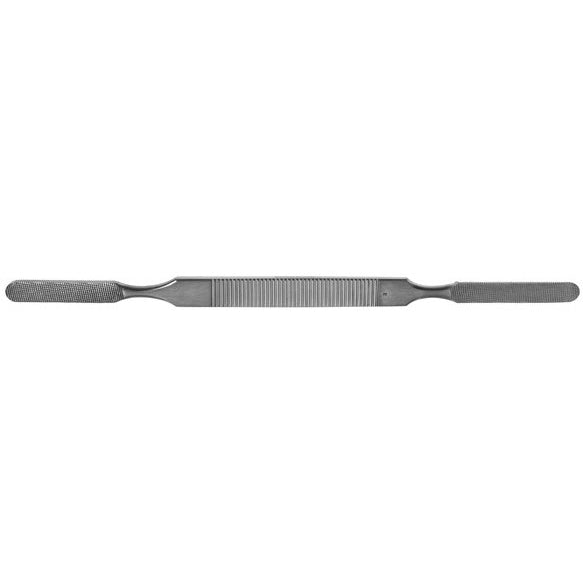
Kleinert-Kutz Rasp, Peak Surgicals SKU PS-000019, is a reusable double-ended surgical rasp designed for controlled bone smoothing, contouring, and surface refinement during nasal, ENT, and reconstructive procedures. The current configuration measures 8.5 inches overall with 8 mm wide working ends and combines one flat blade with one convex blade. Both ends use a four-sided rasp design with fine and coarse teeth, allowing the surgeon to select a different abrasion profile without changing instruments. The flat working surface supports controlled refinement of accessible bone planes, while the convex surface follows curved anatomical contours more effectively during nasal bone shaping. A flat central handle provides direct tactile control while keeping both rasp ends immediately available for sequential use. Peak Surgicals lists PS-000019 as stainless steel, reusable, non-sterile, and currently priced at $27.49. The page identifies Millennium Number 62.768, whose published dimensions independently match the 8.5-inch by 8 mm configuration; however, the page's separate manufacturer and country-of-origin fields should be verified before final publication.
The Kleinert-Kutz Rasp uses two working ends to provide different bone-contact geometries within one instrument. One end has a flat blade for controlled abrasion across comparatively planar or directly accessible bone surfaces, while the opposite convex blade is shaped to follow curved or irregular osseous contours. Both ends are approximately 8 mm wide and incorporate four-sided rasp surfaces, increasing the number of usable abrasive faces available during a procedure. Fine and coarse teeth provide different rates of bone removal. The coarse rasp surface can be selected when more pronounced contour reduction is required, while the fine surface is suited to progressive smoothing and final refinement after the desired general shape has been established. Because rasping removes bone through repeated manual strokes rather than a powered cutting mechanism, the surgeon directly controls pressure, stroke length, orientation, and contact area. The instrument should remain in controlled contact with the intended visible bone surface, and excessive pressure should be avoided where surrounding mucosa, cartilage, soft tissue, or other protected anatomy could enter the rasp pathway.
During rhinoplasty or other reconstructive nasal procedures, the Kleinert-Kutz Rasp can be used after adequate exposure has provided access to the bony area requiring contour refinement. The surgeon can select the coarse surface to reduce a localized irregularity or prominent bone margin through short controlled rasping strokes. Once the major contour has been adjusted, the fine teeth can provide more gradual smoothing and refinement of the remaining surface. The flat end is useful when the target presents a relatively direct plane, while the convex blade can follow curved nasal bone anatomy or other rounded osseous surfaces more naturally. Established surgical catalogs classify Kleinert-Kutz rasps within ENT and nasal instrument families, and the pattern is specifically associated with reconstructive nasal bone contouring. Each stroke should remain deliberate and confined to the intended bone surface. Bone contour, symmetry, surrounding soft tissue, and the amount of remaining osseous structure should be reassessed frequently rather than removing excessive material in one sequence. Final instrument selection and technique remain dependent on the planned reconstructive procedure and individual anatomy.
Peak Surgicals SKU PS-000019 is documented at 8.5 inches overall with 8 mm wide working ends, a double-ended configuration, flat and convex blades, four-sided rasp surfaces, and fine and coarse teeth. The page also specifies Millennium Number 62.768, and Millennium Surgical independently publishes 62.768 as a Kleinert-Kutz Rasp measuring 8.5 inches by 8 mm with fine and coarse working surfaces. This strong dimensional match makes the Millennium reference useful for confirming the current Peak configuration. However, other Kleinert-Kutz rasps should not automatically be treated as the same model. Teleflex documents catalog 441555 at 8 5/8 inches with 7.5 mm four-sided tips, while Ambler Surgical catalog 69-380 measures 8 3/4 inches with 8 mm working ends. These differences matter for procurement and product traceability. PS-000019 should therefore retain its exact 8.5-inch and 8 mm specifications. The fine and coarse surfaces should be selected according to the amount of bone reduction required rather than using one rasp texture throughout every stage of contouring.
Peak Surgicals identifies PS-000019 as a reusable stainless steel instrument supplied non-sterile, so the rasp must be appropriately cleaned and sterilized before clinical use. Reprocessing should begin promptly after surgery because bone particles, blood, and tissue residue can become trapped within the fine and coarse serrations on the four-sided working ends. Cleaning methods should provide complete access to the rasp teeth, blade transitions, and flat handle surfaces without damaging the serrated profiles. After thorough rinsing and drying, sterile-processing personnel should inspect both ends for retained debris, corrosion, bent areas, worn teeth, sharp unintended defects, or structural damage. The instrument should be sterilized according to applicable reusable-instrument instructions and the healthcare facility's validated process. The current Peak listing contains a procurement-data conflict that should also be corrected: it identifies manufacturer Ambler Surgical and country of origin PAK while simultaneously using Millennium Number 62.768. Ambler's own Kleinert-Kutz rasp is catalog 69-380, 8 3/4 inches, and made in Germany. Manufacturer and origin should therefore be physically verified before those fields are retained.
| SKU | PS-000019 |
|---|---|
| Product Name | Kleinert-Kutz Rasp |
| Price | $27.49 USD |
| Millennium Number | 62.768 |
| Overall Length | 8.5 in |
| Working-End Width | 8 mm |
| End Configuration | Double-Ended |
| Blade Design | One Flat Blade and One Convex Blade |
| Rasp Design | Four-Sided Working Ends |
| Teeth Pattern | Fine and Coarse Teeth |
| Handle Type | Flat Handle |
| Instrument Category | ENT / Rhinoplasty Nasal Bone Rasp |
| Procedure | Nasal bone smoothing, rhinoplasty contouring, reconstructive nasal surgery, and controlled osseous surface refinement |
| Material | Stainless Steel |
| Supply Condition | Non-Sterile |
| Sterilization | Reusable; clean and sterilize according to validated reusable-instrument protocols before use |
| Instrument Classification | Reusable Manual Surgical Bone Rasp |
| Reusable | Yes |
| Manufacturer | Requires verification — Peak lists Ambler Surgical, while Millennium Number 62.768 corresponds to the published Millennium 8.5 in × 8 mm configuration |
| Country of Origin | Requires verification — current Peak page states PAK; do not attribute Ambler Germany data to PS-000019 without confirming the supplied instrument |
| Certifications | CE and ISO 13485 procurement documentation; FDA-related documentation should be tied to the exact verified device identity |
| Warranty | 30-Day Money-Back Guarantee on eligible purchases |
| MOQ | 1 Piece for standard online ordering |
| OEM / Custom Orders | Available for institutional, distributor, and custom procurement requirements after confirming the exact branded or OEM configuration |
| After-Sale Service | Return and replacement support under Peak Surgicals policy |
How does the Kleinert-Kutz Rasp differ from a standard single-ended nasal rasp?
The Kleinert-Kutz Rasp provides two different working geometries within one double-ended instrument. One blade is flat while the opposite end is convex, allowing the surgeon to adapt the working surface to different nasal bone contours. It also provides both fine and coarse teeth rather than limiting the procedure to one abrasion level. A single-ended rasp may provide only one blade profile or one tooth pattern and may require instrument changes as contouring progresses. The Kleinert-Kutz Rasp can therefore reduce the number of separate rasps required for sequential coarse reduction and fine smoothing. Instrument choice should still depend on the specific bone contour, access, and planned rhinoplasty technique.
When should the fine rasp surface be used instead of the coarse surface?
The coarse working surface is generally selected when more substantial bone reduction or initial contour correction is required. Its tooth pattern removes material more aggressively with each controlled stroke. The fine surface is better suited to gradual smoothing and refinement after the primary contour has been established. Switching to the finer teeth can help the surgeon make smaller changes as the desired shape is approached. The Kleinert-Kutz Rasp provides both options in one instrument so the working texture can be changed without introducing another rasp. The amount of pressure and number of strokes should always be controlled according to the anatomy and the amount of bone that remains.
Is PS-000019 an Ambler Surgical or Millennium Surgical instrument?
The current Peak product data require correction before that question can be answered definitively. Peak lists Millennium Number 62.768, and Millennium Surgical independently identifies 62.768 as an 8.5-inch by 8 mm Kleinert-Kutz Rasp with fine and coarse surfaces. Those measurements match PS-000019 closely. Peak also lists Ambler Surgical as manufacturer, but Ambler's published Kleinert-Kutz rasp is catalog 69-380 and measures 8 3/4 inches rather than 8.5 inches. Therefore, the brand should be verified from the actual instrument engraving or original purchasing record. Until that check is completed, Peak should avoid presenting the conflicting manufacturer field as confirmed.
Why are the flat and convex ends useful during nasal bone contouring?
The two blade geometries allow the rasp to contact surfaces with different anatomical shapes. A flat blade provides broad controlled contact on relatively planar bone areas. A convex blade can follow curved or irregular osseous contours more naturally and can improve contact where a flat rasp would engage only a limited area. The Kleinert-Kutz Rasp combines these surfaces so the surgeon can rotate the instrument as the bone geometry changes. Fine and coarse teeth further expand the available contouring options on the same instrument. The working end should remain visible and controlled so surrounding nasal soft tissue and cartilage are not unintentionally abraded.
How should hospitals order and reprocess the Kleinert-Kutz Rasp?
Hospitals should order the current Peak listing using SKU PS-000019 and retain the documented 8.5-inch length, 8 mm width, double-ended configuration, and fine/coarse tooth pattern. Peak Surgicals currently lists the product at $27.49 and provides a 30-day money-back guarantee on eligible purchases. The manufacturer field should be verified before institutional records identify the device as Ambler Surgical because the listed Millennium Number corresponds to a different catalog source. The instrument is supplied non-sterile and therefore requires validated processing before clinical use. Following surgery, bone debris should be removed thoroughly from all four rasp surfaces before rinsing, drying, inspection, and sterilization. The instrument should return to service only after both working ends are confirmed clean, structurally intact, and suitable for controlled surgical bone contouring.


