
Featured Collection
Your cart
Featured Collection

PEAK SURGICALS
SKU:PS-000012
Couldn't load pickup availability


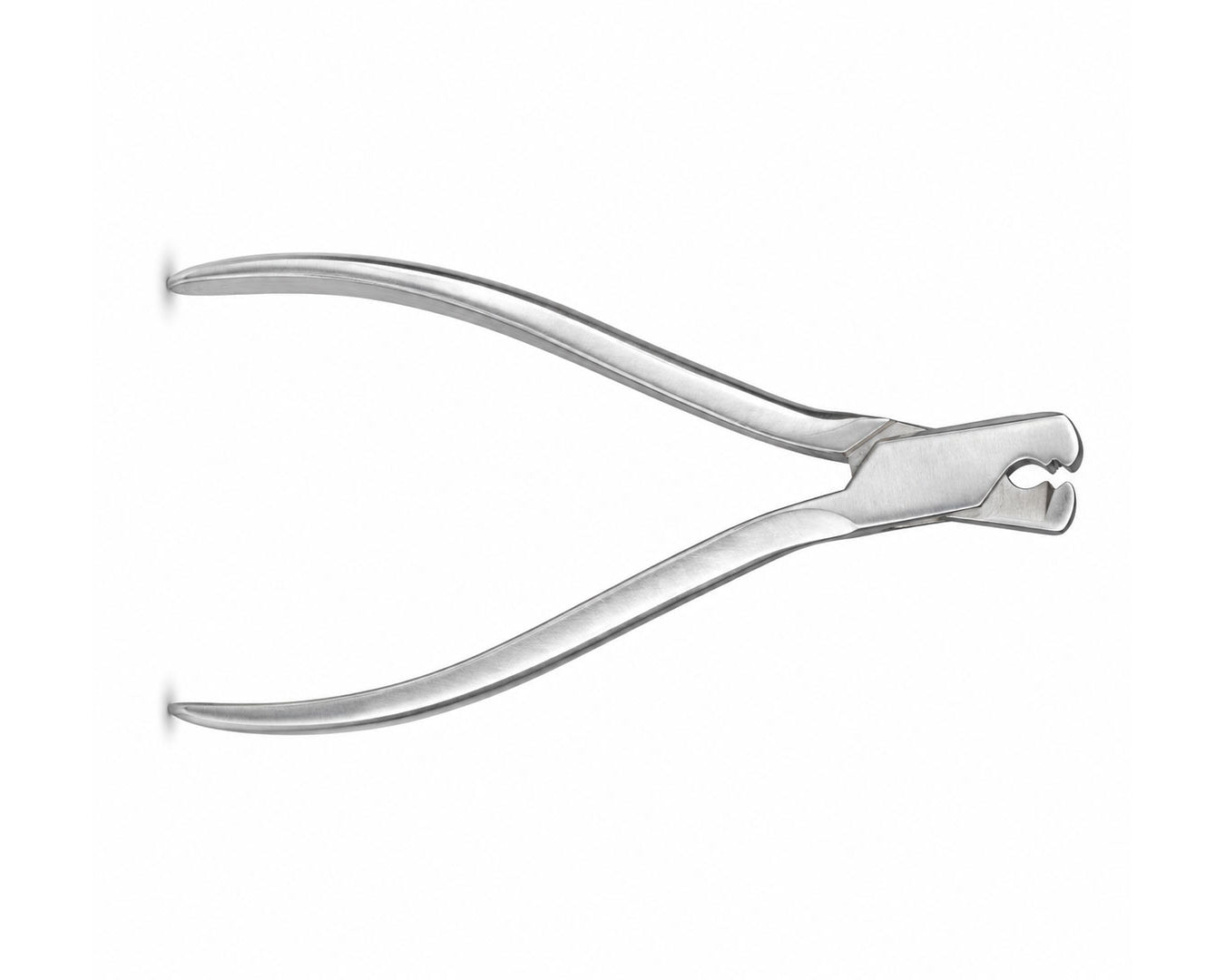
K-Wire and Plate Bender, SKU PS-000012, is a reusable orthopedic instrument designed for controlled bending and contouring of Kirschner wires and small fixation plates. Peak Surgicals identifies this exact configuration with Millennium Number 82.102, an overall length of 5.5 inches, and a maximum K-wire capacity of 1.6 mm. The compact plier-style design gives the surgeon or operating-room team direct manual leverage when shaping a K-wire before fixation or making controlled adjustments to a compatible small orthopedic plate. Its short working length supports precise hand control in hand, wrist, foot, ankle, small-fragment, and reconstructive workflows where larger plate-bending tools may be unnecessarily bulky. Peak lists the instrument as reusable medical-grade steel and currently prices PS-000012 at $27.49. Millennium Surgical independently documents reference 82.102 with the same 5.5-inch length and 1.6 mm maximum K-wire specification, supporting the dimensional identity used for this listing. The tool should be selected according to wire diameter, plate compatibility, required bend geometry, and the implant manufacturer's contouring limitations.
The K-Wire and Plate Bender works through direct manual leverage generated by its plier-style handles and compact working jaws. Once the K-wire or compatible small plate is positioned correctly in the bending area, gradual handle compression applies a controlled force at the selected point. For Kirschner wires, the 1.6 mm maximum capacity defines the largest documented wire diameter for this exact PS-000012 configuration. The operator can create a measured angle or progressive contour by applying a small bend, releasing the instrument, checking alignment, and repeating the adjustment only when necessary. This incremental approach provides greater control than unsupported free-hand bending and reduces the likelihood of creating an excessive or misplaced deformation. When a small orthopedic plate is being contoured, the plate-contact area should engage the implant securely so slipping or unintended twisting is minimized. The instrument is a bending tool rather than a cutter, and the working surfaces should not be used to shear wire or plate unless a separate cutting feature is specifically documented. Final wire or plate geometry should always be checked before implantation or definitive fixation.
During orthopedic fixation, a Kirschner wire may require controlled bending after placement or during preparation so its exposed end, trajectory, or final configuration matches the planned fixation technique. PS-000012 can be positioned around a compatible wire up to 1.6 mm and used to create a deliberate bend while maintaining direct manual control. The same instrument is also intended for contouring small orthopedic plates when the plate dimensions and manufacturer instructions are compatible with its working geometry. In hand, wrist, foot, ankle, or other small-fragment procedures, the compact 5.5-inch frame is useful because it provides leverage without the size of a large-fragment plate bender. Adjustments should be made in small increments and reassessed after each movement. Repeated reverse bending should be minimized because cyclic deformation can affect the fatigue characteristics of metallic fixation components. For plates, particular care is required around screw holes, locking interfaces, and other engineered features. Before fixation is completed, the surgeon should confirm alignment, contour, surface integrity, and absence of unintended cracks, twists, or tool damage.
Peak Surgicals SKU PS-000012 is documented as the 5.5-inch K-Wire and Plate Bender with Millennium Number 82.102 and a maximum K-wire capacity of 1.6 mm. Millennium Surgical independently lists 82.102 with the same 5.5-inch and 1.6 mm specification, making this a strong exact-model dimensional match. A smaller related configuration, Millennium 82.1014, is documented at approximately 4.75 inches with a maximum 1.1 mm K-wire capacity, demonstrating why the capacity must remain tied to the exact model. Peak also maintains another K-Wire Plate Bender page that offers 1.1 mm and 1.6 mm variants, so the PS-000012 page should be optimized specifically around its verified 5.5-inch, 1.6 mm identity rather than generic variant wording. The 1.6 mm limit should be treated as the maximum documented K-wire diameter, not as a plate-thickness rating. Compatible small plate dimensions are not published on the PS-000012 page. Procurement teams should therefore retain the SKU, Millennium reference, overall length, and maximum K-wire capacity while confirming plate-system compatibility separately.
Peak Surgicals identifies PS-000012 as a reusable medical-grade steel instrument intended for repeated professional use. After clinical use, the jaws, bending surfaces, hinge area, and handles should be cleaned promptly so blood, tissue residue, lubricant, or other contamination does not dry on the instrument. Cleaning should be followed by thorough rinsing and complete drying before visual and functional inspection. Sterile-processing personnel should check the working surfaces for deformation, cracks, corrosion, burrs, or damage that could mark a K-wire or plate during contouring. The joint should open and close smoothly without excessive looseness or binding, and the instrument should retain correct alignment under normal manual load. The public Peak page does not publish an exact sterilization cycle, so specific time and temperature parameters should not be invented; reprocessing should follow applicable manufacturer instructions and the healthcare facility's validated protocol. Peak displays CE, FDA, and ISO certification badges and provides a 30-day money-back guarantee. ISO 13485 and other procurement documentation should be retained through supplier qualification, while general FDA badge language should not be rewritten as individual FDA approval of PS-000012.
| SKU | PS-000012 |
|---|---|
| Product Name | Kirschner Wire and Plate Bender |
| Price | $27.49 USD |
| Millennium Number | 82.102 |
| Overall Length | 5.5 in |
| Maximum K-Wire Capacity | 1.6 mm |
| Instrument Category | Orthopedic Wire and Plate Bender |
| Primary Use | Bending and contouring Kirschner wires and compatible small orthopedic plates |
| Procedure | K-wire fixation, small-fragment fracture fixation, hand and foot surgery, plate preparation, and orthopedic reconstruction |
| Mechanism | Manual Plier-Style Bending Leverage |
| Plate Compatibility | Small orthopedic plates; exact plate thickness is not published on the current PS-000012 listing |
| Material | Medical-Grade Steel |
| Sterilization | Reusable; reprocess according to applicable manufacturer instructions and validated healthcare-facility protocols |
| Instrument Classification | Reusable Manual Orthopedic Wire and Plate Bending Instrument |
| Reusable | Yes |
| Certifications | CE and ISO 13485 procurement documentation; FDA-related documentation should be tied to exact device identity |
| Warranty | 30-Day Money-Back Guarantee on eligible purchases |
| MOQ | 1 Piece for standard online ordering |
| OEM / Custom Orders | Available for institutional, distributor, and custom procurement requirements |
| After-Sale Service | Return and replacement support under Peak Surgicals policy |
How does the K-Wire and Plate Bender differ from standard Plate Bending Pliers?
The K-Wire and Plate Bender is specifically documented for Kirschner wires up to 1.6 mm and can also contour compatible small orthopedic plates. Standard Plate Bending Pliers are primarily designed around plate thickness and plate-contouring capacity rather than K-wire diameter. PS-000012 is compact at 5.5 inches and is therefore suited to small-fragment and wire-management workflows. Larger plate-bending pliers provide more leverage and different working surfaces for heavier fixation plates. The K-Wire and Plate Bender should not automatically replace a plate-specific tool when the implant exceeds its documented working geometry. Instrument selection should follow wire diameter, plate dimensions, required bend, and the fixation-system manufacturer's instructions.
Why is the 1.6 mm maximum K-wire capacity important?
The 1.6 mm figure identifies the largest K-wire diameter documented for PS-000012 and Millennium reference 82.102. A wire larger than this specification should not be assumed compatible with the instrument. Millennium also documents a smaller related bender for 1.1 mm K-wires, showing that different models are intended for different wire diameters. The K-Wire and Plate Bender should therefore be matched to the actual Kirschner wire used in the fixation system. The 1.6 mm number describes K-wire capacity and should not be rewritten as a 1.6 mm maximum plate thickness. Plate compatibility should be confirmed separately when the instrument is used for small fixation-plate contouring.
What do CE, ISO 13485 and FDA references mean for procurement?
Peak Surgicals displays CE, FDA, and ISO certification badges on the K-Wire and Plate Bender listing. ISO 13485 relates to quality-management systems used in medical-device manufacturing and associated production controls. CE documentation supports applicable medical-device conformity requirements in relevant markets. The Millennium 82.102 reference independently verifies the instrument's dimensional configuration but does not by itself establish an FDA approval claim for Peak SKU PS-000012. General FDA storefront wording should therefore not be converted into an unsupported statement that this individual product is FDA approved. Procurement teams should retain the Peak SKU, Millennium reference, supplier certificates, and applicable device documentation required by their institution.
How should the K-Wire and Plate Bender be used for controlled bending?
The wire or compatible plate should first be positioned securely within the appropriate bending surfaces. The operator should then apply gradual handle pressure until the desired initial deformation begins to form. The instrument should be released and the wire or plate alignment inspected before further bending is performed. Several small adjustments provide better control than one excessive movement. Repeated reverse bending should be minimized because cyclic deformation can weaken metallic fixation components. The final K-wire or plate should be inspected for correct geometry, structural integrity, and compatibility with the planned orthopedic fixation before use.
How should hospitals order and reprocess the K-Wire and Plate Bender?
Hospitals should order this exact instrument using Peak Surgicals SKU PS-000012 together with Millennium Number 82.102, 5.5-inch overall length, and 1.6 mm maximum K-wire capacity. Peak currently lists the product at $27.49 and displays a 30-day money-back guarantee. The separate Peak K-Wire Plate Bender page with 1.1 mm and 1.6 mm variants should remain a distinct Shopify product unless a consolidation review confirms duplication. Following use, the bending surfaces, joint area, and handles should be thoroughly cleaned, rinsed, and dried. Staff should inspect the instrument for corrosion, jaw damage, bending, burrs, joint looseness, or other defects that could affect controlled wire or plate contouring. Final reprocessing and sterilization should follow applicable manufacturer instructions and the healthcare facility's validated reusable-instrument protocol.


