
Featured Collection
Your cart
Featured Collection

PEAK SURGICALS
SKU:PS-OP-7141
Couldn't load pickup availability


Instruments Set for Angled Blade Plate & Condylar Plates, SKU PS-OP-7141, is a reusable German-forged stainless steel orthopedic set for preparing, inserting, seating, and removing fixed-angle blade plates in the proximal or distal femur. Its 11 coded operative line items comprise the 702.005 chisel guide, 702.006 seating chisel, 702.007 inserter-extractor, 702.008 slotted hammer, 702.009 impactor, 507.99 11 mm stainless steel spanner, 702.011 set of three triangular positioning plates, 702.012 quadrangular positioning plate, 702.013 fixed 130° triple drill guide, 702.014 condylar plate guide, and 260.200 2.0 mm drill bit; the 903.020 container organizes the complete configuration. Orthopedic trauma and reconstructive surgeons use these components during open reduction and internal fixation of selected intertrochanteric and subtrochanteric femoral fractures, proximal femoral corrective osteotomy, and condylar blade-plate fixation of distal femoral fractures. The instruments coordinate reference-plane establishment, angular orientation, cortical entry preparation, U-profile blade-channel creation, plate coupling, controlled impaction, and implant extraction. They are intended for hospital trauma theatres, orthopedic reconstruction services, teaching institutions, and specialist centers where angled blade or condylar plate systems remain part of the approved implant inventory and operative protocol.
The instrumentation converts a planned blade angle into a reproducible osseous track while controlling entry point, coronal inclination, axial orientation, and rotation. The triangular and quadrangular positioning plates act as angular references when the surgeon establishes guide-wire planes relative to the femoral shaft, neck, or condylar surface. For a 130° proximal construct, the fixed triple drill guide maintains three parallel cortical holes in the intended blade plane; those holes define the entry slot before chisel advancement. The chisel guide slides over the seating chisel, and its lateral flap remains referenced to the long axis of the femur so the U-profile cutting edge does not rotate around its shaft. The slotted hammer embraces the chisel body, giving the operator rotational leverage during advancement and permitting controlled backslapping during withdrawal. After the channel is prepared, the inserter-extractor locks to the blade plate so the implant blade and handle remain coplanar while light axial blows advance the construct. The impactor then contacts the plate shoulder to seat the terminal segment against the lateral cortex without striking the implant directly. The 11 mm spanner secures or releases compatible hexagonal connections, while the 2.0 mm drill bit prepares reference or pilot paths used during alignment. These mechanisms preserve the fixed relationship between the blade and plate shaft throughout preparation and implantation.
During 130° angled blade-plate fixation of an intertrochanteric or selected subtrochanteric fracture, the surgeon restores length, rotation, and neck-shaft alignment before defining the blade entry point on the lateral proximal femur. Reference wires and positioning templates establish the femoral-neck plane and the complementary angle between the blade trajectory and shaft. The triple drill guide organizes the parallel cortical openings, after which the prepared entry is linked into a slot for the seating chisel. With the chisel guide flap kept parallel to the femoral shaft, the operator advances the U-profile edge under biplanar imaging control and uses the slotted hammer to prevent axial rotation. The chosen plate is mounted on the inserter-extractor and follows the pre-cut channel; the impactor completes seating at the lateral cortex. For distal femoral condylar fixation, the condylar plate guide references the articular block and lateral cortex while the surgeon controls varus-valgus position, flexion-extension, and the patellofemoral plane. The same channel-preparation and insertion instruments then guide the condylar blade into the distal fragment before the plate shaft is reduced to the proximal femur. In corrective proximal femoral osteotomy, the positioning plates assist angular planning and execution of the intended correction before plate fixation. Final imaging assesses blade depth, joint clearance, plate contact, mechanical alignment, and fracture or osteotomy reduction.
Code 702.005 maintains the rotational reference of the 702.006 seating chisel as its U-shaped profile cuts the blade channel. Code 702.007 couples to the implant for aligned insertion and provides purchase when a blade plate must be withdrawn. Code 702.008 controls chisel rotation, transmits backslapping force, and assists extraction; 702.009 applies the final seating blows at the plate shoulder. The 507.99 stainless steel spanner fits 11 mm hexagonal connections used on compatible assemblies. Code 702.011 contains three triangular templates for selecting complementary angular references during guide-wire placement and osteotomy orientation. Code 702.012 supplies quadrangular reference geometry where the operative plan requires a different combination of measured angles. The 702.013 triple drill guide fixes a 130° relationship and spaces three parallel cortical holes for proximal blade-track preparation. Code 702.014 positions the intended condylar blade plane against the distal femur during guide-wire alignment. The 260.200 2.0 mm drill bit creates a controlled pilot or reference channel without substituting for the larger cutters required by the implant technique. The 903.020 container separates the chisel, guides, templates, hammer, coupling instrument, impactor, spanner, and drill for count control. Set selection must correspond to the implanted blade-plate system because coupling features, channel geometry, guide angles, and plate shoulders are system dependent.
German-forged stainless steel provides the rigidity required to hold angular references and transmit impact force through the seating chisel, slotted hammer, inserter-extractor, and impactor without loss of working geometry. A satin, non-reflective surgical finish reduces glare around fluoroscopic positioning and permits visual inspection for edge damage, fretting, corrosion, or retained soil. Reprocessing begins with prompt removal of blood, bone particles, and marrow from the U-profile chisel, guide channels, drill flutes, slots, and coupling recesses. Staff should disassemble separable connections, brush recessed surfaces, rinse with treated water, dry thoroughly, and function-test every sliding or threaded interface. The templates and long guide surfaces require inspection for bending because angular distortion can alter the planned blade trajectory. Components are returned to the 903.020 container and steam autoclaved through the healthcare facility’s validated cycle in accordance with the manufacturer’s reprocessing instructions. CE marking supports applicable European conformity documentation, while ISO 13485 identifies the controlled quality-management framework for manufacture, inspection, traceability, and set assembly. FDA-compliant procurement refers to the establishment, listing, and device documentation relevant to United States supply rather than a universal claim of individual premarket approval. The set carries a one-year warranty, has a one-set MOQ, supports OEM or private-label configurations, and includes return-and-replacement service for institutional buyers and distributors.
| Code | Instruments Set for Angled Blade Plate & Condylar Plates | Units |
|---|---|---|
| 702.005 | Chisel Guide | 1 |
| 702.006 | Seating Chisel | 1 |
| 702.007 | Inserter-Extractor | 1 |
| 702.008 | Slotted Hammer | 1 |
| 702.009 | Impactor | 1 |
| 507.99 | Spanner, 11 mm, Stainless Steel | 1 |
| 702.011 | Triangular Positioning Plates, Set of Three | 1 set |
| 702.012 | Quadrangular Positioning Plate | 1 |
| 702.013 | Triple Drill Guide, 130° Angle | 1 |
| 702.014 | Condylar Plate Guide | 1 |
| 260.200 | Drill Bit, 2.0 mm | 1 |
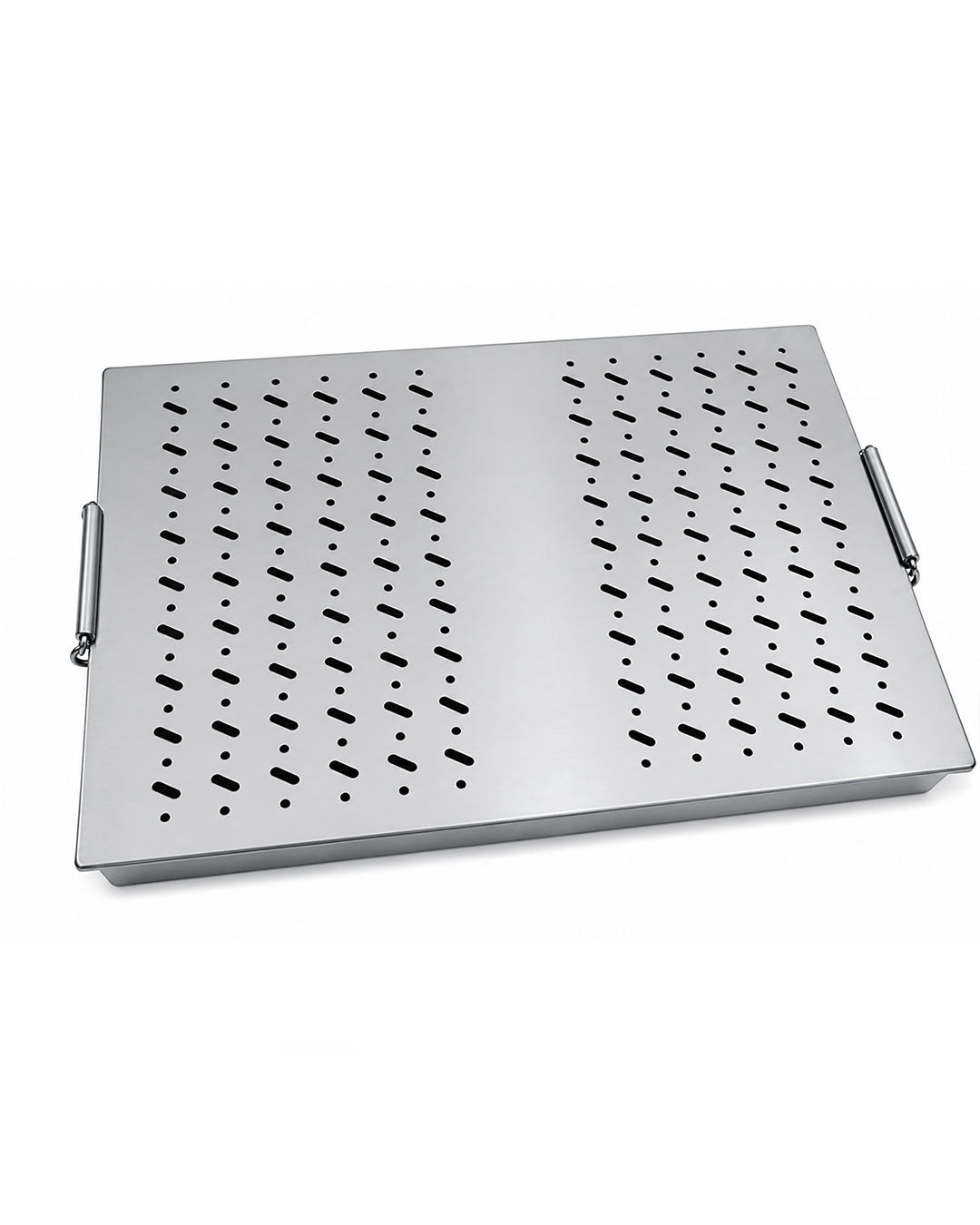
| 903.020 | Empty Container | 1 |
| Specification | Value | Scope |
| SKU | PS-OP-7141 | Catalog identifier |
| Product Name | Instruments Set for Angled Blade Plate & Condylar Plates | Complete set |
| Price | $494.99 USD | Per set |
| Size/Gauge Variants | 130° triple drill guide; 2.0 mm drill bit; 11 mm spanner; three triangular and one quadrangular positioning plate | Included configuration |
| Instrument Category | Orthopedic angled blade and condylar plate instrumentation | Manual surgical set |
| Procedure | Proximal femoral angled blade-plate fixation, corrective osteotomy, and distal femoral condylar plate fixation | Professional orthopedic use |
| Material | German-forged stainless steel | Reusable construction |
| Finish | Satin, non-reflective surgical finish | Inspection-ready surface |
| Sterilization | Reusable and steam-autoclavable after validated cleaning and inspection | Facility reprocessing |
| Instrument Classification | Reusable manual orthopedic implant instrumentation set | Non-powered devices |
| Reusable | Yes | Inspect before every procedure |
| Certifications | CE marked; ISO 13485 quality-management system; FDA-compliant procurement documentation | Institutional purchasing |
| Warranty | 1 year | Commercial warranty |
| MOQ | 1 set | Minimum order |
| OEM / Custom Orders | Available for compatible set configuration and private labeling | Contract supply |
| After-Sale Service | Return and replacement support | Buyer service |
How does this set differ from a Dynamic Condylar Screw instrument set?
The Instruments Set for Angled Blade Plate & Condylar Plates prepares a U-profile channel for the solid blade of a fixed-angle plate. A Dynamic Condylar Screw instrument set instead advances a guide wire, uses a depth-measuring device and triple reamer, taps when indicated, and inserts a large lag screw before the plate barrel is applied. Blade-plate orientation is established through positioning templates, a chisel guide, seating chisel, and rotational control with a slotted hammer. DCS alignment centers on the lag-screw axis and the relationship between that screw and the barrel plate. This set therefore includes an inserter-extractor and plate-shoulder impactor rather than a DCS screw wrench, tap, and barrel-specific insertion assembly. The selected instrumentation must match the chosen implant because neither preparation pathway is interchangeable.
How are the 130° guide and positioning plates selected during femoral surgery?
The Instruments Set for Angled Blade Plate & Condylar Plates uses the 130° triple drill guide for the planned proximal femoral blade relationship. During intertrochanteric or selected subtrochanteric fixation, the surgeon references the femoral shaft axis and femoral-neck plane before establishing the entry slot. The three triangular positioning plates provide complementary angular references for guide-wire placement and corrective osteotomy planning. The quadrangular template supplies another combination of reference edges when the operative drawing requires a different angular construction. For distal femoral fixation, the condylar plate guide is referenced to the lateral condyle, articular block, and patellofemoral plane. Implant angle, fracture morphology, osteotomy objective, biplanar imaging, and system technique determine which reference is used.
What do CE, ISO 13485, and FDA-compliant procurement mean for this set?
The Instruments Set for Angled Blade Plate & Condylar Plates is supplied within Peak Surgicals’ CE-marked device framework for relevant European conformity requirements. ISO 13485 identifies the quality-management system covering controlled production, dimensional inspection, traceability, and set assembly. FDA-compliant procurement concerns manufacturer registration, device listing, labeling, and documentation applicable to United States distribution. It should not be interpreted as an individual FDA approval claim for every reusable manual instrument. Hospital buyers should match the certificate holder, product identity, SKU, intended market, and document validity during vendor qualification. Distributors can request the corresponding records for tenders, import files, and private-label supply.
How do the chisel guide, slotted hammer, and inserter-extractor control the implant pathway?
The chisel guide slides over the seating chisel and keeps its reference flap aligned with the femoral shaft. This relationship controls rotation around the chisel’s long axis while the U-profile edge advances through metaphyseal bone. The slotted hammer surrounds the chisel body so the surgeon can resist twisting and apply controlled backslaps during removal. After channel preparation, the inserter-extractor locks to the blade plate with its handle aligned in the blade plane. Light axial blows then advance the implant along the pre-cut track without creating a second pathway. The impactor completes seating at the plate shoulder, after which the coupling is released and the plate shaft is reduced to the lateral cortex.
What should operating-room procurement and sterile-processing teams check before use?
The Instruments Set for Angled Blade Plate & Condylar Plates should be reconciled against all 11 coded operative line items and the 903.020 container. Because 702.011 contains three separate triangular plates, staff should count each template rather than recording only the set label. Cleaning must reach the seating-chisel profile, drill flutes, slotted hammer recess, guide channels, threaded connections, and inserter coupling. After drying, personnel inspect the chisel edge, drill straightness, template geometry, impact surfaces, and extractor engagement for damage. The instruments are arranged securely in the container and processed through the facility’s validated steam-sterilization cycle under the manufacturer’s instructions. Procurement records should retain the SKU, compatible implant system, warranty, conformity documents, OEM configuration, and return-and-replacement terms.


