
Featured Collection
Your cart
Featured Collection

PEAK SURGICALS
SKU:PS-OT-0733
Couldn't load pickup availability


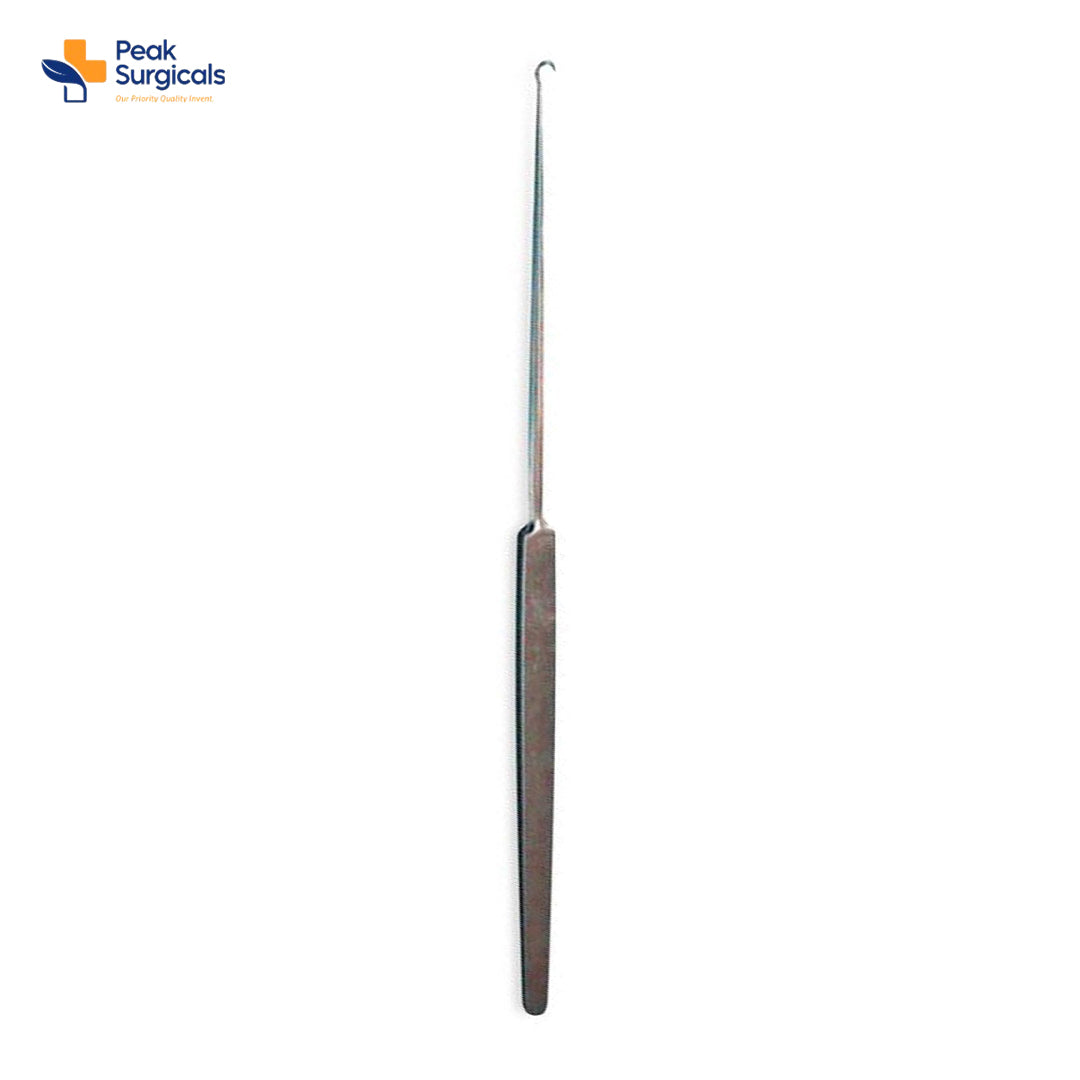
Gillies Skin Hooks, SKU PS-OT-0733, are reusable manual soft-tissue retractors manufactured from German stainless steel for controlled elevation and traction of skin, subcutaneous tissue, and delicate surgical flaps. Two size-specific models are available: PS-9896 Small with a 3 mm hook diameter and PS-9897 Large with a 4 mm hook diameter. Each configuration combines a flat elongated handle, long narrow shaft, and sharply curved single-prong working end that engages a limited tissue point while leaving the surrounding operative field unobstructed. The Gillies pattern is used during facelift dissection, scar revision, skin graft preparation, cutaneous lesion excision, rhinoplasty and facial reconstruction, hand surgery, maxillofacial procedures, and other operations requiring precise wound-edge or flap retraction. The small hook is suited to restricted facial, nasal, digital, and superficial operative fields, while the larger curve provides increased tissue purchase where a broader skin edge must be elevated. Plastic surgeons, reconstructive surgeons, dermatologic surgeons, oral and maxillofacial surgeons, ENT surgeons, and hand surgeons may use these hooks in hospital operating rooms, ambulatory surgical centers, and minor-procedure environments.
The Gillies design works through direct manual traction rather than a ratchet, spring, pivot, or self-retaining mechanism. Its distal end forms a single sharply curved hook that penetrates or catches a small controlled point at the skin edge or flap margin. Because the working tip occupies very little surface area, the surgeon can elevate tissue without placing a broad blade across the incision. The curvature redirects hand-applied traction into upward or lateral movement of the engaged tissue, helping expose the plane beneath a flap or along a wound margin. A long slender shaft separates the working tip from the operator’s hand and allows access into narrow facial, nasal, hand, or reconstructive fields. The flat proximal handle provides rotational stability and permits fine changes in traction direction through finger and wrist movement. It also reduces the tendency of the instrument to roll when placed on a flat sterile surface. There is no mechanical stop, so retraction force responds immediately to the operator’s hand. This direct feedback is important when working with thin skin or surgically elevated flaps, where excessive tension at a sharp contact point can tear tissue. The hook is therefore inserted deliberately, traction is applied progressively, and the tip is disengaged before the tissue margin is repositioned.
During facelift and facial rejuvenation procedures, a Gillies Skin Hook can elevate a skin flap or wound edge while the surgeon develops the subcutaneous dissection plane and controls exposure along the incision. In scar revision and local flap reconstruction, the single-prong tip can hold one margin away from the field while undermining, trimming, or layered closure is performed. During rhinoplasty and facial reconstruction, the narrow shaft permits localized retraction around limited external incisions where a broad handheld retractor would obstruct visualization. In dermatologic surgery, the hook may assist during cutaneous lesion excision, wound-edge handling, and skin-graft preparation when precise focal traction is preferable to grasping the epidermis with toothed forceps. Hand surgery presents similar requirements around the digits, palm, and dorsal soft tissues, where small incisions provide limited working space and delicate structures lie immediately below the skin. The instrument can also support oral and maxillofacial exposure during superficial facial approaches. In each workflow, the tip is positioned at a deliberately selected margin after incision or flap elevation. The assistant or surgeon then applies only enough traction to expose the target plane, maintaining the hook away from nerves, vessels, tendons, and other structures that should not be punctured or compressed.
PS-9896 is the Small Gillies Skin Hook with a 3 mm hook diameter. Its tighter working curve creates a compact contact footprint for narrow incisions and limited tissue margins. This configuration is appropriate when the surgeon needs focused retraction during facial plastic surgery, nasal procedures, small cutaneous excisions, digital surgery, or precise manipulation of thin skin flaps. The smaller radius also occupies less space at the incision edge, preserving room for scissors, dissecting forceps, needle holders, or electrosurgical instruments. PS-9897 is the Large pattern with a 4 mm hook diameter. Its broader curvature provides additional engagement around a thicker or wider tissue margin and can be selected for larger reconstructive flaps, broader wound edges, or superficial operative sites where slightly greater tissue purchase is useful. Hook diameter does not determine the depth of dissection; the shaft position, direction of traction, tissue thickness, and selected engagement point determine how the exposed plane is presented. The 3 mm model should not automatically be chosen because a procedure is delicate, nor should the 4 mm option be used simply for stronger traction. Selection should reflect incision dimensions, flap thickness, tissue mobility, and how much working space must remain around the engaged edge.
German stainless steel provides the stiffness required to preserve the narrow shaft and defined hook geometry while supporting repeated manual traction and routine reprocessing. Peak Surgicals lists satin, dull, and mirror finish options. Satin and dull surfaces can reduce distracting reflection from operative lighting, while a polished surface permits straightforward visual inspection after cleaning. Because the distal end is fine and sharp, sterile-processing personnel should protect it from impact with heavier instruments during transport, cleaning, tray assembly, and sterilization. Reprocessing should begin promptly after use so blood or tissue residue does not dry around the curved tip or shaft-to-handle transition. Cleaning is followed by thorough rinsing, complete drying, and close inspection of the working end for blunting, bending, corrosion, or loss of alignment. A distorted sharp tip should not return to clinical service because inaccurate engagement can compromise controlled traction. The reusable instrument should undergo terminal sterilization using the healthcare facility’s validated process and the applicable instructions for use. Peak Surgicals lists the product as Class I with CE, ISO 13485, and FDA-related procurement information. ISO 13485 relates to medical-device quality-management controls, while CE and FDA documentation should be reviewed within institutional or distributor supplier-qualification procedures rather than converted into an unsupported individual FDA approval claim.
| SKU | PS-OT-0733 |
|---|---|
| Product Name | Gillies Skin Hooks |
| Price | $4.73 USD |
| Size/Gauge Variants | PS-9896 Small: 3 mm hook diameter; PS-9897 Large: 4 mm hook diameter |
| Instrument Category | Plastic and Reconstructive Surgery Skin Hook |
| Procedure | Facelift surgery, scar revision, skin-graft preparation, cutaneous lesion excision, rhinoplasty, facial reconstruction, hand surgery, and superficial maxillofacial exposure |
| Material | German Stainless Steel |
| Finish | Satin, Dull, Mirror |
| Sterilization | Reusable; terminal sterilization following validated institutional reprocessing protocols and applicable instructions for use |
| Instrument Classification | Class I Reusable Manual Soft-Tissue Hook |
| Reusable | Yes |
| Certifications | CE, ISO 13485, FDA-related procurement documentation |
| Warranty | 1 Year |
| MOQ | 1 Piece |
| OEM / Custom Orders | Available |
| After-Sale Service | Return and Replacement |
How do Gillies Skin Hooks differ from Joseph Skin Hooks?
Gillies Skin Hooks use a single sharply curved prong to create focal tissue engagement at a selected skin or flap margin. Joseph Skin Hooks are commonly configured with two sharp prongs, distributing contact across two points rather than one. The Gillies pattern therefore occupies less space at the wound edge and is useful when the surgeon wants highly localized traction in a narrow field. A Joseph pattern can provide broader purchase when a wider section of skin needs to be elevated simultaneously. Both are manually controlled instruments and neither relies on a self-retaining ratchet. Selection depends on incision width, tissue thickness, flap mobility, and whether one-point or two-point engagement best supports the intended dissection.
When should the 3 mm or 4 mm Gillies Skin Hook be selected?
PS-9896 uses a 3 mm hook diameter and provides the smaller working curve in the Peak Surgicals range. It is suited to narrow facial and nasal incisions, digital surgery, small cutaneous excisions, and thin flap margins where the surgeon requires a compact point of engagement. PS-9897 uses a 4 mm diameter and provides a broader curve for larger skin edges or thicker reconstructive flaps. The larger option can provide additional purchase without requiring the operator to engage a wider blade-style retractor. Gillies Skin Hooks should be selected according to tissue thickness, incision dimensions, flap mobility, and available working space rather than by procedure name alone. In either size, traction should remain limited to the force necessary to expose the intended surgical plane.
What do CE, ISO 13485 and FDA references mean for procurement?
Peak Surgicals lists CE, ISO 13485, and FDA-related information for Gillies Skin Hooks. ISO 13485 concerns the quality-management system used for controlled medical-device manufacturing and associated processes. CE documentation supports conformity assessment requirements applicable to relevant medical-device markets. For United States procurement, hospitals and distributors should assess FDA status according to the device category, establishment responsibilities, listing requirements, and purchasing documentation required by their organization. These references should not be converted into an unsupported statement that an individual skin hook is FDA approved. Supplier certificates, product identifiers, regulatory records, and purchasing documentation can be maintained within the institution’s vendor-qualification system.
How is traction controlled when a Gillies Skin Hook has no locking mechanism?
Gillies Skin Hooks are completely manually controlled and contain no ratchet, pivot, spring, or locking assembly. After the sharp curved end is placed at the selected skin or flap margin, the operator applies traction through the flat handle. The long shaft transfers that movement directly to the hook while allowing the surgeon’s or assistant’s hand to remain outside the immediate incision. Small changes in hand position alter the direction and amount of retraction immediately. Because there is no mechanical lock, tissue tension decreases as soon as grip force is reduced. This direct response is particularly useful during flap dissection because exposure can be adjusted continuously as the operative plane changes.
How should hospitals order, inspect and sterilize Gillies Skin Hooks?
Hospitals should order Gillies Skin Hooks using Shopify SKU PS-OT-0733 together with the required PS-9896 3 mm or PS-9897 4 mm model designation. Peak Surgicals lists a one-piece MOQ, one-year warranty, OEM availability, and return-and-replacement after-sale service. Following surgery, visible contamination should be removed promptly from the hook, shaft, and handle before residue dries. The instrument should then be cleaned, rinsed, dried, and inspected carefully for tip blunting, bending, corrosion, or shaft distortion. The sharp distal end should be protected during tray assembly so contact with heavier instruments does not alter its geometry or damage sterilization packaging. Final sterilization should follow the healthcare facility’s validated reusable-instrument process and the applicable instructions for use before the hook returns to the sterile inventory.


