
Featured Collection
Your cart
Featured Collection

PEAK SURGICALS
SKU:PS-000060
Couldn't load pickup availability


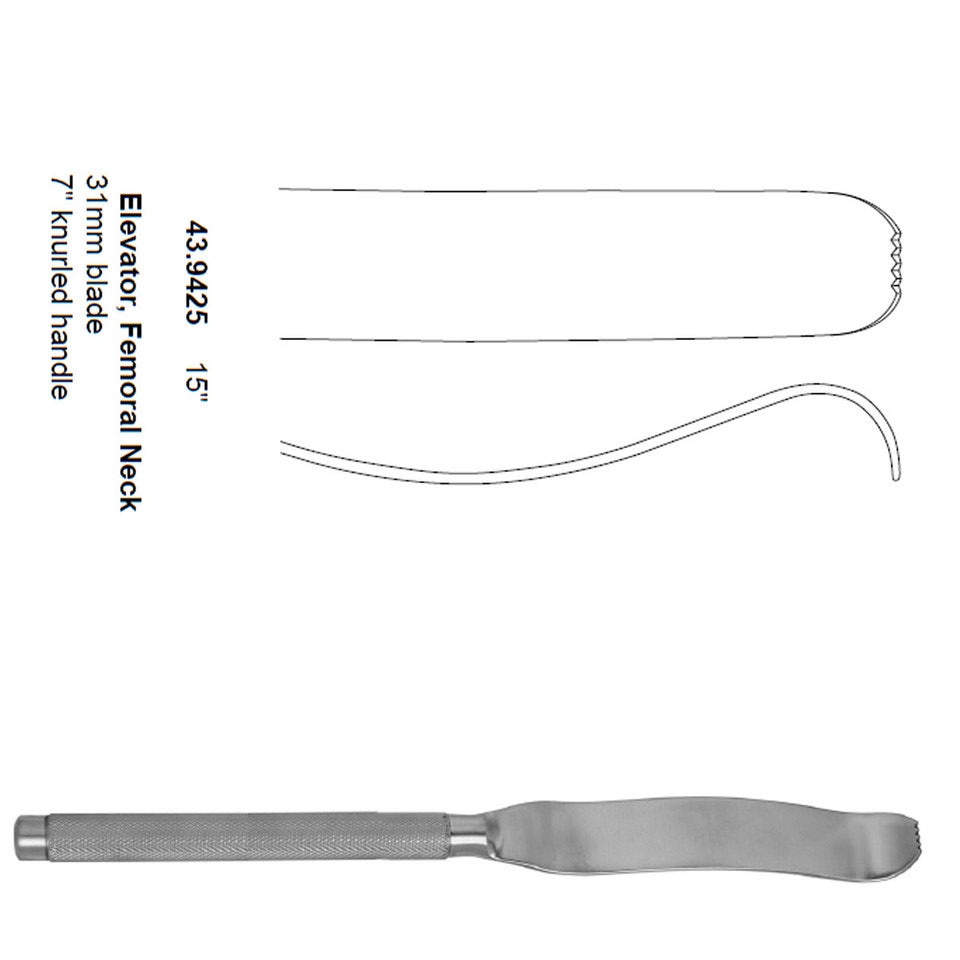
Femoral Neck Elevator Small, SKU PS-000060 and part number gS 43.9425, is a reusable orthopedic hand-held elevator manufactured from US surgical stainless steel for controlled elevation and exposure of the proximal femur during open hip procedures. The instrument measures 15 in overall and combines a 31 mm small curved blade with a 7 in knurled handle, providing extended reach into the hip while maintaining a secure manual grip outside the immediate operative field. Its blade is positioned around the femoral neck or proximal femoral margin to assist with controlled displacement of the bone and surrounding soft tissues during surgical exposure. The pattern is used during total hip arthroplasty, hip hemiarthroplasty, femoral neck fracture surgery, proximal femoral reconstruction, and minimally invasive posterolateral or anterolateral hip approaches where working access must be maintained around the proximal femur. The 31 mm blade provides a more focused contact footprint than wider femoral neck elevators. Hip arthroplasty surgeons, orthopedic trauma specialists, and reconstructive teams use this configuration in hospital operating rooms and specialist joint-replacement centers.
The Femoral Neck Elevator Small functions through direct manual leverage rather than a ratchet, spring, pivot, or self-retaining mechanism. Its 31 mm distal blade is curved so the working end can follow the contour of the proximal femur while the main shaft remains outside the central preparation corridor. Once the blade is positioned at an appropriate visible femoral margin, controlled movement through the handle transfers force along the rigid shaft and toward the working end. The relatively narrow blade provides focused contact compared with broader femoral elevators, allowing the instrument to enter restricted hip approaches without occupying excessive space beside broaches, rasps, retractors, trial components, or implant instruments. The extended shaft separates the surgeon's or assistant's hand from the deep operative site and supports access around the femoral neck through a limited incision. A 7 in knurled handle provides a textured gripping surface for rotational stability and controlled changes in the direction of elevation. Because the device contains no mechanical lock, the amount of force changes immediately with hand pressure. The blade should remain securely seated before sustained leverage is applied, particularly in osteoporotic or fractured proximal femoral bone.
During total hip arthroplasty, the Femoral Neck Elevator Small is used when the proximal femur must be mobilized and presented within the operative field for neck preparation, canal access, broaching, trialing, or stem insertion. After capsular release and appropriate limb positioning, the curved blade can be placed around an accessible femoral neck or proximal bone margin so controlled elevation creates additional working clearance. In minimally invasive posterolateral and anterolateral approaches, the narrow 31 mm blade is useful where the incision and soft-tissue corridor limit the space available for larger retractors. During hip hemiarthroplasty for femoral neck fracture, the same geometry can assist with exposure of the proximal segment after femoral head removal and preparation for stem implantation. Proximal femoral reconstruction may similarly require temporary elevation or displacement while the surgeon evaluates bone, prepares the canal, or positions fixation components. Retraction should be coordinated with adequate soft-tissue release and limb manipulation rather than relying on excessive mechanical leverage. The operator must continually monitor the blade location because uncontrolled pressure against osteoporotic cortex or an unstable fracture segment can increase the risk of unintended bone injury.
Part number gS 43.9425 identifies the 15 in Femoral Neck Elevator Small with a 31 mm working blade and 7 in knurled handle. The 15-inch overall length provides deep reach to the proximal femur while allowing the gripping surface to remain outside the principal hip incision. Its 31 mm blade represents the small configuration within established femoral neck elevator families and provides a concentrated retraction footprint for limited surgical approaches. A narrow blade is advantageous when the surgeon requires focused contact around the femoral neck while preserving space for other instrumentation. Larger configurations in the same instrument family are available with broader working ends, including 56 mm and 70 mm patterns, which increase the surface area engaged during retraction. Those wider models are better suited when anatomy and surgical exposure permit greater blade coverage. The 31 mm PS-000060 configuration should therefore be selected when operative access is restricted, tissue displacement must remain focused, or a larger blade would interfere with broaching and implant preparation. Blade size does not determine safe leverage; bone quality, exposure, blade position, surgical approach, and the degree of proximal femoral mobilization remain central to controlled use.
US surgical stainless steel provides the rigidity, corrosion resistance, and dimensional stability required for a reusable orthopedic elevator exposed to sustained manual leverage during hip surgery. Peak Surgicals identifies this configuration as Premium OR grade with a reusable design. The knurled handle requires deliberate cleaning because blood and other operative residue can remain within the textured surface, while the curved blade and shaft transitions should be inspected for retained tissue or marrow contamination. Reprocessing should begin promptly following use, followed by thorough cleaning, rinsing, and complete drying. Sterile-processing personnel should examine the 31 mm working end for deformation, surface damage, corrosion, or unintended alteration of its curvature and confirm that the 15-inch shaft remains aligned. The handle should retain its textured grip without surface defects that interfere with cleaning or control. Terminal sterilization should follow the healthcare facility's validated reusable-instrument process and applicable manufacturer instructions. Peak Surgicals displays CE, FDA, and ISO certification information and supports ISO 13485 procurement requirements. Regulatory records should be retained through institutional supplier qualification rather than interpreted as an unsupported individual FDA approval claim.
| SKU | PS-000060 |
|---|---|
| Product Name | Femoral Neck Elevator Small |
| Price | $55.00 USD |
| Size/Gauge Variants | gS 43.9425: 15 in overall length, 31 mm small blade, 7 in knurled handle |
| Instrument Category | Orthopedic Femoral Neck Elevator |
| Procedure | Total hip arthroplasty, hip hemiarthroplasty, femoral neck fracture surgery, proximal femoral reconstruction, and minimally invasive hip exposure |
| Material | US Surgical Stainless Steel |
| Finish | Premium OR Surgical Finish |
| Sterilization | Reusable; sterilize following validated healthcare-facility cleaning and reprocessing protocols |
| Instrument Classification | Reusable Manual Orthopedic Elevator |
| Reusable | Yes |
| Certifications | CE, ISO 13485, FDA-related procurement documentation |
| Warranty | 30-Day Money-Back Guarantee |
| MOQ | 1 Piece |
| OEM / Custom Orders | Available for institutional and distributor requirements |
| After-Sale Service | Return and replacement support under Peak Surgicals policy |
How does the Femoral Neck Elevator Small differ from a Femoral Calcar Retractor?
The Femoral Neck Elevator Small uses a broad 31 mm curved blade to provide focused manual elevation and retraction around the proximal femur. A Femoral Calcar Retractor commonly uses a narrower forked or pronged working end designed to engage around the medial calcar region during femoral exposure. The elevator distributes contact across a wider blade surface, while the calcar pattern creates more localized engagement through its distal geometry. Femoral Neck Elevator Small is useful when the surgeon requires a broad controlled surface for lifting or displacing the proximal segment through a limited hip approach. A calcar retractor is selected when focused purchase around the calcar better supports the femoral preparation stage. Both devices are manually controlled, and selection depends on contact anatomy, approach, bone quality, required retraction vector, and available operative clearance.
Why select the 31 mm small Femoral Neck Elevator?
The 31 mm blade provides a more focused working surface than larger femoral neck elevator configurations. This makes Femoral Neck Elevator Small useful in minimally invasive posterolateral or anterolateral hip approaches where the incision and deep working corridor limit the space available for broad retractors. Larger 56 mm or 70 mm patterns provide increased contact area when greater soft-tissue displacement or wider proximal femoral exposure is required. The 31 mm model preserves additional clearance for broaches, rasps, trial stems, and other femoral preparation instruments. Its 15-inch overall length still provides deep reach despite the smaller distal blade. Selection should reflect patient anatomy, bone quality, incision dimensions, surgical approach, and the amount of proximal femoral elevation required.
What do CE, ISO 13485 and FDA references mean for procurement?
Peak Surgicals displays CE, FDA, and ISO certification information for the Femoral Neck Elevator Small and supports ISO 13485 procurement documentation. ISO 13485 concerns the quality-management system used for controlled medical-device manufacturing and associated processes. CE documentation supports conformity review within applicable medical-device markets. United States hospitals and distributors should evaluate FDA-related manufacturer, establishment, listing, and device records according to their purchasing requirements. These references should not be converted into an unsupported statement that PS-000060 is individually FDA approved. Procurement teams can retain the SKU, part number, supplier certificates, purchasing records, and applicable regulatory documents within their vendor-qualification files.
How is the Femoral Neck Elevator controlled without a locking mechanism?
Femoral Neck Elevator Small is a fixed manual instrument with no ratchet, spring, pivot, or self-retaining lock. The surgeon or assistant positions the 31 mm curved blade against an appropriate visible femoral neck or proximal bone margin before applying elevation force. The rigid shaft transfers movement directly from the 7-inch knurled handle to the distal working end. The textured grip helps resist unwanted rotation while the operator adjusts the direction and amount of leverage. Reducing hand pressure immediately decreases retraction, allowing the proximal femur to be repositioned as broaching, trialing, or implant insertion progresses. The blade should be lifted and reseated when the required direction changes rather than levered blindly against an unseen cortical surface.
How should hospitals order and reprocess the Femoral Neck Elevator Small?
Hospitals should order Femoral Neck Elevator Small using SKU PS-000060 and part number gS 43.9425 together with the 15-inch length, 31 mm blade, and 7-inch knurled-handle specification. Peak Surgicals currently lists the instrument at $55.00 and provides a 30-day money-back guarantee. Standard online procurement begins with one piece, while institutional and distributor requirements can be coordinated through Peak Surgicals. Following surgery, blood, marrow, and tissue residue should be removed promptly from the curved blade, shaft, and textured handle. Cleaning should be followed by complete rinsing, drying, and inspection for corrosion, blade deformation, shaft bending, or damage within the knurled grip. Final sterilization should follow the healthcare facility's validated reusable surgical-instrument process before PS-000060 returns to the hip arthroplasty or orthopedic trauma tray.


