
Featured Collection
Your cart
Featured Collection

PEAK SURGICALS
SKU:PS-OP-7310
Couldn't load pickup availability


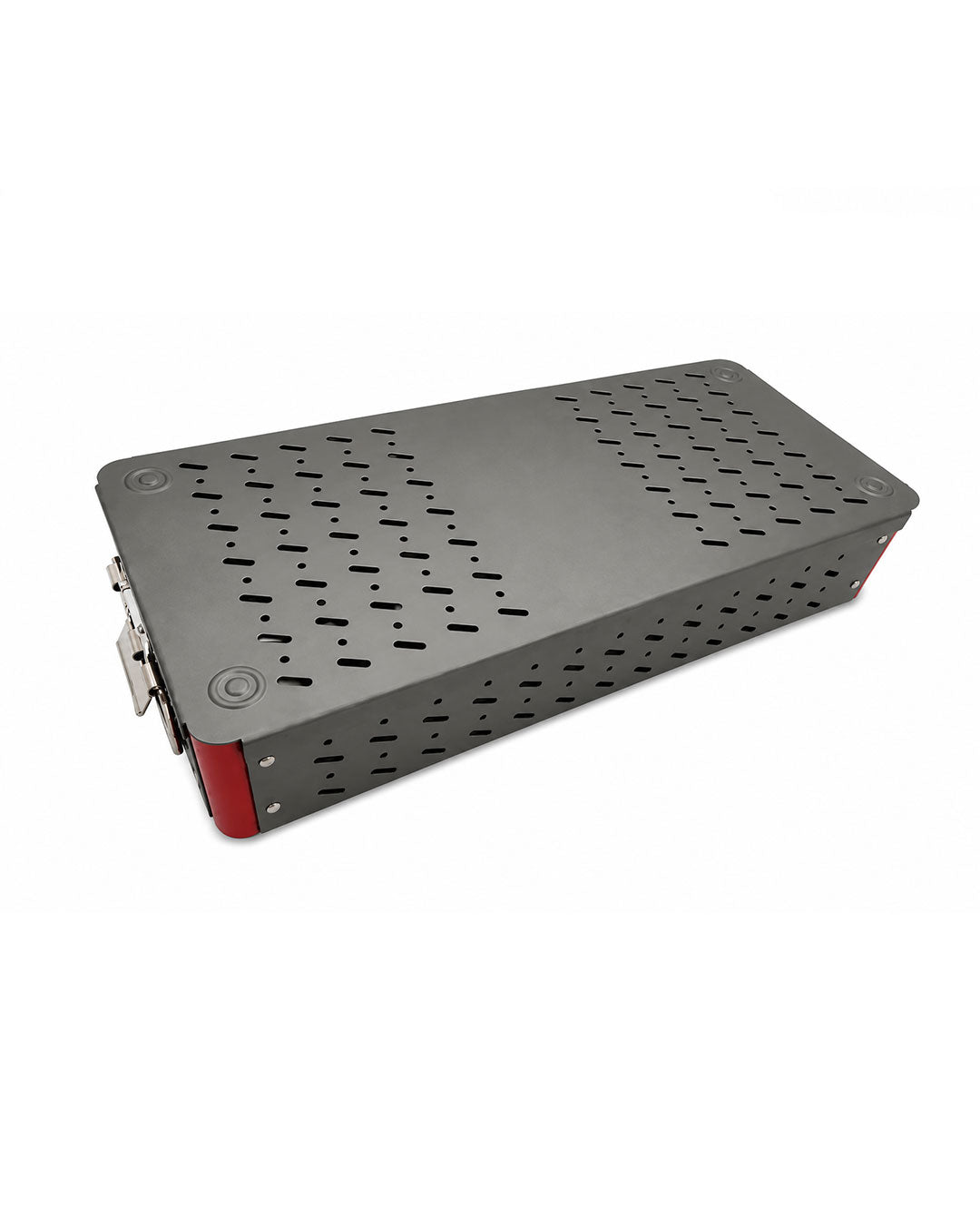
DHS/DCS Plate Instruments Set, SKU PS-OP-7310, is a reusable German stainless steel orthopedic system for guided sliding hip screw and dynamic condylar screw fixation. The 26-instrument main configuration comprises six 2.5 mm × 230 mm threaded guide wires, a quick-coupling T-handle, direct measuring device, DHS triple reamer, DHS screw wrench, impactor with two spare Teflon tips, DHS tap, centering sleeves for the tap and wrench, two insertion coupling screws, two guide shafts, a long removal coupling screw, stylet, DCS triple reamer, DCS angle guide, Excel variable angle guide, and 3.5 mm hexagonal screwdriver, arranged in an empty container. Optional additions include a 135° DHS angle guide, short-barrel DHS triple reamer, two 4.3 mm drill bits, and two 4.3 mm drill sleeves for compatible safety locking plates. Orthopedic trauma surgeons use this set during open reduction and internal fixation of intertrochanteric, selected proximal femoral, distal femoral, and supracondylar fractures, as well as corrective osteotomy and compatible implant removal. It supports fluoroscopy-guided work in hospital operating rooms, trauma centers, teaching institutions, and specialist orthopedic clinics where controlled guide-wire placement, stepped reaming, tapping, screw insertion, plate seating, and final fixation are performed in sequence.
The system works around a threaded 2.5 mm guide wire that establishes the planned axis and resists migration while the surgeon checks position fluoroscopically. The direct measuring device passes over that wire to determine the required lag-screw length from the exposed wire segment. DHS and DCS triple reamers then prepare concentric stepped channels for the screw, barrel, and junction geometry in one controlled pass; the dedicated short-barrel option limits preparation to the corresponding implant profile. A quick-coupling T-handle accepts compatible shafts and transfers manual torque while allowing rapid exchange between reaming, tapping, and insertion stages. The DHS tap cuts the cancellous thread path, while its centering sleeve keeps the tap aligned with the pilot trajectory. A separate sleeve stabilizes the wrench during lag-screw advancement. The coupling screw threads into the implant and joins the guide shaft, creating an axial driving assembly; the longer version provides purchase during extraction. The impactor seats the barrel plate without direct hammer contact on the implant surface, and its replaceable Teflon tip cushions the interface. Fixed and variable angle guides control wire orientation, the stylet clears cannulated passages, and the 3.5 mm hexagonal driver engages compatible screw recesses for plate fixation.
For an intertrochanteric fracture, the surgeon reduces the proximal femur, positions the selected DHS angle guide against the lateral cortex, and advances the threaded wire toward the center of the femoral head under anteroposterior and lateral fluoroscopy. The measuring device establishes screw length before the DHS triple reamer prepares the lateral cortex, femoral neck, and barrel seat along the same axis. Tapping is selected when bone density or implant instructions require a preformed thread path; the coupled wrench assembly then advances the lag screw to the planned depth. The barrel plate slides over the screw shaft, and the impactor brings it flush to the lateral femur before cortical or locking fixation. For a distal femoral or supracondylar construct, the DCS angle guide establishes the condylar trajectory, followed by length measurement, DCS reaming, screw insertion, and side-plate seating. The Excel variable guide supports a surgeon-selected orientation for a compatible plate design or corrective osteotomy. During revision, the long coupling screw reconnects to the lag screw for controlled removal after the plate screws are released. The same ordered workflow helps trauma teams maintain coaxial preparation and avoid independent passes that could enlarge the osseous channel.
The 2.5 mm × 230 mm threaded wire is the reference for measurement and cannulated preparation in both hip and condylar workflows; six units support replacement when a trajectory is revised or a wire is damaged. The DCS guide sets the fixed condylar orientation required for distal femoral placement, whereas the optional 135° DHS guide establishes the standard neck-shaft relationship used with a compatible hip plate. The Excel variable angle guide is chosen when the construct permits planned angular adjustment rather than a fixed template. Separate DHS and DCS triple reamers reproduce the stepped geometry of their respective lag-screw and barrel systems and are not interchangeable. The short-barrel reamer is reserved for a matching low-profile barrel configuration, preventing preparation beyond that implant’s seating requirement. Two insertion coupling screws and two guide shafts provide duplicate working interfaces for the primary implant-driving stage; the single long coupling element serves extraction. The 3.5 mm hexagonal screwdriver addresses matching plate-screw recesses. Optional 4.3 mm drill bits create pilot channels for compatible DHS/DCS safety locking plate screws, while paired 4.3 mm sleeves constrain the bit at the plate hole. The Teflon tips are replaceable contact elements rather than cutting tools.
German stainless steel provides the strength, dimensional stability, and corrosion resistance required for guide surfaces, cutting profiles, threaded connections, and torque-transmitting shafts exposed to repeated orthopedic cycles. A satin finish reduces glare beneath operating lights and allows inspection for residual soil, pitting, edge damage, or distortion. The set is supplied non-sterile and must enter a validated facility protocol before first use and after every procedure. Reprocessing begins with prompt point-of-use soil control, followed by disassembly of removable tips and coupling interfaces, cleaning of cannulations and threads, thorough rinsing, drying, functional inspection, tray organization, packaging, and steam sterilization according to the healthcare facility’s validated parameters. Reamers, taps, guide wires, sleeves, and stylets require particular attention because retained debris can obstruct coaxial passage or alter cutting performance. CE marking and manufacture under an ISO 13485 quality management system support documented medical-device procurement and traceability. For United States purchasing, FDA-compliant procurement means the hospital or distributor reviews the applicable device listing, labeling, establishment information, intended use, and import records for the supplied configuration. Reusable status does not replace cycle-by-cycle inspection; bent wires, dulled flutes, damaged threads, worn couplings, or compromised Teflon contacts must be removed from service.
| Code | Main Set Component | Units |
|---|---|---|
| 701.035 | Guide Wire with Threaded Tip, 2.5 mm Diameter × 230 mm Length | 6 |
| 701.023 | T-Handle with Quick Coupling | 1 |
| 701.024 | Direct Measuring Device | 1 |
| 701.025 | DHS Triple Reamer | 1 |
| 701.026 | Wrench for DHS Screws | 1 |
| 701.027 | DHS Impactor | 1 |
| 701.110 | Spare Teflon Tip for DHS Impactor | 2 |
| 701.028 | DHS Tap | 1 |
| 701.029 | Centering Sleeve for DHS Tap | 1 |
| 701.030 | Centering Sleeve for DHS Wrench | 1 |
| 701.031 | Coupling Screw for Inserting DHS Screw, for 2.5 mm Guide Wire | 2 |
| 701.032 | Guide Shaft for Coupling Screw | 2 |
| 701.033 | Long Coupling Screw for DHS Screw Removal | 1 |
| 701.034 | Stylet | 1 |
| 701.040 | DCS Triple Reamer | 1 |
| 701.041 | DCS Angle Guide | 1 |
| 701.049 | Variable Angle Guide – Excel | 1 |
| 301.050 | Hexagonal Screwdriver, 3.5 mm Tip | 1 |
| 900.071 | Empty Container | 1 |
| Code | Optional Component | Units |
|---|---|---|
| 701.022 | DHS Angle Guide, 135° | 1 |
| 701.042 | DHS Triple Reamer for Short Barrel | 1 |
| PS435.002 | Drill Bit, 4.3 mm, for DHS/DCS Safety Locking Plates | 2 |
| PS435.006 | Drill Sleeve, 4.3 mm, for DHS/DCS Safety Locking Plates | 2 |
| Specification | Details |
|---|---|
| SKU | PS-OP-7310 |
| Product Name | DHS/DCS Plate Instruments Set |
| Price | $1,045.00 USD |
| Size/Gauge Variants | 2.5 mm × 230 mm guide wires; 3.5 mm hexagonal driver; optional 135° DHS guide, short-barrel reamer, and 4.3 mm locking plate drills and sleeves |
| Instrument Category | Orthopedic trauma plate and sliding screw fixation instrumentation |
| Procedure | DHS fixation of intertrochanteric and selected proximal femoral fractures; DCS fixation of distal femoral and supracondylar fractures; corrective osteotomy; compatible implant removal |
| Material | German stainless steel with replaceable Teflon impactor tips |
| Finish | Satin finish |
| Sterilization | Supplied non-sterile; clean, inspect, package, and steam sterilize under a validated reusable-instrument protocol |
| Instrument Classification | Reusable manual orthopedic surgical instrument set |
| Reusable | Yes |
| Certifications | CE marked; manufactured under ISO 13485; FDA-compliant procurement documentation supported |
| Warranty | One-year manufacturing defect warranty |
| MOQ | 1 set |
| OEM / Custom Orders | Available for instrument selection, branding, tray configuration, and distributor packaging |
| After-Sale Service | Technical, documentation, replacement-component, and reordering support |
How does this set differ from a cannulated screw instrument set?
A cannulated screw instrument set prepares and inserts independent screws over guide wires, usually without a plate barrel that permits controlled sliding. The DHS/DCS Plate Instruments Set includes stepped triple reamers, lag-screw coupling hardware, plate-seating tools, and fixed or variable angle guides for a screw-and-side-plate construct. Its DHS pathway addresses a proximal femoral lag screw aligned with a lateral barrel plate. Its DCS pathway prepares a condylar screw that couples to a side plate across the distal femur. Cannulated screw systems instead use individual washers or screw heads to compress fragments along separate trajectories. Selection therefore depends on the planned implant construct, fracture pattern, reduction strategy, and compatible manufacturer technique.
Which guide and reamer should be selected for each anatomical site?
For intertrochanteric fixation, the optional 135° guide establishes a standard proximal femoral trajectory when the selected DHS plate has that barrel angle. The standard DHS triple reamer prepares the matching lag-screw and barrel channel, while the short-barrel version is used only with its corresponding implant. For distal femoral or supracondylar fixation, the DCS angle guide and DCS triple reamer reproduce the geometry of the condylar construct. The 2.5 mm × 230 mm threaded wire is used as the coaxial reference at both sites. Optional 4.3 mm bits and sleeves address compatible safety locking plate holes rather than the central lag-screw channel. The DHS/DCS Plate Instruments Set should be configured against the selected plate, screw dimensions, preoperative plan, and operative technique.
What do CE, ISO 13485, and FDA-compliant procurement mean for this product?
CE marking supports placement within the applicable European medical-device framework and requires the associated conformity documentation. ISO 13485 identifies the quality management system used for controlled production, traceability, corrective action, and device records. These credentials give procurement teams a structured basis for supplier qualification but do not replace hospital approval. For United States orders, FDA-compliant procurement requires review of applicable registration, listing, labeling, intended-use, and import documentation. The DHS/DCS Plate Instruments Set can be supplied with commercial and quality records needed for a purchasing file. Hospitals and distributors should retain the documents linked to the delivered SKU, lot, configuration, and destination market.
How do the quick coupling and centering controls work intraoperatively?
The T-handle quick coupling captures a compatible shaft and releases it for rapid exchange between manual preparation steps. The DHS tap sleeve constrains the tap around the guide-wire axis, reducing lateral excursion while threads are formed. The wrench sleeve performs the same stabilizing role as the lag screw is advanced. A coupling screw engages the implant internally, and the guide shaft transfers rotational input from the handle to that connection. For extraction, the long coupling screw restores axial purchase after plate disengagement. Within the DHS/DCS Plate Instruments Set, each interface must lock fully and rotate concentrically before it enters the prepared femoral channel.
How should an operating room team receive and reprocess the set?
The DHS/DCS Plate Instruments Set arrives non-sterile and requires complete processing before first use. Receiving personnel should reconcile every code and quantity against the main and optional tables, then record the SKU and supplied configuration. Sterile processing should disassemble detachable parts, brush cannulations and threads, clean cutting flutes, rinse, dry, and inspect all working surfaces. The instruments should then be organized in the container, packaged, and steam sterilized under the facility’s validated cycle. After surgery, guide wires, reamers, taps, couplings, sleeves, and Teflon tips require focused inspection for bending, wear, retained soil, or damaged engagement surfaces. Distributors and hospitals can request OEM tray configuration, replacement components, quality documentation, and after-sale reordering support.


