
Featured Collection
Your cart
Featured Collection

PEAK SURGICAL
SKU:PS-6949 B
Couldn't load pickup availability


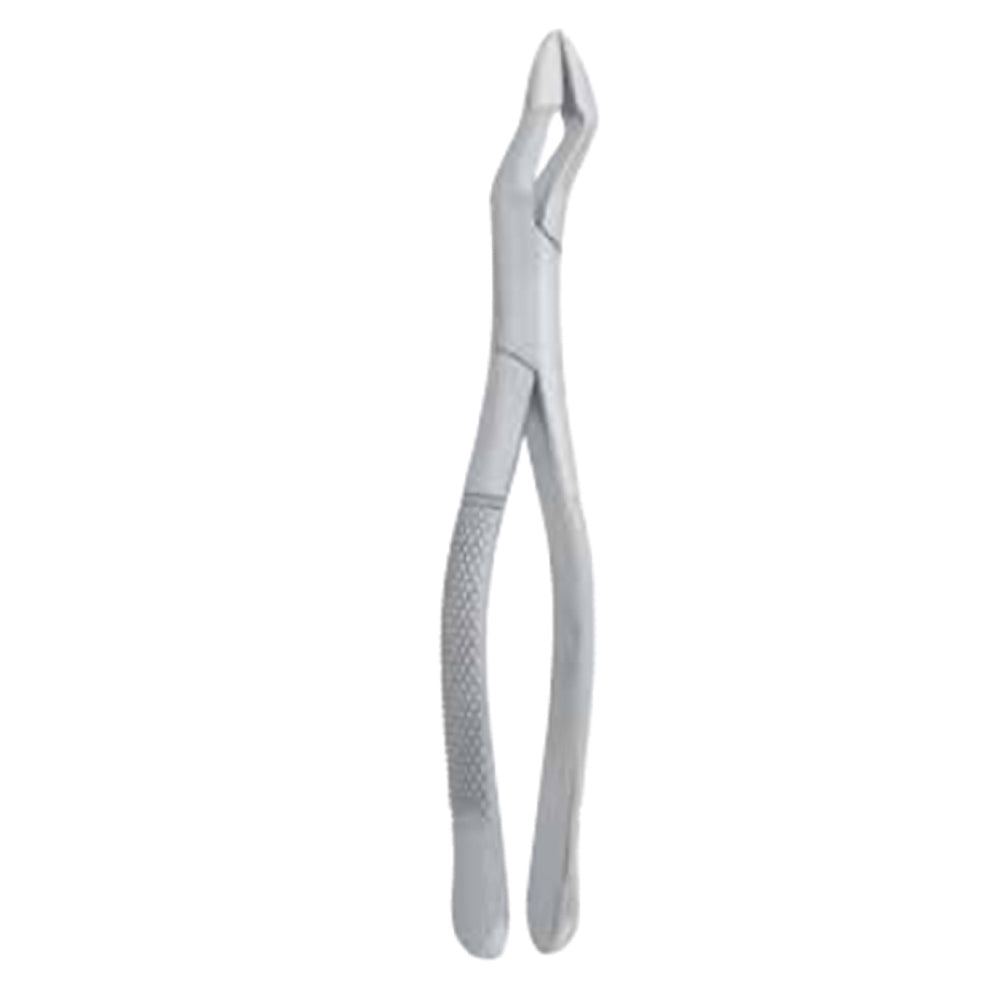
The Dental Tooth Extracting Forceps from Peak Surgicals (price: $11.55 — confirm SKU and specific pattern number with Peak Surgicals) are a medical-grade stainless steel dental extraction instrument designed for the controlled removal of teeth from the upper or lower dental arch. This listing is a separate product from the Dental Extracting Forceps ($12.65) also available from Peak Surgicals — both fall within the broad category of tooth extraction forceps, but Peak Surgicals' product catalogue lists multiple distinct extracting forceps patterns under separate SKUs, including dedicated collections for American Pattern Forceps and Extracting Forceps with Gold Handle, suggesting this listing represents a specific pattern or tooth-type designation distinct from the other extraction forceps products on the site. As with all dental extracting forceps, the instrument functions by engaging the tooth at the cervical margin — the junction between crown and root just below the gumline — with beaks shaped to match the root anatomy of the intended tooth group, and applying controlled buccal-lingual rocking force, with rotational force added only for single-rooted teeth with round root cross-sections, to expand the periodontal ligament space and mobilise the tooth for delivery along its natural path of withdrawal. It is used by general dentists, oral and maxillofacial surgeons, and dental surgery residents in dental clinics and oral surgery suites for routine and surgical tooth extraction. Available in satin, dull, and mirror finishes, reusable, autoclave compatible, and supplied under CE Mark, ISO 13485, and FDA certification.
Dental tooth extracting forceps achieve tooth removal not by cutting or drilling but by mechanically disrupting the periodontal ligament — the fibrous connective tissue suspending the tooth root within its bony socket — through controlled, progressive force application. The forceps beaks are seated as far apically along the root surface as the gingival and bone anatomy allow, engaging below the cementoenamel junction rather than gripping the crown alone, since crown-only engagement risks crown fracture without transmitting adequate force to the root and surrounding ligament. Once seated, the clinician applies alternating buccal and lingual or palatal pressure, which progressively stretches and tears the periodontal ligament fibres on each side of the root in sequence, widening the ligament space and the apparent socket diameter around the root. This rocking motion is the foundation of extraction technique for the great majority of tooth types. Once sufficient mobility is achieved — confirmed by palpable looseness and visible movement of the tooth within the socket — the tooth is delivered along its path of least resistance, typically toward the buccal or labial aspect of the arch where the surrounding bone is thinnest.
The specific beak geometry, handle angulation, and overall length of dental extracting forceps vary substantially across the many available patterns, each matched to a particular tooth type, root configuration, and arch position. Forceps intended for single-rooted anterior teeth — incisors and canines in both arches — typically feature narrower, more pointed beaks proportioned to encircle a single conical root without excess lateral play. Forceps for premolars, which may have single or occasionally bifurcated roots depending on the specific tooth and arch, use an intermediate beak width and contour. Forceps for molars, particularly in the upper arch where the typical three-root configuration (two buccal roots and one palatal root) creates an asymmetric cervical profile, often use asymmetric beak designs — one beak shaped to engage the buccal root bifurcation and the other contoured for the palatal root. Lower molar forceps frequently use a cowhorn or beaked pattern that engages the furcation between the mesial and distal roots typical of mandibular molars. The handle-to-beak angle also differs between upper and lower patterns to accommodate the different approach trajectories required for the maxillary versus mandibular arch when the clinician is positioned at the patient's side or behind the headrest.
Successful use of dental tooth extracting forceps depends on the clinician correctly anticipating the root anatomy of the target tooth before force is applied, since the appropriate technique — rocking alone versus rocking combined with rotation — differs by root configuration. Teeth with a single round or oval root cross-section, most notably the maxillary central and lateral incisors and canines, can tolerate a rotational component added to the rocking motion once initial mobility is established, since a round root can rotate slightly within an expanding socket without binding against the bony walls. Teeth with curved, flattened, fused, or multiple root configurations — the majority of premolars, all molars, and the mandibular incisors, which often have a flattened mesial-distal root cross-section — should be extracted using rocking technique without significant rotational force, since rotation applied to a non-round root risks binding against the irregular socket geometry and fracturing the root rather than mobilising it. Radiographic assessment of root number, curvature, and divergence prior to extraction allows the clinician to anticipate which technique is appropriate and to select the forceps pattern best matched to the anticipated root configuration.
The Dental Tooth Extracting Forceps are manufactured from medical-grade stainless steel, providing the structural rigidity required to transmit the substantial mechanical force of tooth luxation through the beak and handle without flex or deformation, which would compromise both the precision of force application and the clinician's tactile feedback during the procedure. The instrument is available in satin, dull, and mirror surface finishes — satin and dull finishes provide a non-glare working surface, while mirror finish offers maximum corrosion resistance and ease of visual inspection. All three finishes are compatible with steam autoclave sterilization. Periodic inspection of beak alignment is recommended, confirming the beaks meet evenly along their gripping surface without gapping, since uneven closure reduces the secure grip on the tooth root that the procedure depends on for safe, controlled force transmission.
The Dental Tooth Extracting Forceps are manufactured under CE Mark, ISO 13485, and FDA compliant quality standards. ISO 13485 certification confirms Peak Surgicals operates a documented quality management system covering medical-grade stainless steel material traceability, pattern-specific beak geometry dimensional tolerancing, and manufacturing process controls for reusable dental extraction instruments. CE Mark confirms conformity with EU MDR requirements for reusable non-powered dental instruments. FDA compliance supports procurement for US dental practices, oral and maxillofacial surgery centres, and hospital dental departments requiring verified regulatory documentation. Class I instrument classification, 1-year warranty, OEM availability, and MOQ of 1 piece support both institutional dental tray procurement and individual practice replacement ordering.
| Product Name | Dental Tooth Extracting Forceps |
|---|---|
| Price | $11.55 USD |
| Pattern / Tooth Type | Confirm specific pattern number and tooth designation with Peak Surgicals |
| Instrument Type | Tooth extraction forceps |
| Instrument Category | Dental Surgery — Extraction Instruments |
| Procedure | Routine and surgical tooth extraction |
| Material | Medical-Grade Stainless Steel |
| Finish | Satin / Dull / Mirror (specify on order) |
| Sterilization | Steam autoclave compatible |
| Instrument Classification | Class I |
| Reusable | Yes |
| Rust Free | Yes |
| Certifications | CE Mark, ISO 13485, FDA |
| Warranty | 1 Year |
| MOQ | 1 Piece |
| OEM / Custom Orders | Available |
| Packing | Carton Box |
| After-Sale Service | Return and Replacement |
How does this product differ from the Dental Extracting Forceps also listed by Peak Surgicals?
The Dental Extracting Forceps ($12.65) and the Dental Tooth Extracting Forceps (this product, $11.55) are listed as separate products on the Peak Surgicals catalogue, with a $1.10 price difference, which most likely indicates they represent different specific patterns within the broad category of tooth extraction forceps — for example, different tooth-type designations, arch positions (upper versus lower), or handle styles such as standard versus gold handle, given that Peak Surgicals also lists separate collections for American Pattern Forceps and Extracting Forceps Gold Handle. Procurement teams ordering for a specific clinical application should confirm the exact pattern, tooth-type designation, and beak configuration of each listing directly with Peak Surgicals before ordering, since the generic product names alone do not specify which tooth types or arch positions each listing is designed for.
What determines whether rotational force can be safely added during extraction?
Rotational force can be safely added to the rocking extraction motion only for teeth with a round or oval root cross-section that can tolerate rotation within an expanding socket without the root binding against irregular bony walls — this applies most reliably to the maxillary central and lateral incisors and canines, whose roots are typically single and approximately conical or oval in cross-section. For teeth with curved roots, multiple roots, or a flattened root cross-section — which describes the majority of premolars, all molars, and the mandibular incisors — rotational force risks the root binding against the socket and fracturing rather than rotating freely. In these cases, extraction relies on rocking motion alone, sometimes combined with controlled apical pressure, until sufficient mobility is achieved through periodontal ligament disruption rather than rotation. Pre-extraction radiographic review of root number and curvature is the standard method for anticipating which technique is appropriate for a given tooth.
Why is correct forceps pattern selection important for a successful extraction?
Selecting a forceps pattern not matched to the target tooth's root anatomy increases the risk of several extraction complications. A beak too narrow for a multi-rooted molar may fail to achieve adequate engagement across the tooth's full root span, reducing the mechanical advantage available and increasing the force the clinician must apply through a smaller contact area, which raises the risk of slippage. A beak shaped for the wrong arch's typical root angulation may seat poorly against the cervical margin, again increasing slippage risk. Slippage during force application can result in soft tissue laceration, damage to the adjacent tooth, or loss of the controlled force vector needed for safe luxation. Selecting the forceps pattern specifically designed for the tooth type and arch position being extracted is therefore a basic safety requirement of extraction technique, not merely a matter of efficiency.
What maintenance and inspection routine is recommended for these forceps?
Before each clinical use, the beaks should be inspected to confirm they close evenly along their full length, since uneven closure — often resulting from repeated heavy use or improper handling — reduces the secure grip on the tooth root and increases slippage risk during the substantial force applied in extraction. The beak gripping surface, which may include fine serrations or a textured finish to improve purchase on the tooth surface, should be inspected for wear or debris accumulation, particularly after cleaning, to confirm the texturing remains effective. The handle hinge should move smoothly without excessive looseness. After each use, the instrument undergoes standard decontamination, cleaning with attention to the beak surface texturing, drying, and steam autoclave sterilization before return to the dental instrument tray.
What certifications does this instrument carry?
The Dental Tooth Extracting Forceps carry CE Mark, ISO 13485, and FDA compliance certification. CE Mark confirms conformity with EU MDR requirements for reusable non-powered dental instruments. ISO 13485 certification confirms Peak Surgicals maintains a quality management system covering medical-grade stainless steel material traceability, pattern-specific beak geometry dimensional tolerancing, and manufacturing process controls for reusable dental extraction instruments. FDA compliance supports procurement for US dental practices, oral and maxillofacial surgery centres, and hospital dental departments requiring verified regulatory documentation. Class I instrument classification, 1-year warranty, MOQ of 1 piece, and OEM availability satisfy institutional and individual practice procurement requirements for dental extraction instrument sets.


