
Featured Collection
Your cart
Featured Collection

PEAK SURGICALS
SKU:PS-OP-02674
Couldn't load pickup availability


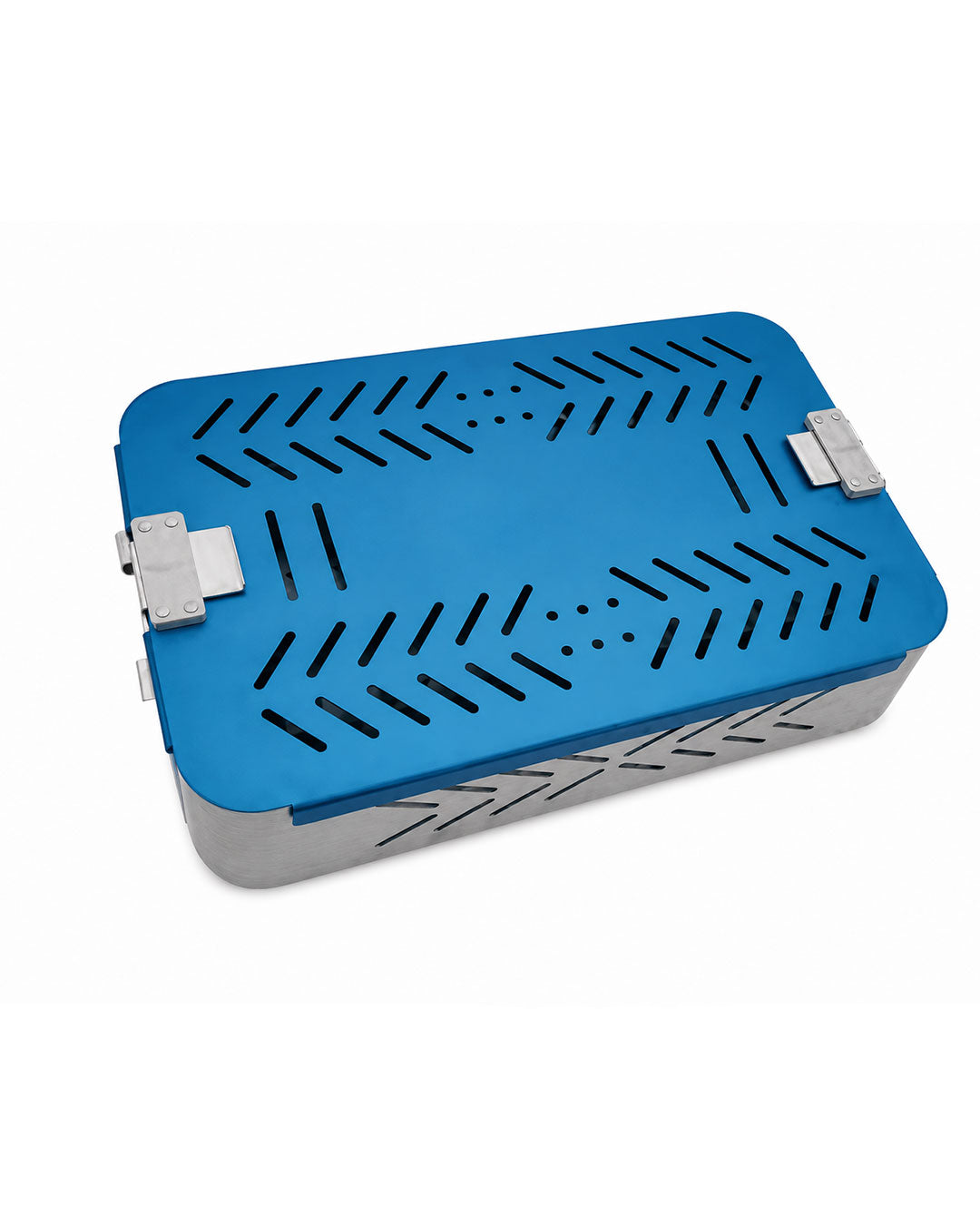
Damaged Broken Screws Removal Instruments Set, SKU PS-OP-02674, is a 52-instrument German stainless steel orthopedic system supplied in a coded container for extracting stripped, seized, buried, or fractured fixation screws. Its profile-specific interfaces include cross and small or large slotted shafts; 1.2 and 1.5 mm square drives; 1.5, 2.0, 2.5, 3.0, 3.5, 4.0, 4.5, 5.0, and 5.5 mm hexagonal drivers; T6, T6.2, T7, T8, T9, T10, T15, T18, T20, T25, and T30 star tips; and a 2.0 mm triangular option. Small, medium, and large trepans, measured trephines from 2.0 to 8.0 mm, 1.2 to 4.0 mm hexagonal slip extractors, 4.0 to 6.0 mm drill bits, a reamer, sharp hook, spine T-type spanner, bone screw holding forceps, round bone sword, and quick-coupling T and straight handles support staged retrieval. Orthopedic trauma, revision arthroplasty, foot and ankle, hand, and spine surgeons use the system during plate removal, failed fixation revision, long-bone hardware extraction, periarticular reconstruction, and posterior spinal implant removal in operating rooms, ambulatory surgical centers, and specialist orthopedic hospitals.
The system begins with the least destructive interface that can transmit removal torque. Cross, slotted, square, triangular, hexagonal, and star-tip shafts seat within corresponding screw recesses; close profile contact distributes torsion across the remaining internal geometry rather than concentrating force on an already damaged corner. The straight quick handle supports controlled axial alignment in confined exposure, while the T-type quick handle increases the moment arm when greater breakout torque is required. Their couplings retain interchangeable shafts yet permit rapid changes as the recess condition becomes apparent. Hexagonal slip extractors use an aggressive engagement form to obtain purchase inside a rounded socket after a standard driver spins without capture. Trepans and calibrated trephines pass concentrically around a buried head or retained shaft, removing a narrow annulus of cortical bone, callus, or ongrowth so the implant can be grasped without broad excavation. Drill bits create or deepen a central purchase point, and the reamer refines the prepared channel. The sharp hook clears the recess or retrieves loose fragments; holding forceps capture an exposed head or shank. The spine T-type spanner supplies leverage at compatible spinal interfaces, while the round bone sword develops a controlled access path through obstructing bone. Together, these mechanisms allow escalation from direct engagement to circumferential release and mechanical extraction.
During removal of a tibial plateau, distal femoral, proximal humeral, clavicular, ankle, or forefoot plate, the surgeon exposes the implant, removes debris from each recess with the sharp hook, and first tests the matching driver under firm axial load. An intact interface is backed out with the straight handle; a cold-welded locking screw can be addressed with the T handle, provided the recess still accepts its profile. If the socket is rounded, a slip extractor is seated to obtain reverse purchase. For a head concealed by callus, the selected trephine cores only the bone required to expose the circumference before the holding forceps stabilize and rotate the component. A fractured shaft retained in the femur, tibia, humerus, radius, ulna, calcaneus, or metatarsal can be approached by centering a drill bit, refining the tract with the reamer, and coupling an extractor once purchase is established. In revision hip or knee exposure, this sequence assists removal of screws obstructing implant explantation or reconstruction. During posterior cervical, thoracic, or lumbar hardware revision, the star, hexagonal, and spine-spanner interfaces address accessible fasteners while surrounding neural elements remain protected by the established surgical exposure. Instrument choice progresses according to recess profile, diameter, depth, and retained fragment position, not force alone.
The cross and slotted shafts address conventional cruciform and straight-slot heads; small and large slotted patterns are selected by slot width to avoid edge loading. Square 1.2 and 1.5 mm and triangular 2.0 mm options engage less common internal drives. Hexagonal drivers span 1.5–5.5 mm for small-fragment through large-fragment fixation, whereas T6–T10 star shafts cover smaller recesses and T15–T30 address progressively larger star interfaces. The 1.2, 2.5, 2.7, 3.5, and 4.0 mm slip extractors are matched to the residual socket so their biting surfaces engage without expanding the screw head. Small, medium, and large trepans provide rapid pattern selection; measured 2.0, 2.7, 3.5, 4.0, 4.5, 5.0, 6.5, and 8.0 mm trephines are chosen to pass around the retained metal while preserving adjacent cortex. The 4.0, 5.0, and 6.0 mm drills prepare centered access appropriate to fragment diameter, and the reamer regularizes that tract. The hook cleans and mobilizes; forceps maintain direct purchase once enough head or shank is visible. The round bone sword opens a precise pathway through local osseous overgrowth. Straight and T quick handles govern reach and leverage, the spinal spanner addresses compatible posterior constructs, and the perforated container separates long shafts from larger extraction tools for identification, cleaning, and count control.
German stainless steel provides the hardness required for driver profiles, extractor flutes, trephine teeth, and drill geometry while retaining the toughness needed under manual torsional load. Corrosion resistance supports repeated exposure to enzymatic cleaning, rinsing, drying, inspection, packaging, and steam sterilization when the hospital follows a validated reusable-instrument cycle. The satin surface moderates glare beneath operating lights and makes retained soil, pitting, or edge damage easier to identify during inspection. Hingeless shafts and open working profiles remain directly accessible for brushing; cannulated or recessed areas require flushing until visibly clean. Trephine teeth, driver corners, coupling ends, and extractor engagement surfaces should be checked under magnification before each case because deformation changes fit and can worsen recess stripping. The set is supplied non-sterile and requires cleaning and sterilization before initial and subsequent use. Its perforated container organizes coded components while permitting cleaning-agent contact, drainage, and sterilant circulation; instruments should be disassembled from handles and arranged without overlapping working ends. CE documentation supports applicable European conformity review, and ISO 13485 identifies manufacture under a medical-device quality management system. For United States procurement, FDA status is evaluated through device classification, establishment registration, listing, labeling, and importer records rather than interpreting CE marking or ISO certification as FDA approval.
| PS-674 Damaged Broken Screws Removal Instruments Set | Set Consisting of | Units |
|---|---|---|
| PS-674.01 | Cross Screwdriver Shaft | 1 |
| PS-674.02 | Slotted Screwdriver Shaft - Small | 1 |
| PS-674.03 | Slotted Screwdriver Shaft - Large | 1 |
| PS-674.04 | Square Screwdriver Shaft 1.2mm | 1 |
| PS-674.05 | Square Screwdriver Shaft 1.5mm | 1 |
| PS-674.06 | Trepan - Small | 1 |
| PS-674.07 | Trepan - Medium | 1 |
| PS-674.08 | Trepan - Large | 1 |
| PS-674.09 | Hexagonal Screwdriver Shaft 1.5mm | 1 |
| PS-674.10 | Hexagonal Screwdriver Shaft 2.0mm | 1 |
| PS-674.11 | Hexagonal Screwdriver Shaft 2.5mm | 1 |
| PS-674.12 | Hexagonal Screwdriver Shaft 3.0mm | 1 |
| PS-674.13 | Hexagonal Screwdriver Shaft 3.5mm | 1 |
| PS-674.14 | Hexagonal Screwdriver Shaft 4.0mm | 1 |
| PS-674.15 | Hexagonal Screwdriver Shaft 4.5mm | 1 |
| PS-674.16 | Hexagonal Screwdriver Shaft 5.0mm | 1 |
| PS-674.17 | Hexagonal Screwdriver Shaft 5.5mm | 1 |
| PS-674.18 | Spine T-Type Spanner | 1 |
| PS-674.19 | Trephine 2.0mm | 1 |
| PS-674.20 | Trephine 2.7mm | 1 |
| PS-674.21 | Hexagonal Slip Extractor 1.2mm | 1 |
| PS-674.22 | Hexagonal Slip Extractor 2.5mm | 1 |
| PS-674.23 | Hexagonal Slip Extractor 2.7mm | 1 |
| PS-674.24 | Hexagonal Slip Extractor 3.5mm | 1 |
| PS-674.25 | Hexagonal Slip Extractor 4.0mm | 1 |
| PS-674.26 | Screwdriver Shaft (Star Tip) T6 (1.8mm) | 1 |
| PS-674.26A | Screwdriver Shaft (Star Tip) T6.2 (2.0mm) | 1 |
| PS-674.27 | Screwdriver Shaft (Star Tip) T7 (2.36mm) | 1 |
| PS-674.28 | Screwdriver Shaft (Star Tip) T8 (2.46mm) | 1 |
| PS-674.29 | Screwdriver Shaft (Star Tip) T9 (2.7mm) | 1 |
| PS-674.30 | Screwdriver Shaft (Star Tip) T10 (3.0mm) | 1 |
| PS-674.31 | Screwdriver Shaft (Star Tip) T15 (3.4mm) | 1 |
| PS-674.32 | Screwdriver Shaft (Star Tip) T18 (3.9mm) | 1 |
| PS-674.33 | Screwdriver Shaft (Star Tip) T20 (4.3mm) | 1 |
| PS-674.34 | Screwdriver Shaft (Star Tip) T25 (4.5mm) | 1 |
| PS-674.35 | Screwdriver Shaft (Star Tip) T30 (5.2mm) | 1 |
| PS-674.36 | Trephine 4.0mm | 1 |
| PS-674.37 | Trephine 5.0mm | 1 |
| PS-674.38 | Trephine 6.5mm | 1 |
| PS-674.39 | Trephine 8.0mm | 1 |
| PS-674.40 | Drill Bit 4.0mm | 1 |
| PS-674.41 | Drill Bit 5.0mm | 1 |
| PS-674.42 | Drill Bit 6.0mm | 1 |
| PS-674.43 | Reamer | 1 |
| PS-674.44 | Sharp Hook | 1 |
| PS-674.45 | T-Type Quick Handle | 1 |
| PS-674.46 | Straight Quick Handle | 1 |
| PS-674.47 | Trephine 4.5mm | 1 |
| PS-674.48 | Trephine 3.5mm | 1 |
| PS-674.49 | Bone Screw Holding Forceps | 1 |
| PS-674.50 | Round Sword for Bone | 1 |
| PS-674.51 | Triangular Screwdriver Shaft 2.0mm | 1 |
| PS-674.00 | Empty Container | 1 |
| Specification | Details |
|---|---|
| SKU | PS-OP-02674 |
| Product Name | Damaged Broken Screws Removal Instruments Set |
| Price | $1,098.90 USD |
| Size/Gauge Variants | Driver profiles: square 1.2–1.5mm, hexagonal 1.5–5.5mm, star T6–T30, triangular 2.0mm; slip extractors 1.2–4.0mm; trephines 2.0–8.0mm; drills 4.0–6.0mm |
| Instrument Category | Orthopedic implant removal and revision instrumentation |
| Procedure | Damaged screw extraction, broken screw retrieval, plate removal, fixation revision, spinal hardware removal |
| Material | German stainless steel |
| Finish | Satin, low-reflection finish |
| Sterilization | Supplied non-sterile; clean and steam sterilize using the healthcare facility's validated reusable-instrument cycle |
| Instrument Classification | Reusable manual orthopedic surgical instrument set |
| Reusable | Yes |
| Certifications | CE & ISO 13485; FDA-compliant procurement documentation |
| Warranty | 1-year warranty against manufacturing defects |
| MOQ | 1 set |
| OEM / Custom Orders | Available for instrument marking, set configuration, packaging, and distributor programs |
| After-Sale Service | Technical support, replacement-part coordination, and warranty assistance |
How does this set differ from a standard orthopedic screwdriver set?
The Damaged Broken Screws Removal Instruments Set combines profile-matched drivers with dedicated extraction and bone-release tools. A standard orthopedic screwdriver set primarily transfers torque to an undamaged recess. Its conventional shaft can lose purchase when an internal hex or star profile has rounded or when the head is buried beneath callus. Slip extractors in this system bite into a compromised socket, while trephines remove a narrow ring of bone around inaccessible metal. Drill bits, a reamer, a hook, and holding forceps support fragment preparation, exposure, and capture after direct driving has failed. The broader mechanism range makes this set appropriate for revision and hardware-removal cases rather than routine screw insertion alone.
How is the correct driver, extractor, or trephine size selected?
Selection starts with the implant recess profile, measured interface, screw diameter, and remaining bone around the fragment. For an intact hex recess, the 1.5–5.5 mm driver that seats fully without rotational play is used; T6–T30 shafts serve matching star recesses. Square 1.2 or 1.5 mm and triangular 2.0 mm shafts address their corresponding proprietary geometries. If a rounded socket cannot transmit torque, the 1.2–4.0 mm slip extractor is sized to gain purchase inside the residual cavity. For a buried head or fractured shank, the 2.0–8.0 mm trephine is chosen to clear the metal circumference while limiting cortical removal. The Damaged Broken Screws Removal Instruments Set supports this progression during distal radius, clavicle, tibial plateau, ankle, femoral, and spinal fixation revision.
What do CE, ISO 13485, and FDA requirements mean for procurement?
CE documentation addresses applicable European medical-device conformity requirements for the Damaged Broken Screws Removal Instruments Set. ISO 13485 identifies a quality management system governing medical-device production, traceability, corrective action, and controlled records. Neither designation should be represented as United States FDA approval. US hospitals and distributors assess the applicable device classification, establishment registration, listing, labeling, importer, and shipment documentation. Procurement teams should retain the quotation, product identification, lot or batch records, instructions for use, and supplied conformity documents within their vendor file. This framework supports credentialing and receiving controls without merging three distinct regulatory pathways.
How are the quick-coupling handles and extraction controls used intraoperatively?
The straight quick handle locks a selected shaft on axis for controlled seating and removal in a narrow exposure. Its coupling allows the operator to change from a conventional driver to a slip extractor without exchanging the complete handle. The T-type quick handle provides a wider lever arm when measured manual breakout torque is needed. Axial pressure is maintained during rotation to prevent cam-out and further recess damage. If direct engagement fails, the Damaged Broken Screws Removal Instruments Set permits progression to trephine release, drilling, reaming, and forceps capture. The surgeon stops escalation when the selected interface deforms, the fragment migrates, or additional bone removal would threaten the planned reconstruction.
How should hospitals reprocess and manage the set between cases?
The Damaged Broken Screws Removal Instruments Set is supplied non-sterile and requires reprocessing before first use and after every procedure. Staff detach all shafts from quick handles, remove gross soil promptly, and clean recesses, teeth, flutes, and coupling ends with the facility's validated chemistry and method. After rinsing and drying, each coded piece is inspected for corrosion, retained debris, blunt teeth, rounded driver corners, distortion, and secure coupling. The 53 components are reconciled against the composition table and returned to their designated container positions without stacking working ends. The loaded perforated case is packaged and steam sterilized under the healthcare organization's validated cycle for reusable stainless steel instruments. Distributors and operating-room supply teams can use the PS-674 codes for replenishment, service communication, and set reconciliation.


