
Featured Collection
Your cart
Featured Collection

PEAK SURGICAL
SKU:PS-P-001004
Couldn't load pickup availability
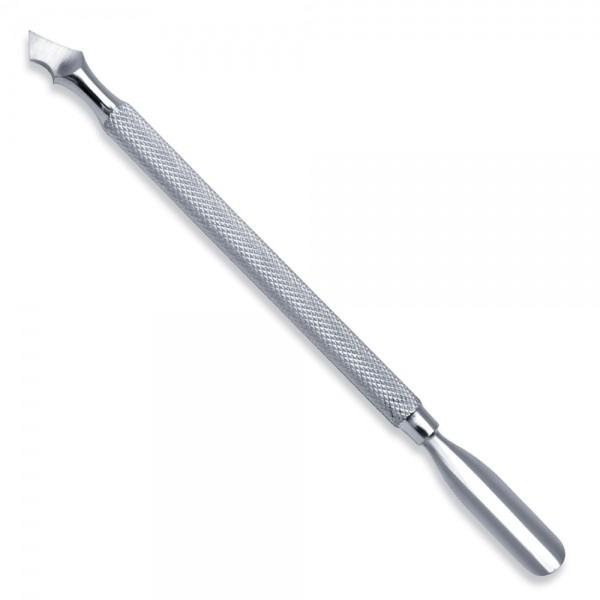
The Cuticle Remover Tool is a stainless steel periungual debridement instrument available in three blade widths — 4mm (Size 12 / 0.16in), 5mm (Size 14 / 0.20in), and 6mm (Size 16 / 0.24in) — designed for the mechanical removal of dead cuticle tissue and pterygium from the nail plate surface in professional manicure, pedicure, gel nail preparation, and periungual skin care settings. The working edge of the cuticle remover is a fine curved or beveled blade profile that scrapes and debrides the thin layer of keratinized dead tissue that adheres to the nail plate surface after cuticle retraction, removing the residual pterygium — the translucent skin that migrates from the proximal nail fold across the nail plate — that a pusher alone cannot fully separate and that a nipper cannot reach in the flat, plate-adherent zone. The three blade widths address different nail sizes and working zones: the 4mm Size 12 for fine fingernail debridement and narrow nail plates; the 5mm Size 14 as the all-purpose width for standard fingernail cuticle removal across the full hand; and the 6mm Size 16 for broader nail plates including the hallux and larger fingernails where a wider blade reduces the number of passes needed to clear the plate surface completely. Manufactured from stainless steel for disinfection compatibility, corrosion resistance, and durability in high-volume professional settings. Used by nail technicians, gel nail specialists, manicurists, and podiatric nail care professionals in nail salons, beauty clinics, and podiatric practices. Sold as 1 piece per size selected.
The cuticle remover tool occupies a specific and distinct step in the professional cuticle preparation sequence — a step that neither the pusher nor the nipper performs. After cuticle retraction with a pusher moves the bulk of the cuticle tissue back toward the nail fold, a thin film of keratinized pterygium frequently remains adherent to the nail plate surface in the zone between the retracted cuticle line and the free edge of the nail fold. This pterygium is the distal portion of the nail fold's stratum corneum that has migrated and bonded to the nail plate keratin during the growth cycle. It is too thin and plate-adherent to be lifted by the spade tip of a pusher and too flat and continuous to be captured cleanly by a nipper jaw without risking contact with the surrounding living epithelium. The cuticle remover's beveled or curved working edge addresses this residual tissue by scraping it from the nail plate surface — a debridement action that lifts the pterygium away from the plate keratin with a light, controlled stroking motion. The three blade widths allow the operator to match the blade coverage to the nail width and working zone: the 4mm blade is used for precise work in the narrow zone immediately above the cuticle line on smaller nails, the 5mm blade covers the standard proximal nail plate width in average fingernails, and the 6mm blade is used for wider nails where a single-pass stroke across the full plate width is preferred over multiple narrower passes. Complete pterygium removal is a clinically significant outcome for gel nail services, where any residual dead tissue on the plate surface under gel product creates a bonding void that leads to proximal lifting and premature service failure.
The cuticle remover tool is most critically valued in gel and acrylic nail enhancement services, where the tolerance for residual cuticle tissue on the nail plate surface is effectively zero. In standard polish manicure services, a small amount of residual pterygium may be acceptable because polish films are thin and conform to minor surface irregularities; in gel and acrylic applications, the same residual tissue creates a physical and chemical barrier between the product adhesion layer and the nail plate keratin. UV gel polish adhesion to nail plate keratin is a molecular bonding process that requires direct contact between the gel formulation and the nail keratin surface — any interposing tissue, no matter how thin, disrupts the bond at that location. The cuticle remover tool, used after the cuticle pusher to clear any remaining pterygium, provides the final clean nail plate surface that gel adhesion requires. In standard manicure, the cuticle remover serves a finishing function: after retraction and nipping, any thin transparent film remaining on the nail plate is scraped clean, producing the precise, defined cuticle line that distinguishes a professional service from a consumer-level result. In podiatric nail care, the instrument is used for debridement of the proximal nail fold and lateral nail sulcus where accumulated dead skin, debris, and thickened pterygium are common findings in patients with onychomycosis, chronic paronychia, or psoriatic nail disease — where mechanical debridement with an appropriately sized blade is preferable to chemical remover products that may irritate compromised periungual skin.
The three blade widths in this series — 4mm (Size 12), 5mm (Size 14), and 6mm (Size 16) — mirror the sizing conventions used across professional cuticle instruments and allow the operator to match the working blade coverage to the specific nail anatomy and service being performed. The 4mm Size 12 blade is the precision width for fine debridement work: narrow enough to work within the 3–5mm proximal nail plate zone of smaller fingernails, to reach into the lateral nail fold recesses adjacent to the nail groove, and to address the narrow nail plates of the little finger and ring finger without the blade overhanging onto the lateral nail fold skin. This size is preferred by gel nail specialists who need to clear pterygium from the precise zone immediately proximal to the free edge of the retracted cuticle without disturbing the healthy nail fold epithelium on either side. The 5mm Size 14 blade covers the proximal plate width of average adult fingernails in a single stroke, making it the most efficient choice for a standard ten-finger manicure where consistent plate clearance across all nails is the goal. The 6mm Size 16 blade is appropriate for larger nail plates — the thumb, the hallux in pedicure services, and the larger nails of clients with wide nail beds — where a 5mm blade would require multiple overlapping passes to clear the full plate width and a single 6mm stroke provides complete coverage in one motion. Selecting the correctly sized blade reduces procedural time, minimises the number of strokes needed for complete debridement, and reduces the risk of inadvertently contacting the lateral nail fold with a blade that is too wide for the nail being treated.
The Cuticle Remover Tool is manufactured from stainless steel, which provides the blade edge stability, corrosion resistance, and chemical compatibility required for a professional nail debridement instrument in a high-volume salon or clinical environment. The working edge of the cuticle remover depends on its dimensional precision — a blade that has dulled, chipped, or deformed from corrosion or mechanical wear will scrape irregularly, catching on the nail plate surface rather than gliding smoothly across it, producing an uneven debridement result and increasing the pressure required for each stroke. Stainless steel maintains its edge geometry and surface finish through repeated use and chemical disinfection cycles, unlike lower-grade metals that pit, corrode, and deform after exposure to cuticle remover products, acetone, alcohol, and quaternary ammonium disinfectants. The instrument should be inspected at each cleaning cycle for any visible edge deformation, corrosion spotting, or surface roughness at the working edge; any blade showing these signs should be replaced, as working edge condition directly determines debridement quality and the safety margin between the blade and the nail fold epithelium. The stainless steel construction is fully compatible with standard professional nail salon disinfection protocols and with autoclave sterilization for clinical settings requiring patient-to-patient sterilization.
The Cuticle Remover Tool is manufactured under a quality management system certified to ISO 13485, governing all production stages including stainless steel material sourcing, precision blade geometry machining at all three stated widths, dimensional inspection, surface finishing, and packaging. CE Mark certification confirms conformity with applicable European requirements for professional stainless steel personal care instruments. FDA compliance documentation is maintained for United States distribution, meeting applicable regulatory requirements for professional-use stainless steel nail care instruments supplied to US nail salons, beauty clinics, spa businesses, and podiatric practices. These certifications are recognized by institutional buyers in the USA, India, Pakistan, Vietnam, and across international beauty industry and clinical supply frameworks. Certificates of conformity and quality documentation are available on request. OEM manufacturing and custom blade width or geometry configurations are available within the same certified manufacturing framework.
| SKU | — (verify in Shopify admin) |
|---|---|
| Product Name | Cuticle Remover Tool |
| Price | $4.47 USD per piece |
| Available Blade Widths | 4mm / Size 12 / 0.16in · 5mm / Size 14 / 0.20in · 6mm / Size 16 / 0.24in |
| Working End | Curved or beveled scraper blade for pterygium and dead cuticle debridement from nail plate surface |
| Instrument Function | Mechanical removal of pterygium and residual dead cuticle tissue from the nail plate surface after retraction |
| 4mm / Size 12 Application | Fine fingernail pterygium removal, narrow nail plates, lateral nail fold zone, gel nail precision prep |
| 5mm / Size 14 Application | Standard fingernail cuticle removal across full proximal plate width, general professional manicure |
| 6mm / Size 16 Application | Wide nail plates, thumb and hallux nails, pedicure and podiatric nail debridement |
| Category | Pushers & Skin Care Tools / Manicure & Pedicure Instruments |
| Material | Stainless Steel |
| Certifications | CE Mark, ISO 13485, FDA |
| Reusability | Reusable |
| Quantity | 1 Piece |
| Rust Resistance | Yes |
| Warranty | 1 Year |
| MOQ | 1 Piece |
| OEM / Custom Orders | Available |
| Packing | Carton Box |
| Place of Origin | Pakistan |
| Brand | Peak Surgicals |
| Primary Use | Professional mechanical removal of pterygium and dead cuticle tissue from the nail plate surface in manicure, gel nail preparation, pedicure, and podiatric nail care settings |
| After-Sale Service | Return and Replacement |
What is pterygium and why does removing it from the nail plate require a dedicated tool?
Pterygium unguis is the clinical term for the thin layer of epithelium from the proximal nail fold that migrates forward and adheres to the nail plate surface as the nail grows distally. In everyday professional nail care terminology it is called pterygium or, more loosely, dead cuticle or plate skin. It is structurally distinct from the cuticle proper (the free edge of the nail fold that can be retracted with a pusher) because it is already bonded to the nail plate surface at a molecular level — it has fused with the nail plate keratin during the nail growth cycle and cannot simply be lifted away by a pushing motion. This is why a cuticle pusher alone does not complete the job: the pusher moves the bulk of the nail fold and the free cuticle margin proximally, but the pterygium that was already adherent to the plate stays behind, flat against the plate surface, largely invisible in normal lighting. A cuticle nipper cannot remove it either, because its spring-action jaw requires tissue thickness and free margin to capture — pterygium lying flat against the plate provides neither. The cuticle remover tool, with its beveled or curved scraper blade, provides the third mechanical action in the cuticle preparation sequence: it scrapes along the nail plate surface, dislodging the bonded pterygium layer with a controlled shearing motion that lifts the tissue away from the plate without requiring it to have a free edge. The blade widths (4mm, 5mm, 6mm) are designed to match the working width of the plate zone being cleared, allowing efficient single-pass debridement of the pterygium layer across the full proximal plate surface.
Where does the cuticle remover tool fit in the professional nail preparation sequence?
In a complete professional nail preparation sequence, three mechanical instruments are used in a defined order to prepare the nail plate for service. The cuticle pusher (retraction) is used first — after soaking or cuticle remover product application — to move the bulk of the cuticle and proximal nail fold tissue proximally away from the nail plate, exposing the plate surface and defining the cuticle line. The cuticle remover tool is used second, after retraction, to scrape the pterygium and any adherent dead tissue from the nail plate surface in the zone that the pusher has exposed — this step completes the plate clearance that the pusher initiated. The cuticle nipper is used third, to trim away the detached and now-visible cuticle tissue at the nail fold margin — cutting tissue that has been lifted and defined by the pusher and cleared of adhered pterygium by the remover. Each instrument in this sequence performs a function the others cannot: the pusher moves but cannot clear plate-adherent pterygium; the remover clears plate-adherent pterygium but cannot lift bulk cuticle tissue; the nipper cuts freed tissue but cannot scrape plate-adherent layers. In gel nail services, the remover step is often considered the most critical of the three because it is pterygium residue on the nail plate that most commonly causes proximal gel lifting — the pusher and nipper can be executed well, but if the remover step is skipped, gel adhesion at the proximal plate edge will be incomplete.
How does this Cuticle Remover Tool differ from the Cuticle Nail Clippers also in the Peak Surgicals range?
The Cuticle Remover Tool and the Cuticle Nail Clippers are mechanically and functionally distinct instruments that address different tissue types with different actions. The Cuticle Nail Clippers (a cuticle nipper) use a spring-action scissor mechanism with two opposing cutting blades that close to shear tissue — they work on free, detached cuticle tissue that has been lifted by the pusher and has a defined free margin that the nipper jaw can capture. The Cuticle Remover Tool has a scraper-style blade that is drawn across the nail plate surface with a stroking motion — it works on plate-adherent pterygium that has no free margin and cannot be sheared by a nipper. Both tools come in matching size variants (4mm/Size 12, 5mm/Size 14, 6mm/Size 16) because both need to match the nail plate width they address, but the size indicates blade width for the remover and jaw opening width for the nipper. In a fully equipped professional nail preparation kit, both instruments are stocked alongside a cuticle pusher: the pusher for retraction, the remover for plate debridement, and the nipper for tissue trimming — each addressing a distinct step that the others cannot perform. The Cuticle Nail Clippers page describes the nipping step in detail; this page addresses the plate debridement step that should precede it in gel and acrylic nail preparation workflows.
What cleaning and disinfection protocol is recommended?
After each client, rinse the working blade under running water and brush away any tissue debris. Immerse the instrument fully in an EPA-registered hospital-grade disinfectant — quaternary ammonium compound, 70% isopropyl alcohol, or an approved barbicide-equivalent — for the full required contact time per your state cosmetology board regulations, typically 10 minutes minimum for metal nail implements in the United States. Remove, rinse, and dry before next use. The blade edge should be inspected at each cleaning cycle for dullness, chipping, or surface roughness; a blade that drags or catches rather than glides should be replaced. For podiatric or dermatological clinical use requiring sterilization between patients, the stainless steel construction is fully compatible with steam autoclave sterilization at 134°C pre-vacuum parameters. The instrument should be pre-cleaned thoroughly — including any tissue debris in the blade-to-handle joint — before terminal sterilization.
What certifications does this product carry?
The Cuticle Remover Tool is manufactured under an ISO 13485-certified quality management system covering material procurement, blade machining at stated widths, dimensional inspection, surface finishing, and packaging. CE Mark certification confirms conformity with applicable European requirements for professional stainless steel skin care instruments. FDA compliance documentation supports United States distribution. Certificates of conformity are available on request for institutional procurement and vendor qualification purposes.
Are bulk or OEM orders available?
Yes. Peak Surgicals accepts bulk orders with a minimum order quantity of 1 piece per size, and volume pricing is available for nail salons, beauty supply distributors, gel nail supply companies, podiatric supply wholesalers, and professional nail tool chains. All three blade widths can be ordered individually or as assortments. OEM manufacturing is available for private-label branding, modified blade geometry, alternative working tip profiles, or custom packaging within the ISO 13485-certified framework. Free shipping on orders of $99 or more.
