
Featured Collection
Your cart
Featured Collection

PEAK SURGICALS
SKU:
Couldn't load pickup availability


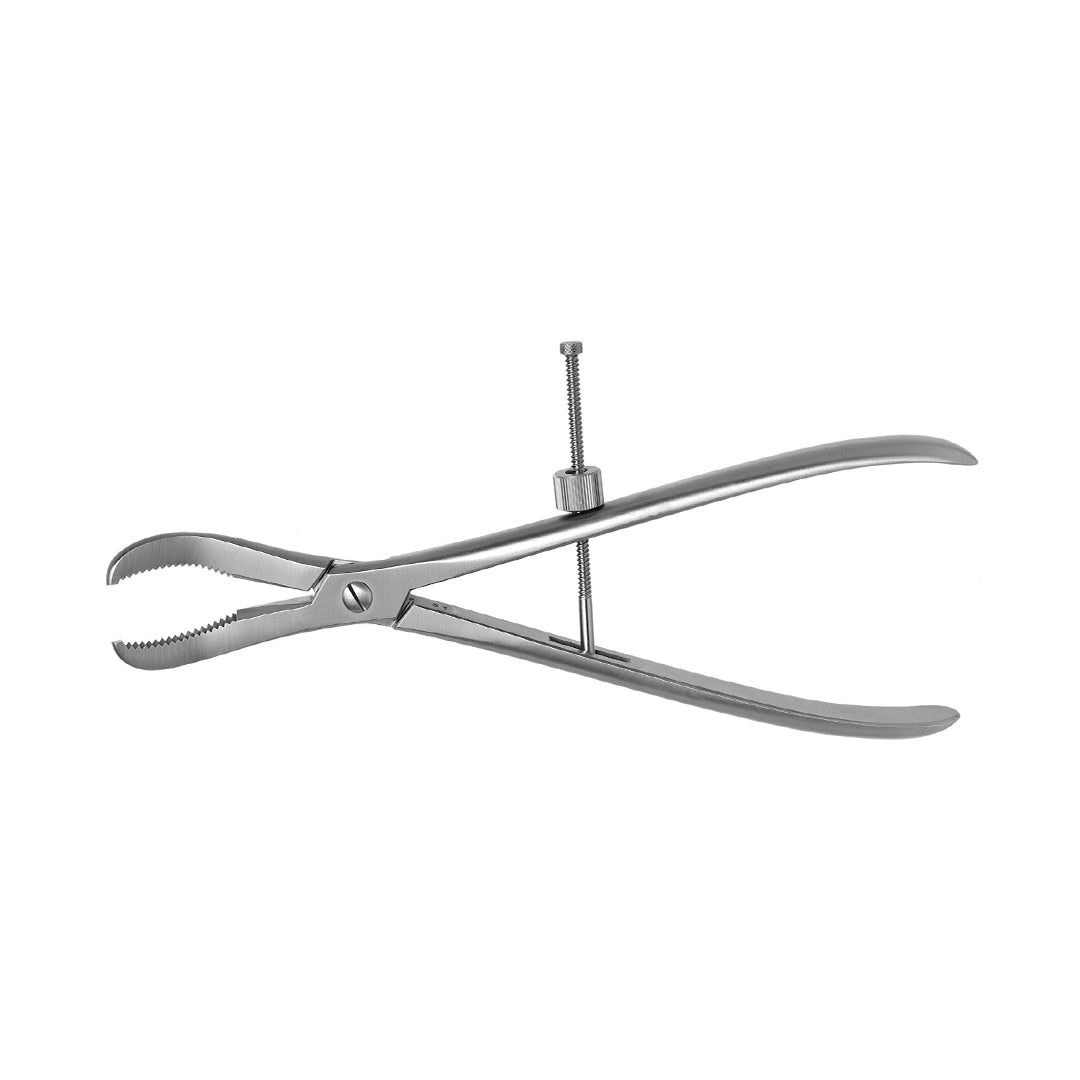
Bone Holding Forceps with Speedlock, part number gS 46.2407, are reusable orthopedic forceps manufactured from German surgical stainless steel for controlled gripping, reduction, rotation, compression, and temporary stabilization of bone during fracture and reconstructive procedures. The instrument measures 7 in overall and incorporates curved serrated jaws, a Speedlock closure mechanism, and a documented maximum opening of approximately 28 mm. The curved jaw profile follows the contour of exposed osseous surfaces while serrations improve resistance to slipping during fragment manipulation. The Speedlock mechanism allows the surgeon to establish and maintain the selected jaw position without continuous manual squeezing, while still permitting controlled adjustment when reduction changes. This configuration is used during open fracture reduction, small- and medium-bone fixation, osteotomy, plate positioning, drilling, screw insertion, and other orthopedic workflows requiring temporary bone control. Its compact 7-inch length supports maneuverability within restricted surgical exposures while maintaining enough leverage for controlled reduction. Orthopedic trauma surgeons and reconstructive teams use this pattern when secure bone purchase and rapidly adjustable locked stabilization are required.
The defining features of gS 46.2407 are its curved serrated jaws and Speedlock locking mechanism. The curved distal profile allows the jaws to approach opposing cortical surfaces while maintaining a practical relationship between the bone and proximal handle. Serrations increase friction at the contact interface and help resist unwanted migration as a fracture fragment is rotated, reduced, or temporarily compressed. Once the jaws are positioned, the Speedlock mechanism is advanced to maintain the selected opening and holding pressure without requiring constant hand force. Compared with a conventional stepped ratchet, the Speedlock design provides a screw-controlled locking relationship that supports gradual adjustment of jaw closure. The documented 28 mm maximum opening defines the working capacity of this exact 7-inch model and should not be confused with the larger 9-inch configuration. Compression should be increased only until secure stabilization is achieved because excessive closure can damage thin, osteoporotic, or comminuted cortical bone. If purchase is unsatisfactory, the instrument should be released and repositioned rather than tightened beyond the pressure required for stable control.
During open fracture reduction, the Bone Holding Forceps with Speedlock can be positioned after sufficient exposure has created a safe pathway to the selected bone surfaces. The surgeon places the curved serrated jaws around the fragment and uses the forceps to assist restoration of alignment, rotation, and cortical relationship. Once satisfactory positioning is obtained, the Speedlock can maintain temporary stabilization while direct visualization or fluoroscopic assessment confirms the reduction. The forceps may remain engaged during plate positioning, provisional fixation, drilling, depth measurement, or selected screw insertion when the frame does not interfere with the implant pathway. During osteotomy or reconstructive surgery, the same mechanism can hold a divided bone segment while angular or rotational correction is established. The compact 7-inch configuration is particularly useful when larger clamps would occupy unnecessary working space around smaller or medium osseous structures. Surrounding muscle, periosteum, vessels, nerves, and other soft tissue should remain clear of the serrated gripping surfaces. The clamp should be repositioned whenever bone geometry or fixation requirements change rather than maintaining unsuitable contact through additional locking pressure.
Part number gS 46.2407 identifies the exact 7-inch Bone Holding Forceps with Speedlock configuration documented for this Peak Surgicals listing. The established gSource family includes a separate gS 46.2409 model measuring 9 in with a larger maximum jaw opening, so the two configurations should not be treated as interchangeable. The 7-inch gS 46.2407 model has a documented maximum opening of approximately 28 mm and uses curved serrated jaws for controlled bone purchase. Its compact length makes it suitable when the target fragment can be reached without the additional projection of a longer forceps. A larger 9-inch model can provide additional reach and jaw capacity for larger bone segments or deeper operative exposure. Selection should therefore be based on bone diameter, fracture morphology, operative depth, available cortical purchase, surrounding soft tissue, and the fixation equipment that must work beside the forceps. Hospitals should retain gS 46.2407 together with the 7-inch and 28 mm specifications in purchasing and tray records so this exact model is not confused with Peak's separate multi-size Speedlock product listing.
German surgical stainless steel provides the strength, corrosion resistance, dimensional stability, and surface durability required for reusable orthopedic forceps subjected to repeated clamping and sterilization cycles. Reprocessing should begin promptly after clinical use so blood, marrow, bone debris, and other contamination do not dry within the curved serrated jaws, locking components, joints, or handle surfaces. The instrument should be opened sufficiently during cleaning to permit access to the working surfaces and Speedlock mechanism. Thorough rinsing and complete drying should follow before visual and functional inspection. Sterile-processing personnel should confirm jaw alignment, serration integrity, smooth opening and closing, reliable Speedlock engagement and release, and absence of corrosion, cracks, bending, or retained residue. Moving interfaces should receive instrument-compatible maintenance according to the healthcare facility's validated procedure when appropriate. Terminal sterilization should follow validated protocols for reusable stainless steel surgical instruments. Peak Surgicals displays CE, ISO, and FDA-related procurement information, while gS 46.2407 is also represented in FDA AccessGUDID as commercially distributed reusable bone holding forceps.
| SKU / Part Number | gS 46.2407 |
|---|---|
| Product Name | Bone Holding Forceps with Speedlock |
| Price | $44.00 USD |
| Size/Gauge Variants | 7 in overall length; approximately 28 mm maximum opening |
| Jaw Configuration | Curved Serrated Jaws |
| Locking Mechanism | Speedlock |
| Instrument Category | Orthopedic Bone Holding and Reduction Forceps |
| Procedure | Open fracture reduction, bone stabilization, rotational correction, compression, plate fixation, osteotomy, and orthopedic reconstruction |
| Material | German Surgical Stainless Steel |
| Finish | Premium OR Surgical Finish |
| Sterilization | Reusable; sterilize following validated healthcare-facility cleaning and reprocessing protocols |
| Instrument Classification | Reusable Bone Holding Forceps |
| Reusable | Yes |
| Certifications | CE, ISO 13485, FDA-related procurement documentation |
| Warranty | 30-Day Money-Back Guarantee on eligible purchases |
| MOQ | 1 Piece for standard online ordering |
| OEM / Custom Orders | Available for institutional, distributor, and custom procurement requirements |
| After-Sale Service | Return and replacement support under Peak Surgicals policy |
How do Bone Holding Forceps with Speedlock differ from conventional ratchet bone forceps?
Bone Holding Forceps with Speedlock use a screw-controlled locking mechanism rather than relying only on stepped ratchet teeth between the handles. This permits the operator to establish and maintain jaw closure through progressive adjustment. Conventional ratchet forceps move between fixed locking positions as the handles are compressed. The Speedlock mechanism can therefore provide more gradual control of the gripping relationship around a bone fragment. Both systems allow temporary stabilization without continuous hand pressure once locked. Selection should reflect fracture geometry, required compression, surgeon preference, operative access, and the degree of adjustment needed during reduction.
Why select the 7-inch gS 46.2407 instead of the 9-inch Speedlock model?
The 7-inch gS 46.2407 configuration has a documented maximum opening of approximately 28 mm and provides compact handling within restricted orthopedic fields. The separate 9-inch gS 46.2409 model provides greater overall reach and a larger jaw capacity for broader bone segments. The 7-inch Bone Holding Forceps with Speedlock are therefore better suited when the target fragment does not require the additional length or opening of the larger model. Compact dimensions can also preserve more working space around plates, guides, drills, and fixation hardware. A larger instrument should not automatically be selected simply because greater opening is available. Selection should follow bone diameter, operative depth, fracture configuration, and the planned fixation pathway.
What do CE, ISO 13485 and FDA references mean for procurement?
Peak Surgicals displays CE, FDA, and ISO-related certification information on the Bone Holding Forceps with Speedlock product page. ISO 13485 concerns the quality-management system used for controlled medical-device manufacturing and associated processes. CE documentation supports applicable conformity-assessment requirements within relevant medical-device markets. FDA AccessGUDID lists gS 46.2407 as commercially distributed Bone Holding Forceps with Speedlock under the bone holding forceps device category. A GUDID record should not be rewritten as a claim that this instrument is individually FDA approved. Hospitals and distributors should retain the exact part number, supplier documentation, applicable certificates, and regulatory records within their vendor-qualification files.
How does the Speedlock mechanism control fracture stabilization?
The Speedlock mechanism changes the relationship between the jaws through controlled manual adjustment of the locking system. As it is advanced, the curved serrated jaws move into closer engagement around the selected bone fragment. This allows the surgeon to increase holding pressure progressively while monitoring reduction and cortical purchase. Once adequate stability is reached, the mechanism maintains the jaw position without continuous squeezing. Further tightening increases compression at the bone interface and should only be performed when clinically required. If the fragment moves or the jaws are poorly positioned, the lock should be released and the forceps repositioned rather than overtightened.
How should hospitals order and reprocess Bone Holding Forceps with Speedlock?
Hospitals should order this exact configuration using part number gS 46.2407 together with the 7-inch length, curved serrated jaws, Speedlock mechanism, and approximately 28 mm maximum-opening specification. Peak Surgicals currently lists this product at $44.00 and displays a 30-day money-back guarantee. The separate multi-size Peak listing and the larger gS 46.2409 model should not be substituted unless a different configuration is specifically required. After surgery, blood, marrow, tissue, and bone debris should be removed promptly from the jaws, serrations, joint, Speedlock components, and handle surfaces. Cleaning should be followed by thorough rinsing, complete drying, and inspection of jaw alignment and locking performance. Final sterilization should follow the healthcare facility's validated reusable stainless steel instrument process before the forceps return to the orthopedic bone-holding and fracture-reduction tray.


