
Featured Collection
Your cart
Featured Collection

PEAK SURGICAL
SKU:PS-VS-00807
Couldn't load pickup availability
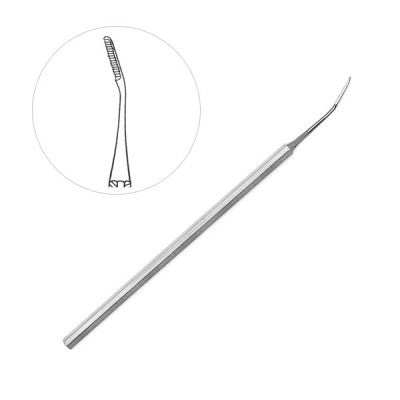
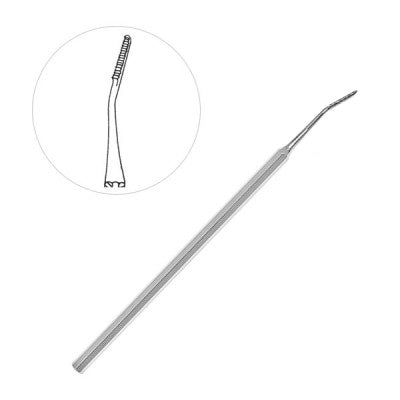
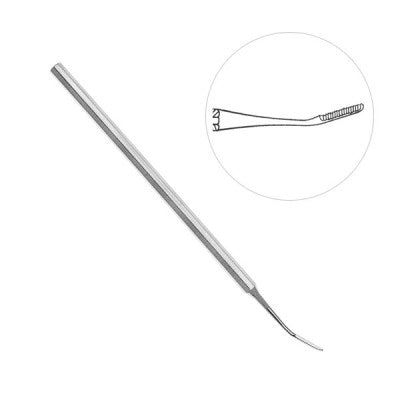
Overview of Bone File Angled Curved
It is a Bone File Angled Curved, a precise-engineered surgical instrument specifically designed for smoothing the contours, refining, and smoothing the bone surface during maxillofacial, orthopedic and reconstructive surgeries. Since it is a single-ended device with an angled working tip It is designed to give better access to difficult-to-access anatomical regions. The curved, angled design lets surgeons work effectively in tight or deep surgical fields, while keeping control and precision.
Bone files are vital for procedures in which the bone edges need to be smoothed following cutting, drilling or performing osteotomy. Bone surfaces that are rough or sharp could cause irritation to soft tissues around and hinder the healing process. This Bone File angle Curved allows for the controlled removal of bone and surface refinement, which leads to more effective surgical outcomes.
Made from top-quality surgical stainless steel The instrument is tough and resistant to corrosion. It is also suitable for repeated cycles of sterilization. The sturdy construction guarantees longevity in the most demanding surgical conditions.
Design and Structural Features
The Bone File Angled Curved is specifically designed to offer the highest level of precision and flexibility. Its key features include:
A configuration with a single-ended end to provide a specific function
An angle at the working ends to facilitate access to deep or restricted zones
A curved surface of the blade allows anatomical contouring
Sharp ridged surface for filing to provide effective bone smoothing
Construction of stainless steel to ensure strength and durability
The angled working tip is the main aspect of this device. It lets surgeons approach bone surfaces at an angle, which makes it easier to smooth areas not accessible by straight instruments. The curved shape conforms to the natural bone contours, which allows for precision shaping and the ability to refine.
The ridged surface provides effective scraping, and also provides tactile feedback. The balanced handle gives security and comfort while reducing the strain on your hands when performing long-term operations.
Clinical Applications
Bone File Angled Curve - Bone File Angled Curved is often employed in:
The use of orthopedic surgeries to contour bone following the repair of fractures
Maxillofacial treatments for the shaping of facial bones
Dental and oral surgeries to smoothing of the alveolar bone
Reconstructive surgery requires exact bone finishing
In orthopedic procedures, instruments are used in conjunction with osteotomies and implant placement to smooth edges and refine the bone's surface. In maxillofacial surgery, it aids in contouring bone structures in order to obtain aesthetic and functional results. The angled shape can be particularly helpful in places where straight files aren't able to access the proper area.
With perfectly smooth bones, the device aids in reducing the postoperative irritation of tissue and promotes optimal healing.
Advantages of the Angled Curved Design
This Bone File Angled Curved offers numerous benefits for the user:
Access is enhanced to areas of anatomical difficulty
Bone smoothing that is precise , with very little trauma to the tissue
Better control because of ergonomic design
Sturdy stainless steel structure
Reduced the requirement for multiple instruments
The angled design increases efficiency and precision during surgery, especially in tight surgical spaces.
Sterilization and Maintenance
Being a reusable surgical instrument The Bone File Angled Curved must be properly cleaned and sterilized after every use. It can be used in conjunction with the standard autoclave sterilization processes. After surgery, the file surface should be checked for wear or debris and thoroughly cleaned to preserve efficiency.
Regular maintenance is essential to ensure optimal functionality, structure integrity and longevity of reliability in clinical practice.
