
Featured Collection
Your cart
Featured Collection

PEAK SURGICALS
SKU:PS-J-0822
Couldn't load pickup availability


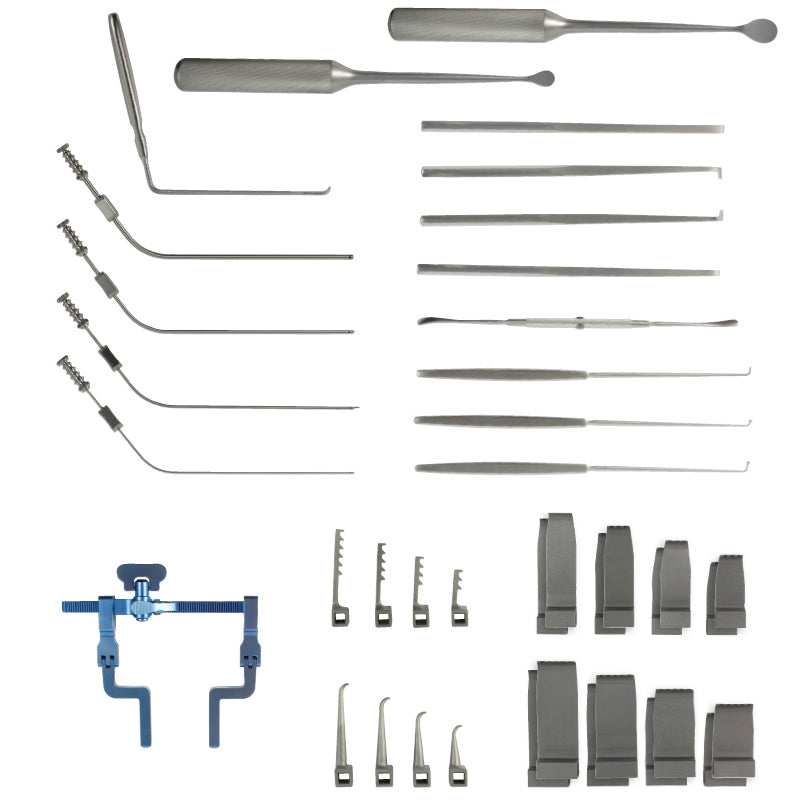
Anteater Microdiscectomy Set, SKU PS-J-081, is a reusable lumbar spine exposure and disc-access system built around a hinged titanium retractor frame (73-1505T) and interchangeable titanium blades. The set combines wide muscle blade pairs in 4 cm (73-1511T), 5 cm (73-1512T), 6 cm (73-1513T), and 7 cm (73-1514T); narrow muscle blade pairs in 4 cm (73-1521T), 5 cm (73-1522T), 6 cm (73-1523T), and 7 cm (73-1524T); hook blades in 3–6 cm (73-1531T, 73-1532T, 73-1533T, 73-1534T); and toothed blades in 3–6 cm (73-1541T, 73-1542T, 73-1543T, 73-1544T). It also includes the 73-1553 nerve root retractor, 73-1554 double-ended blunt elevator, 4 mm and 6 mm osteotomes (73-1564, 73-1566), right and left hockey-stick chisels (73-1571, 73-1572), 1/2-inch and 3/4-inch Cobb Endura-Cut spinal elevators (72-1091, 72-1092), 5, 7, 9, and 12 Fr Anteater suction tubes (74-5505, 74-5507, 74-5509, 74-5512), 4 mm and 7 mm ball probes (73-1590, 73-1593), 5 mm manipulation hook (73-1598), and sterilization case (73-1501). It is configured for lumbar microdiscectomy, limited laminotomy, nerve-root decompression, and focused posterior lumbar exposure in hospital operating rooms and spine surgery centers.
The Anteater system creates a compact posterior lumbar working corridor by combining a hinged frame with interchangeable paired and single blades. After the selected blades are positioned through the paraspinal exposure, the frame is opened to separate the blades and maintain the chosen retraction width without continuous hand-held traction. Wide muscle blades distribute pressure across a broader contact surface, whereas narrow blades occupy less lateral space when the incision and fascial opening are limited. Hook blades provide focal edge capture where a narrow point of engagement is preferred, while toothed blades add mechanical purchase on soft tissue when slippage would compromise the corridor. The 3–7 cm blade lengths let the surgeon match retractor depth to the distance from skin and thoracolumbar fascia to the lamina and facet region. The nerve root retractor provides localized neural protection during disc access; the blunt elevator and Cobb elevators develop tissue planes and mobilize paraspinal soft tissue from bone. Osteotomes and right/left hockey-stick chisels address controlled osseous work around the laminar or facet margin. Angled suction tubes evacuate blood and irrigation while keeping the surgeon’s hand outside the direct line of sight, and the probes and manipulation hook permit tactile assessment and controlled tissue handling within the decompression field.
In a standard posterior lumbar microdiscectomy workflow, exposure begins after midline or paramedian access with fascial opening and paraspinal muscle mobilization toward the lamina. A blade depth is selected to reach the operative level without leaving excessive metal above the wound or driving the frame unnecessarily deep. Wide blades are useful when the surgeon wants broader muscle displacement around the interlaminar window; narrow blades suit a smaller corridor where preservation of surrounding soft tissue is a priority. Once the frame maintains exposure, the Cobb elevators and blunt elevator can assist with subperiosteal muscle elevation and definition of the laminar margin. The 4 mm and 6 mm osteotomes and right/left hockey-stick chisels support focused bony work during limited laminotomy or medial facet exposure when required by the decompression. After the ligamentous and neural elements are identified, the 6 mm nerve root retractor can shield and gently displace the affected root while the disc space is addressed. Ball probes and the 5 mm manipulation hook help assess the decompressed recess and mobilize tissue under direct visualization. The 5–12 Fr suction tubes provide graded fluid evacuation during exposure, decompression, annular work, and final hemostatic inspection. The configuration is suited to orthopedic spine surgeons and neurosurgeons performing lumbar disc herniation decompression in hospital operating rooms and ambulatory spine centers.
Component selection is based on exposure depth, muscle-corridor width, tissue engagement, and fluid burden. The wide muscle blades are supplied as 4, 5, 6, and 7 cm pairs for progressively deeper posterior lumbar exposures, while the narrow blade pairs cover the same depths with a smaller transverse footprint. Hook blades are provided in 3, 4, 5, and 6 cm lengths for focal soft-tissue edge retention, and toothed blades in 3, 4, 5, and 6 cm lengths provide more secure tissue purchase when smooth retraction is insufficient. The 4 mm osteotome supports fine bone removal, while the 6 mm pattern covers a broader osseous contact area. The 1/2-inch Cobb elevator is suited to narrower subperiosteal elevation, whereas the 3/4-inch model provides wider contact for broader muscle release from the posterior elements. The 5 Fr suction tube is the smallest-bore option for confined work near the neural corridor; 7 Fr and 9 Fr provide intermediate evacuation capacity; and 12 Fr is appropriate when faster removal of blood or irrigation is needed. The 4 mm and 7 mm ball probes provide different contact footprints for palpation, while the 5 mm manipulation hook supports directed handling within the decompression field. The complete configuration contains 33 catalog line items and 41 physical pieces when each blade pair is counted as two, including the sterilization case.
Set Includes:
| SKU | Quantity | Description |
|---|---|---|
| 73-1505T | 1 | Anteater Retractor Frame, hinged, titanium |
| 73-1511T | 1 pair | Anteater Wide Muscle Blade, 4 cm, pair, titanium |
| 73-1512T | 1 pair | Anteater Wide Muscle Blade, 5 cm, pair, titanium |
| 73-1513T | 1 pair | Anteater Wide Muscle Blade, 6 cm, pair, titanium |
| 73-1514T | 1 pair | Anteater Wide Muscle Blade, 7 cm, pair, titanium |
| 73-1521T | 1 pair | Anteater Narrow Muscle Blade, 4 cm, pair, titanium |
| 73-1522T | 1 pair | Anteater Narrow Muscle Blade, 5 cm, pair, titanium |
| 73-1523T | 1 pair | Anteater Narrow Muscle Blade, 6 cm, pair, titanium |
| 73-1524T | 1 pair | Anteater Narrow Muscle Blade, 7 cm, pair, titanium |
| 73-1531T | 1 | Anteater Hook Blade, 3 cm, each, titanium |
| 73-1532T | 1 | Anteater Hook Blade, 4 cm, each, titanium |
| 73-1533T | 1 | Anteater Hook Blade, 5 cm, each, titanium |
| 73-1534T | 1 | Anteater Hook Blade, 6 cm, each, titanium |
| 73-1541T | 1 | Anteater Toothed Blade, 3 cm, each, titanium |
| 73-1542T | 1 | Anteater Toothed Blade, 4 cm, each, titanium |
| 73-1543T | 1 | Anteater Toothed Blade, 5 cm, each, titanium |
| 73-1544T | 1 | Anteater Toothed Blade, 6 cm, each, titanium |
| 73-1553 | 1 | Anteater Nerve Root Retractor, 5", 6 mm |
| 73-1554 | 1 | D/E Blunt Elevator |
| 73-1564 | 1 | Osteotome, 4 mm |
| 73-1566 | 1 | Osteotome, 6 mm |
| 73-1571 | 1 | Chisel, "Hockey Stick", right |
| 73-1572 | 1 | Chisel, "Hockey Stick", left |
| 72-1091 | 1 | Cobb Endura-Cut Spinal Elevator, 1/2", 11 1/4" |
| 72-1092 | 1 | Cobb Endura-Cut Spinal Elevator, 3/4", 11 1/4" |
| 74-5505 | 1 | Anteater Suction Tube, WL 5", 5 Fr |
| 74-5507 | 1 | Anteater Suction Tube, WL 5", 7 Fr |
| 74-5509 | 1 | Anteater Suction Tube, WL 5", 9 Fr |
| 74-5512 | 1 | Anteater Suction Tube, WL 5", 12 Fr |
| 73-1590 | 1 | Ball Probe, 4 mm, 9 1/2" |
| 73-1593 | 1 | Ball Probe, 7 mm, 2.5 mm Ball Diameter |
| 73-1598 | 1 | Manipulation Hook, 5 mm |
| 73-1501 | 1 | Sterilization Case for Anteater |
The hinged retractor frame and interchangeable muscle, hook, and toothed blades are titanium in this configuration, reducing the mass carried by the self-retaining system while maintaining the rigidity needed for controlled lumbar exposure. Applicable ancillary elevators, osteotomes, chisels, suction tubes, probes, and manipulation instruments use Peak Surgicals’ German stainless steel construction for repeated cleaning, inspection, and steam sterilization. Low-reflective surgical surfaces help limit operating-light glare around the wound, while smooth functional areas support cleaning and controlled instrument passage. Before sterilization, detachable blades should be removed from the frame, visible soil eliminated, joints and engagement surfaces opened for cleaning, and suction lumens thoroughly flushed so debris does not remain inside the bore. Each component should then be inspected for deformation, damaged edges, blocked lumens, impaired frame movement, or loss of secure blade engagement before packaging in the supplied sterilization case. Steam sterilization should follow the hospital’s validated reusable-instrument cycle and the applicable device reprocessing instructions. Peak Surgicals lists CE and ISO certification for this product line and operates within an ISO 13485 quality-management framework; CE documentation supports procurement for applicable regulated markets. FDA context for U.S. purchasing concerns device establishment, listing, labeling, and procurement documentation rather than a blanket claim of individual FDA approval. The set is reusable, supported by a one-year limited warranty for manufacturing defects, and covered by return and replacement service for eligible orders.
| Specification | Details |
|---|---|
| SKU | PS-J-0822 |
| Product Name | Anteater Microdiscectomy Set |
| Price | $495.69 USD |
| Size/Gauge Variants | Wide and narrow muscle blades 4–7 cm; hook and toothed blades 3–6 cm; osteotomes 4 mm and 6 mm; Cobb elevators 1/2" and 3/4"; suction tubes 5, 7, 9 and 12 Fr; ball probes 4 mm and 7 mm |
| Set Count | 33 catalog line items; 41 physical pieces when each supplied pair is counted as two, including 1 sterilization case |
| Instrument Category | Orthopedic and Spine Surgery Instruments |
| Procedure | Lumbar microdiscectomy, limited laminotomy, nerve-root decompression and posterior lumbar exposure |
| Material | Titanium retractor frame and interchangeable blades with German stainless steel ancillary instruments |
| Finish | Low-reflective surgical finish with smooth functional surfaces |
| Sterilization | Reusable and suitable for validated hospital steam-sterilization workflows |
| Instrument Classification | Reusable manual orthopedic and spinal surgical instrument set |
| Reusable | Yes |
| Certifications | CE Mark, ISO 13485, FDA procurement compliance context |
| Warranty | 1 Year Limited Warranty |
| MOQ | 1 Set |
| OEM / Custom Orders | Available |
| After-Sale Service | Return and Replacement |
How does the Anteater Microdiscectomy Set compare with a tubular microdiscectomy retractor system?
The Anteater Microdiscectomy Set differs from a tubular microdiscectomy retractor system in how the surgical corridor is created and maintained. The Anteater design uses a hinged open frame with interchangeable muscle, hook, and toothed blades, allowing the surgeon to tailor depth and tissue contact while preserving direct access around the sides of the exposure. A tubular system creates a cylindrical working channel after sequential dilation and usually restricts instruments to the internal diameter of the tube. The open Anteater configuration permits broader lateral instrument movement and independent blade selection rather than a fixed circular corridor. Its wide and narrow blade families also allow the contact footprint to be changed without replacing the entire retractor body. The preferred system depends on surgeon technique, incision strategy, required visualization, and whether an open mini-corridor or tubular access is planned.
How should blade depth and suction gauge be selected for lumbar microdiscectomy?
Blade depth should correspond to the skin-to-lamina working distance and the thickness of the paraspinal muscle corridor at the selected lumbar level. In the Anteater Microdiscectomy Set, 4–7 cm wide or narrow muscle blades cover progressively deeper exposures, while the 3–6 cm hook and toothed blades provide focal retention at shallower or intermediate depths. Wide blades are appropriate when broader muscle displacement is needed around the interlaminar window, whereas narrow blades reduce the transverse footprint in a limited incision. The 4 mm osteotome is suited to fine laminar or facet-edge work, while the 6 mm pattern provides a broader bone-contact surface. Suction selection progresses from 5 Fr for confined work close to the neural corridor through 7 Fr and 9 Fr for intermediate evacuation, up to 12 Fr when greater blood or irrigation removal is required. The 1/2-inch and 3/4-inch Cobb elevators similarly let the surgeon choose between narrower and broader subperiosteal contact during posterior element exposure.
What do CE, ISO 13485 and FDA requirements mean when procuring this set?
The Anteater Microdiscectomy Set is supplied within Peak Surgicals’ medical-device quality and procurement framework. CE documentation supports conformity requirements for applicable markets, while ISO 13485 relates to the quality-management system governing medical-device manufacture and control. For U.S. procurement, FDA context concerns the appropriate establishment, device listing, labeling, and regulatory documentation associated with the supplied instrument category. FDA clearance or approval terminology applies only where that specific regulatory status exists for an individual device. Hospitals and distributors can use available CE, ISO 13485, and U.S. regulatory documentation during vendor qualification, tender review, and procurement-file completion. This distinction provides procurement teams with a more precise regulatory record for purchasing and supplier assessment.
How is the hinged retractor frame controlled during the procedure?
The hinged frame is the primary control feature of the Anteater Microdiscectomy Set. After the selected blade pair or individual blade configuration is seated in the exposure, the frame is opened to increase separation and establish the required operative corridor. The hinge allows the two sides of the frame to move in a controlled relationship rather than functioning as independent hand-held retractors. Once the desired opening is reached, the mechanical frame maintains tissue displacement so the assistant does not need to sustain continuous manual retraction. Blade choice determines the tissue interface, while frame opening determines the width of the working window. During use, the surgeon selects the minimum separation that provides visualization and instrument access around the lamina, nerve root, and disc space.
What should hospitals and distributors know about ordering and sterilizing the complete set?
For hospital or distributor procurement, the Anteater Microdiscectomy Set is supplied as a reusable multi-instrument configuration with a dedicated sterilization case and individually identified component models. The Peak Surgicals commercial specification supports a one-set MOQ, a one-year limited warranty for manufacturing defects, OEM or custom-order requests, and return-and-replacement after-sale support for eligible orders. Before first clinical use and after each procedure, the set should enter the facility’s validated reusable-instrument reprocessing pathway. Detachable blades should be separated from the frame, suction lumens flushed, joints and engagement surfaces cleaned in the open position, and each component inspected before packaging. Steam sterilization should follow the validated cycle used by the healthcare facility together with the applicable instrument reprocessing instructions. The component-level SKU table also helps sterile-processing and procurement teams reconcile missing blades, suction tubes, probes, or ancillary instruments before the tray is released to the operating room.


