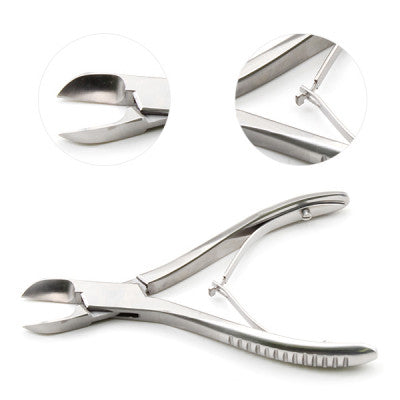
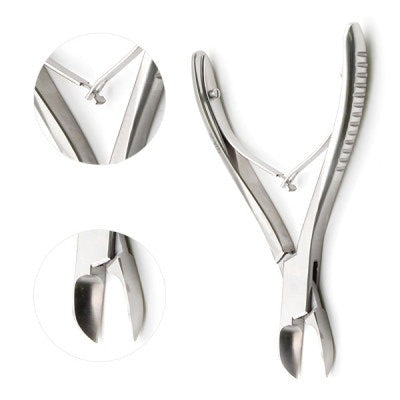
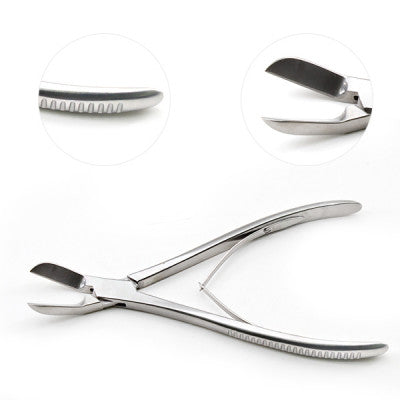
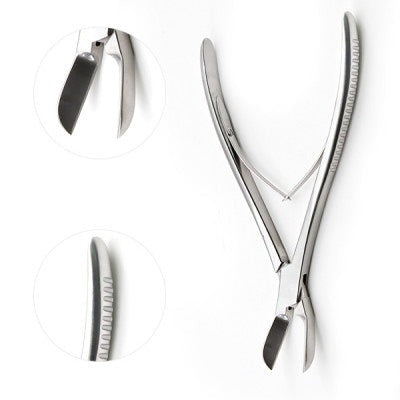
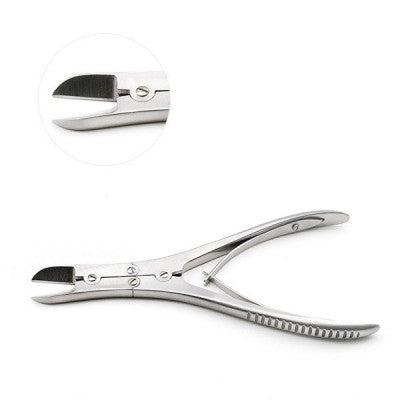
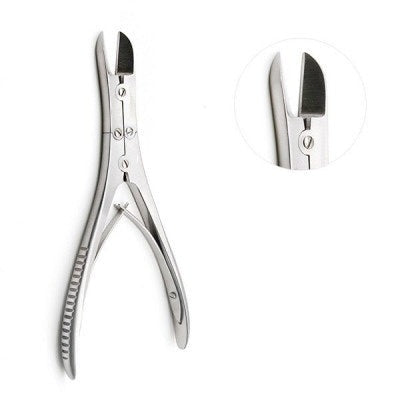
Veterinary bone cutting forceps section and contour bone during orthopedic procedures, a compound-action jaw that multiplies hand grip into cutting force, built for the density and geometry of animal bone across species and sizes. Peak Surgicals supplies three patterns, Liston straight, Liston angled and Ruskin Liston, from $22.00 to $44.00. Each is CE marked and built under ISO 13485. Compare all three patterns in the grid below.
Straight, Angled or Ruskin: Which for Which Approach?
The straight Liston pattern applies direct force along the shaft for open, accessible bone work, the angled Liston reaches around anatomy or approaches bone at an angle a straight instrument cannot manage, and the Ruskin Liston carries its own jaw geometry for cases the base pattern does not cover. Approach angle, not bone size alone, decides which pattern belongs on the tray.
Liston Bone Cutting Forceps Straight (from $27.50) is the default for direct access, cutting or contouring bone where the surgical field is open and the shaft can reach the target in a straight line. Liston Bone Cutting Forceps Angled (from $22.00) steps the jaw off-axis, useful where the approach is confined or where a straight shaft would foul on surrounding tissue. Ruskin Liston Bone Cutting Forceps ($44.00) carries a compound-action joint with sharp inner-edge jaws in straight or curved profiles, built to cut through cortical and cancellous bone with a plier-style grip that reduces hand fatigue across longer procedures. We supply every pattern at MOQ 1.
Compound Action and Jaw Edge
The compound-action joint is what makes hand-powered bone cutting practical. Rather than transmitting grip force directly to the jaws in a 1:1 ratio, the compound linkage trades hand travel for cutting force, the surgeon's grip closes further than the jaws move, and that mechanical advantage is what lets the instrument section bone that a simple hinge could not cut without a mallet.
Jaw edge geometry is the second variable. Sharp inner edges concentrate force along a defined cutting line, dividing bone structure cleanly rather than crushing it, crushed bone at a cut margin heals less predictably than a clean division. Straight and curved jaw profiles exist for the same reason shaft angle does: to match the instrument's cutting line to the bone surface being approached, whether that surface is flat and accessible or curved and confined.
Reprocessing, Joint Integrity and Certification
These forceps are forged from stainless steel, corrosion-resistant across repeated autoclave cycles, and holding jaw alignment under the mechanical load bone cutting applies. The compound joint and jaw edges are the inspection points: a stiff joint loses its mechanical advantage, and a dulled or chipped edge crushes bone instead of dividing it. Check both before each use, and ultrasonic-clean before autoclaving so bone debris does not collect at the joint.
Every instrument is Class I, reusable, CE marked and built under ISO 13485, the documentation a veterinary supply team verifies before qualifying a vendor. Warranty is one year with return-and-replacement, MOQ is 1 piece, orders over $99 ship free in carton box packing, and OEM marking is available for distributors. For related patterns see veterinary orthopedic instruments; browse all veterinary surgical instruments. Talk to us about OEM and volume terms.