
Featured Collection
Your cart
Featured Collection

PEAK SURGICAL
SKU:PS-OCFSIS-00104
Couldn't load pickup availability
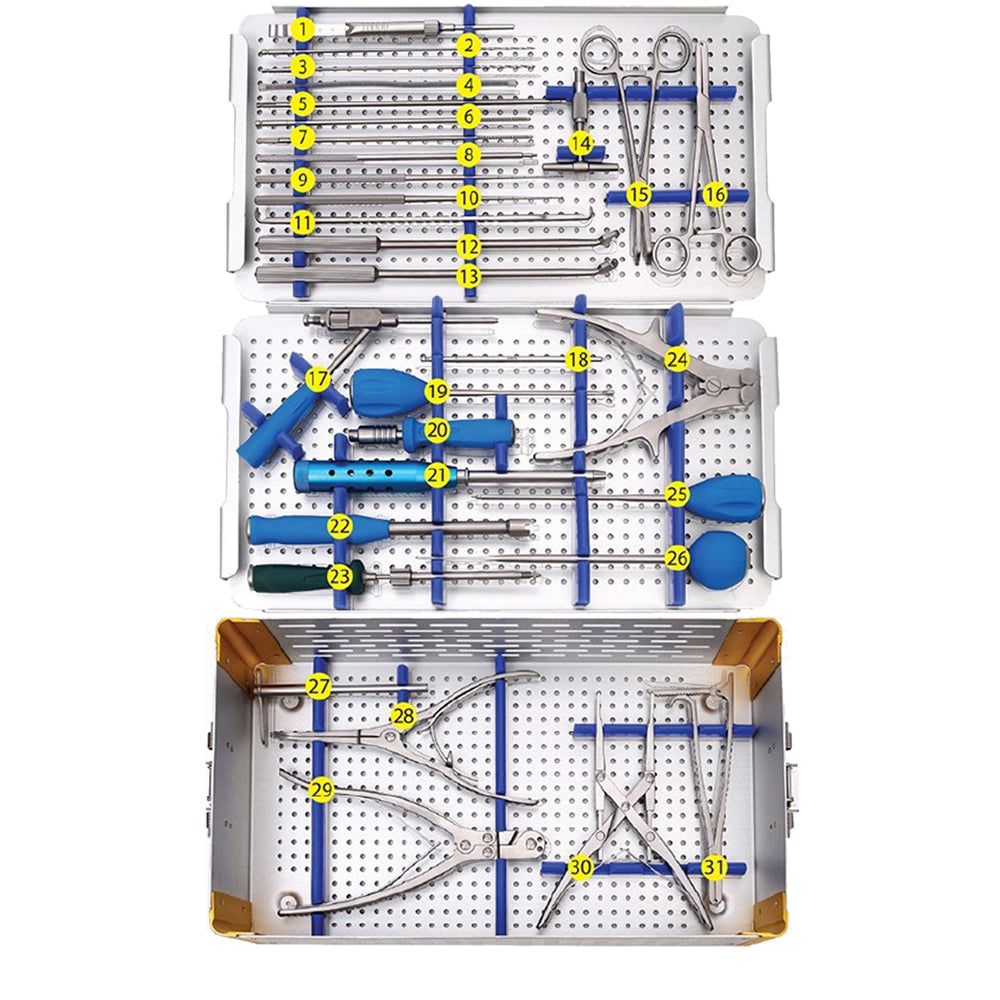
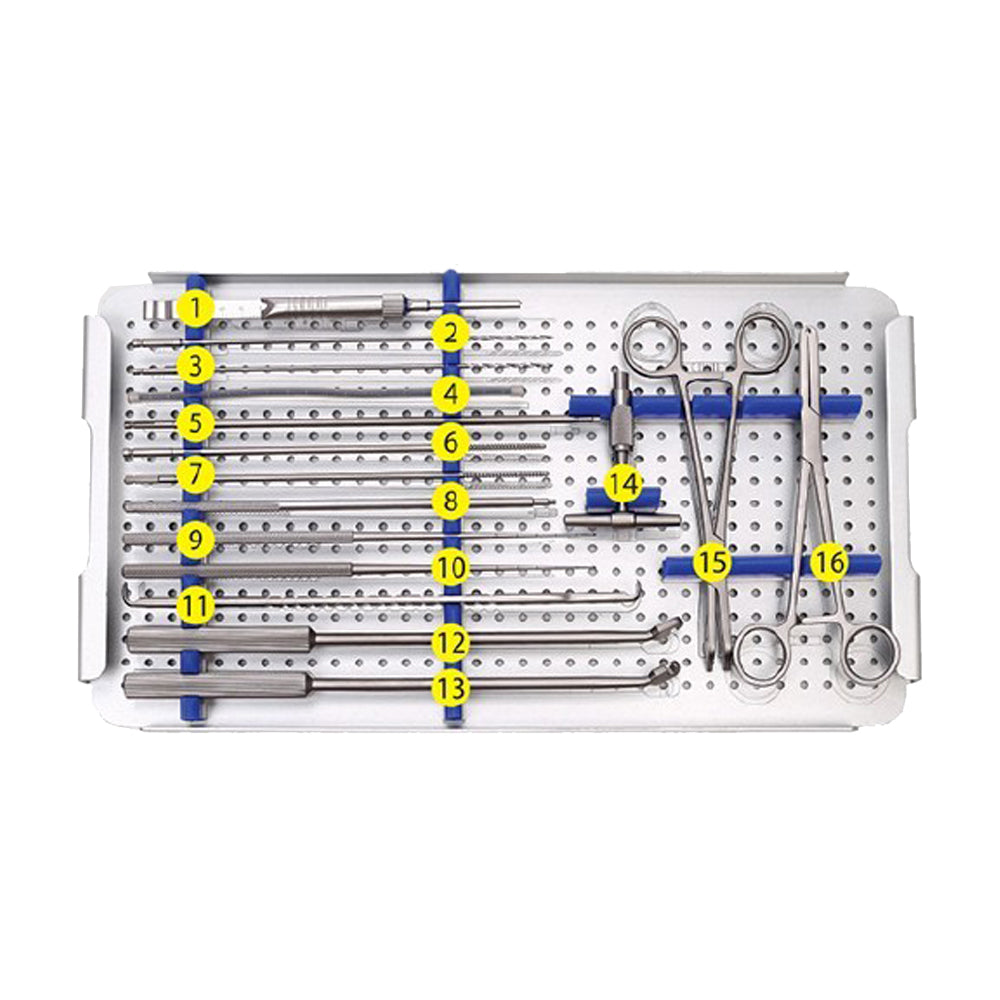
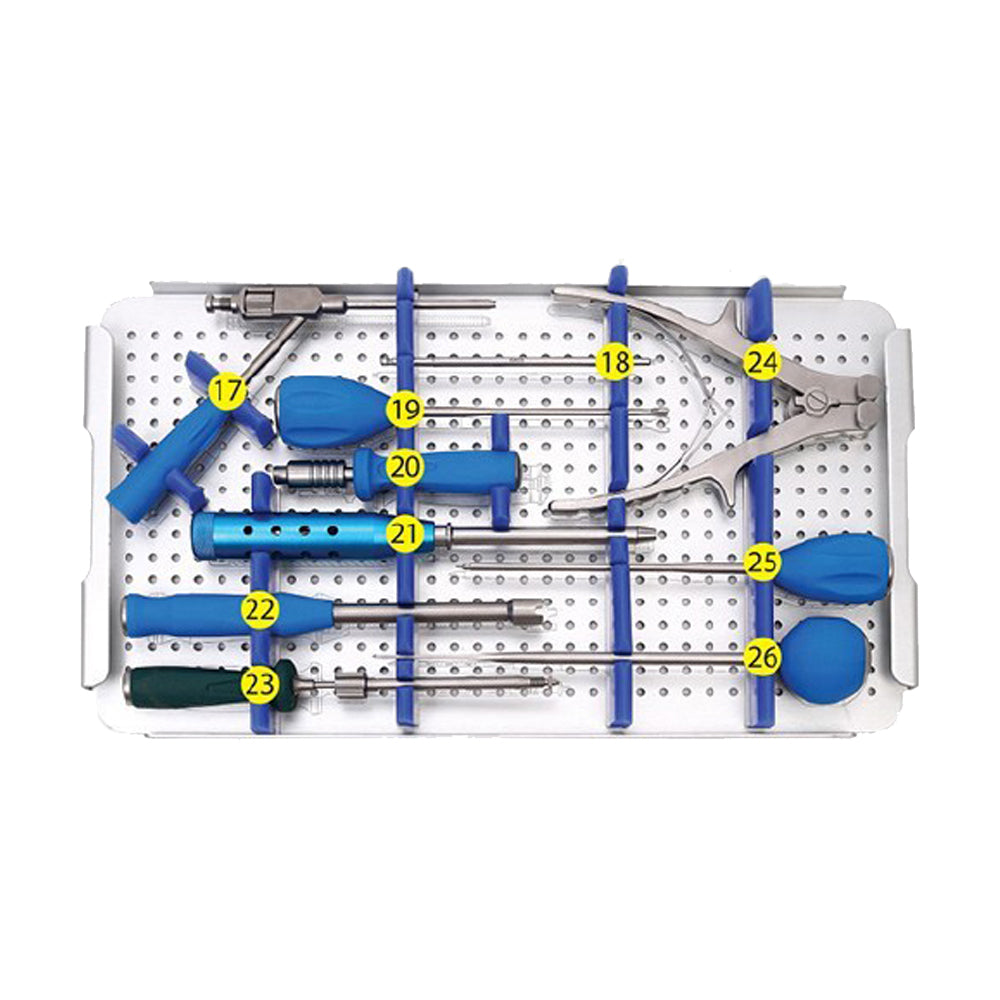
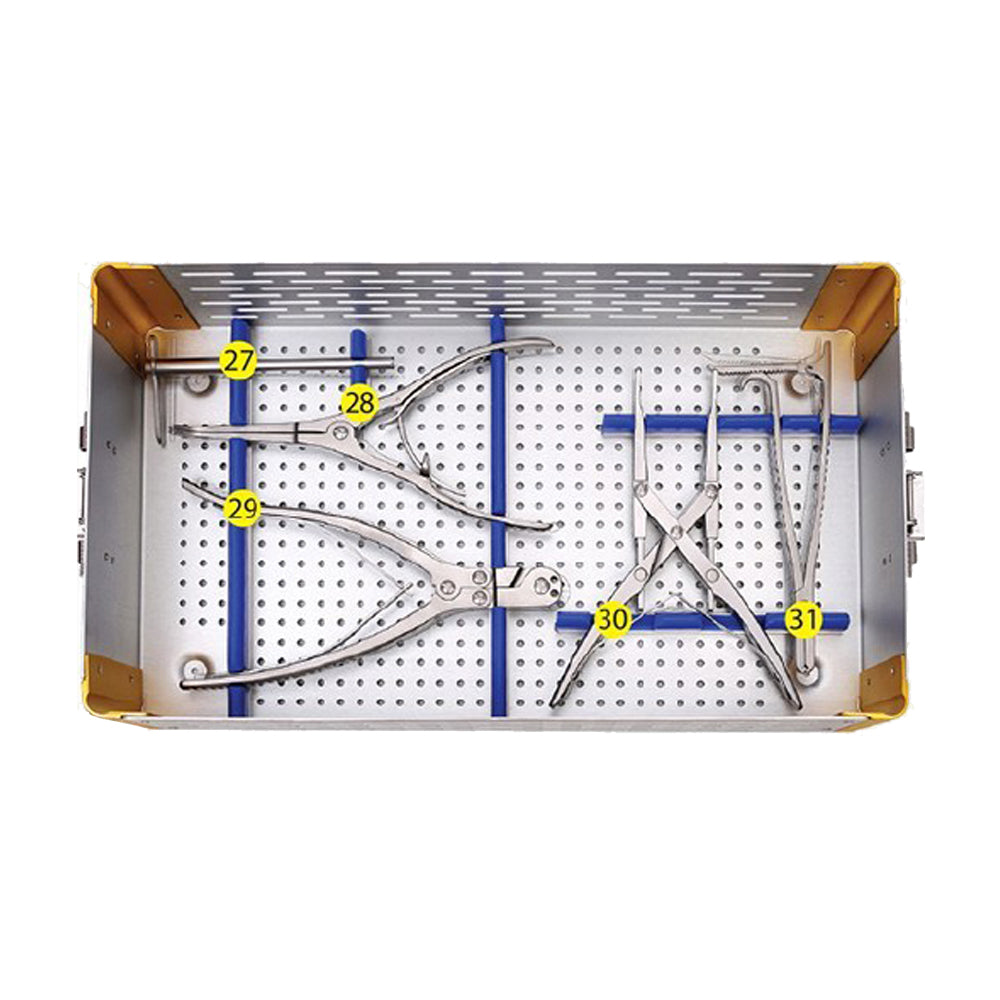
The Occipito Cervical Fusion System Instrument Set from Peak Surgicals (SKU: PS-OCFSIS-00104) is a 31-piece posterior occipito-cervical fixation and fusion instrumentation set in stainless steel, designed for the complete intraoperative workflow of occiput-to-cervical posterior plate-rod fixation — covering occipital screw preparation with Depth Gauge 0–40mm (PS-DG-001), Drill Bit 2.7mm (PS-DB-002) and Drill Bit 2.4mm (PS-DB-003), and Taps φ3.5mm (PS-T-007) and φ4.0mm (PS-T-006); pedicle channel assessment with Feeler for Screw Channel Straight (PS-FSCS-010) and Bent (PS-FSCB-009); posterior cervical screw insertion with Screwdriver for Polyaxial Screw (PS-SPS-023); screw head management with two Screwdrivers Hexagonal 2.5mm (PS-SH-005, PS-SH-018), Nut Holder (PS-NH-008), and Counter Torque (PS-CT-022); rod contouring with a Rod Bender (PS-RB-024) and Trail Rod (PS-TR-004); rod seating with Rod Holding Forcep (PS-RHF-016), Rod Pushing Forcep (PS-RPF-019), and Rod Cutter (PS-RC-029); in-situ rod bending with In-situ Bending Iron L (PS-IBIL-012) and R (PS-IBIR-013); rod rotation with Rod Twist (PS-RT-031); hook fixation with Hook Holding Forcep (PS-HHF-015); distraction with Distracter (PS-D-011) and Distraction Forcep (PS-DF-028); compression with Parallel Compression Forcep (PS-PCF-030); guide wire management with Guider (PS-G-017) and Protection Sleeve (PS-PS-027); two AWLs (PS-AWL-025, PS-AWL-026); and T-Handle (PS-TQC-014), Straight Handle (PS-SHQC-020), and Insert Device for Fixation Pin (PS-IDFP-021), all in an Aluminum Box (PS-AB-032). It is used by spine surgeons and neurosurgeons performing posterior occipito-cervical fixation for craniocervical instability from trauma, rheumatoid arthritis, congenital anomalies, tumour, or infection involving the occiput, C1, C2, and subaxial cervical spine.
The occiput-to-cervical spine posterior fusion is indicated when pathology at the craniocervical junction — the anatomical transition between the base of the skull and the upper cervical vertebrae — produces instability, deformity, or neural compression that cannot be managed without rigid fixation spanning from the occipital bone to the stable subaxial cervical levels below the pathology. The occipital plate is anchored to the occiput with screws prepared using the drill bits and taps in this set, and connecting rods extend from the plate downward through the posterior cervical exposure to lateral mass or pedicle screws in the cervical vertebrae below, forming the posterior occiput-to-cervical construct. The Occipito Cervical Fusion System Instrument Set differs from the Occipital Cervical Fixation System Set (PS1705 series, $1,590.59) available from Peak Surgicals in several specific instrument additions: it includes both left and right In-situ Bending Irons for sagittal rod adjustment at the occipital-cervical curve transition, a Hook Holding Forcep for hook-rod constructs used when hooks replace pedicle screws at certain levels, a Distraction Forcep for segmental distraction alongside the separate Distracter, a Parallel Compression Forcep for compression at the lower construct levels, and a Rod Cutter for in-situ rod trimming — instruments that collectively support a more complex multi-level occipito-cervical construct assembly workflow.
The Depth Gauge 0–40mm (PS-DG-001) measures the occipital bone cortical thickness at each intended screw position before drilling begins, guiding the drill depth selection to maximise cortical purchase without penetrating the inner table of the occipital bone and entering the posterior cranial fossa. The two Drill Bits — 2.7mm (PS-DB-002) for use with the φ3.5mm tap and 2.4mm (PS-DB-003) for use with the φ4.0mm tap — create the pilot holes at the confirmed drill depth. The two Taps — φ3.5mm (PS-T-007) and φ4.0mm (PS-T-006) — pre-cut the cortical thread in the occipital bone pilot hole before screw insertion, reducing the rotational force on the screw-head driver interface in the dense occipital cortex. The two AWLs (PS-AWL-025 and PS-AWL-026) provide the initial cortical entry at each screw site — the two AWL instruments allow simultaneous access at two screw positions or provide a backup AWL when the first becomes dull on the dense occipital outer cortex. The Protection Sleeve (PS-PS-027) protects the soft tissue during drilling in the posterior occipital and cervical exposure.
The Screwdriver for Polyaxial Screw (PS-SPS-023) inserts the polyaxial lateral mass and pedicle screws at each subaxial cervical level from C2 to the lowest instrumented level, providing the multi-axial tulip freedom that accommodates the varied screw trajectories from level to level in the subaxial cervical spine without requiring precisely matched rod contouring at every angle. The two Hexagonal Screwdrivers 2.5mm (PS-SH-005 and PS-SH-018) drive the hexagonal-headed occipital plate screws at the occipital level and the set screws or locking nuts at the cervical screw levels — the two instruments allow different tip configurations or handle lengths for access at the confined occipital plate and the more accessible cervical screw levels. The Nut Holder (PS-NH-008) retains the nut on the screwdriver tip during introduction. The Counter Torque (PS-CT-022) stabilises the tulip or screw body during final locking torque application. The Hook Holding Forcep (PS-HHF-015) handles cervical hook implants — sublaminar, supralaminar, or transverse process hooks that may be used at upper cervical levels (C1, C2) where pedicle screw insertion carries higher risk of vertebral artery or spinal cord injury. The Feeler for Screw Channel Straight (PS-FSCS-010) and Bent (PS-FSCB-009) assess lateral mass and pedicle channel wall integrity before screw insertion, and the Guider (PS-G-017) provides guide wire trajectory guidance for hook or screw placement at difficult-access levels.
The Rod Bender (PS-RB-024) contours the connecting rod to the planned occipito-cervical curve — the transition from the occipital plate plane through the cervical lordosis to the lower instrumented cervical levels requires a three-dimensional rod contour that bridges the occipital-cervical junction curve and the subaxial cervical lordosis in a single rod segment. The Trail Rod (PS-TR-004) is bent to the screw head positions as a malleable template before the definitive rod is shaped. The In-situ Bending Iron L (PS-IBIL-012) and In-situ Bending Iron R (PS-IBIR-013) allow left-sided and right-sided sagittal fine-tuning after the rod is seated without rod removal — at the occipito-cervical junction, minor sagittal adjustments after seating are frequently needed to match the individual patient's anatomy at the occipital plate level. The Rod Holding Forcep (PS-RHF-016) controls the rod during introduction. The Rod Pushing Forcep (PS-RPF-019) seats the rod into successive tulips from the occipital plate level down to the lowest cervical screw. The Rod Cutter (PS-RC-029) trims the rod to the correct length in situ after final positioning. The Rod Twist (PS-RT-031) applies axial rod rotation for deformity correction at any level. The Distracter (PS-D-011) applies distraction between adjacent construct levels — at the occiput-C1 or C1-C2 junction — before the rod is locked, restoring height and reducing the compressive component of the instability. The Distraction Forcep (PS-DF-028) provides a forcep-type distraction tool for more localised controlled distraction at restricted access levels. The Parallel Compression Forcep (PS-PCF-030) applies controlled compression between adjacent subaxial cervical levels along the seated rod for arthrodesis preparation or sagittal alignment adjustment at the lower construct levels.
The Occipito Cervical Fusion System Instrument Set is manufactured under CE Mark, ISO 13485, and FDA compliant quality standards. ISO 13485 certification confirms Peak Surgicals operates a documented quality management system covering design control, material traceability, and production consistency for spinal surgical instruments. CE Mark confirms conformity with European medical device regulations, and FDA compliance supports procurement for US-based hospitals, spine surgery centers, and neurosurgical departments.
| SKU | PS-OCFSIS-00104 |
|---|---|
| Product Name | Occipito Cervical Fusion System Instrument Set |
| Price | $1,375.00 USD |
| Total Instruments | 31 + Aluminum Box |
| Instrument Category | Spine Surgery — Posterior Occipito-Cervical Plate-Rod Fusion |
| Procedure | Posterior occipito-cervical fixation for craniocervical instability from trauma, rheumatoid arthritis, tumour, infection, congenital anomaly |
| Drill Bits | 2.7mm (PS-DB-002), 2.4mm (PS-DB-003) |
| Taps | φ3.5mm (PS-T-007), φ4.0mm (PS-T-006) |
| AWLs | ×2 (PS-AWL-025, PS-AWL-026) |
| Feelers | Straight (PS-FSCS-010), Bent (PS-FSCB-009) |
| Measurement | Depth Gauge 0–40mm (PS-DG-001) |
| Screwdrivers | Polyaxial (PS-SPS-023), Hex 2.5mm ×2 (PS-SH-005, PS-SH-018) |
| Assembly Tools | Nut Holder (PS-NH-008), Counter Torque (PS-CT-022), Hook Holding Forcep (PS-HHF-015), Guider (PS-G-017), Protection Sleeve (PS-PS-027), T-Handle QC (PS-TQC-014), Straight Handle QC (PS-SHQC-020), Insert Device for Fixation Pin (PS-IDFP-021) |
| Rod Instruments | Rod Bender (PS-RB-024), Trail Rod (PS-TR-004), In-situ Bending Iron L (PS-IBIL-012), In-situ Bending Iron R (PS-IBIR-013), Rod Holding Forcep (PS-RHF-016), Rod Pushing Forcep (PS-RPF-019), Rod Cutter (PS-RC-029), Rod Twist (PS-RT-031) |
| Alignment Instruments | Distracter (PS-D-011), Distraction Forcep (PS-DF-028), Parallel Compression Forcep (PS-PCF-030) |
| Container | Aluminum Box (PS-AB-032) |
| Certifications | CE Mark, ISO 13485, FDA |
| Warranty | 1 Year |
| MOQ | 1 Set |
| OEM / Custom Orders | Available |
| After-Sale Service | Return and Replacement |
What conditions require occipito-cervical fusion?
Posterior occipito-cervical fixation and fusion is indicated for pathological conditions at the craniocervical junction that produce instability or neural compression that cannot be managed without rigid occipital-to-cervical construct fixation. Primary indications include traumatic craniocervical dissociation and occipital condyle fractures with instability requiring fusion from the occiput to C2 or below; atlantoaxial instability from odontoid fractures, os odontoideum, or C1-C2 ligamentous disruption requiring extension to the occiput when the occipital condyle-atlas articulation is also compromised; rheumatoid arthritis with cranial settling, basilar invagination, and atlantoaxial subluxation requiring occipito-cervical fusion when the occiput-C1 joint is destroyed by pannus; occipital condyle or clivus destruction from tumour, metastasis, or infection requiring occipital fixation; and revision surgery for failed prior posterior C1-C2 fixation where the construct must be extended to the occiput for additional proximal purchase.
How does this set differ from the Occipital Cervical Fixation System Set (PS1705) also available from Peak Surgicals?
Both are posterior occipito-cervical instrumentation sets for the same surgical indication, but this Occipito Cervical Fusion System Instrument Set (PS-OCFSIS-00104, $1,375.00) includes several instruments not present in the PS1705 Occipital Cervical Fixation System Set ($1,590.59): paired In-situ Bending Irons L and R for left-sided and right-sided sagittal rod adjustment after seating; a Hook Holding Forcep for cervical hook management at levels where hooks replace pedicle screws; a Distraction Forcep in addition to the Distracter for localised distraction; a Parallel Compression Forcep for subaxial cervical compression; and a Rod Cutter for in-situ rod trimming. The PS1705 set in turn includes the Marker Pins ×6 and Marker Pin Inserter for occipital plate position marking, the Probe Straight and Probe Curved for cervical lateral mass assessment, and an Elevator for subperiosteal dissection, which are not in this set. The two sets address the same procedure with different instrument configurations; confirm instrument content with Peak Surgicals before ordering.
Why are there two In-situ Bending Irons (L and R) in this set?
The In-situ Bending Iron L (PS-IBIL-012) and R (PS-IBIR-013) are matched paired instruments that apply three-point bending to the rod after it is seated in the screw tulips, without requiring the rod to be removed for external bending. The L and R designation indicates the arm geometry — the left-sided iron engages the rod from the left side of the surgeon's operating position and the right-sided iron from the right, allowing the in-situ bend to be applied in the correct direction for sagittal plane correction at any level from the occipital plate attachment through the cervical levels. At the occipito-cervical junction, the rod must transition from the horizontal occipital plate plane to the curved cervical sagittal profile, and minor in-situ adjustments at this transition point are frequently needed after the rod is passed through all the screw tulips to fine-tune the sagittal alignment before locking screws are tightened. The paired L+R design allows the surgeon to apply the correct bend direction from either approach angle in the confined posterior craniocervical wound.
What is the Hook Holding Forcep used for?
The Hook Holding Forcep (PS-HHF-015) handles cervical spinal hooks — sublaminar, supralaminar, or transverse process hooks — that may be used in the posterior craniocervical construct at levels where pedicle or lateral mass screw insertion carries unacceptable risk. At C1, the lateral mass screws pass close to the vertebral artery in the transverse foramen, and at C2, the pedicle screw trajectory passes between the vertebral artery medially and the C2 nerve root dorsally. Some surgeons use C2 isthmus screws, C2 laminar screws, or C1-C2 sublaminar wire/hook constructs rather than pedicle or lateral mass screws at these levels. The Hook Holding Forcep grips the hook implant during its introduction and seating onto the lamina or transverse process, maintaining orientation and preventing the hook from rotating or displacing off the lamina during the rod seating step.
What certifications does this set carry?
The Occipito Cervical Fusion System Instrument Set is manufactured under CE Mark, ISO 13485, and FDA compliant quality standards. ISO 13485 certification confirms Peak Surgicals operates a documented quality management system covering design control, material traceability, and manufacturing consistency for spinal surgical instruments. CE Mark confirms conformity with European medical device regulations, and FDA compliance supports procurement for US hospitals, spine surgery centers, and neurosurgical departments requiring verified regulatory documentation.
