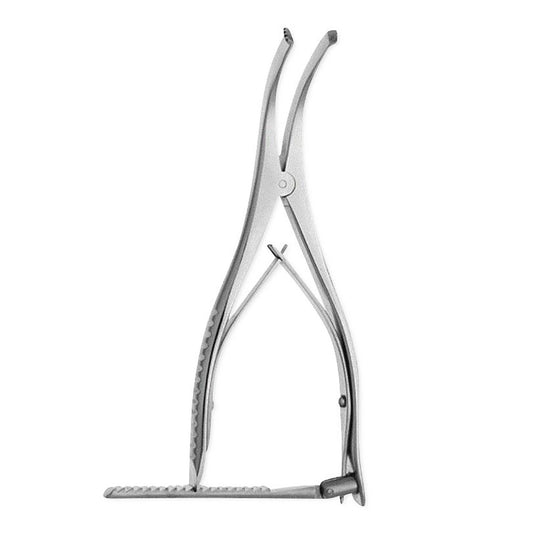
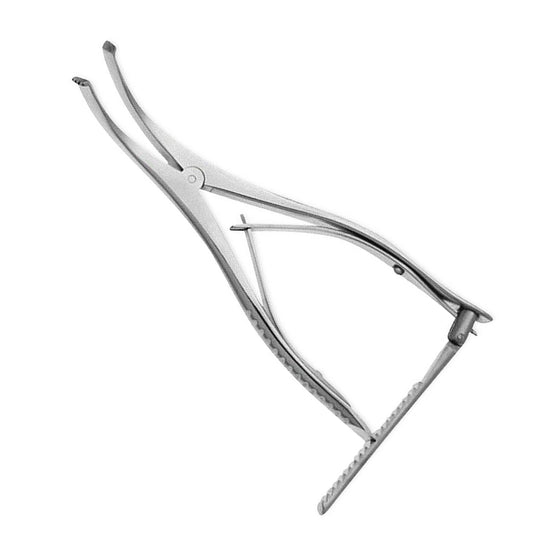
A lamina spreader does not hold tissue back. It pushes two pieces of bone apart and keeps them there, working against a structure that resists rather than one that yields. Peak Surgicals supplies the Furst Inge Lamina Spreader (PS-2551, $44.00) in German stainless steel, CE marked and built under ISO 13485. See the full specification in the grid below.
Why a Spreader Is Not a Retractor
The distinction from a retractor is mechanical and it decides the whole design. A retractor pulls soft tissue away from a working surface, so its blade only has to resist tissue that gives. A spreader is placed between two rigid structures and forced apart, so every part of it carries compressive load: the arms, the hinge and the locking mechanism all work against bone pushing back.
That is why a spreader locks with a rack and pinion rather than a simple ratchet. A ratchet holds a position that tissue is not seriously trying to close; a rack holds against sustained force and lets the surgeon advance the spread in controlled increments rather than in one movement. In laminar work that control is the point, because the distraction is opening a space around neural structures and the last few millimetres matter more than the first.
Where the Blades Sit, and What to Confirm
The Inge pattern places its blades on the laminae themselves, so the spread happens where the bone is strong enough to take it. Blade shape follows from that: the working surfaces sit on cortical bone rather than gripping it, and the geometry keeps the arms clear of the interlaminar space being opened.
Two things should be confirmed against the catalogue before ordering, because neither is visible from a product image. The first is the maximum spread, since a spreader that cannot open far enough for the level being worked is the wrong instrument regardless of how well it holds. The second is blade dimensions, which determine whether the instrument seats on the lamina or slips off it. We supply at MOQ 1.
Material, Reprocessing and Certification
The instrument is forged from German stainless steel and passivated for corrosion resistance across repeated cycles. The inspection point on a spreader is the locking mechanism, and it should be load-tested rather than looked at: open the arms to a working position and try to force them closed, because a rack that slips under compression collapses a distraction the surgeon is working inside. Run the mechanism through full travel to confirm it advances and releases cleanly at every tooth, and check the blades are flat, unbent and free of burring, since a blade edge that has sharpened will bite into cortex instead of sitting on it. Clean immediately with a neutral-pH enzymatic solution, brushing bone debris out of the rack and hinge before it dries, then rinse with deionised water and dry fully, following the reprocessing instructions supplied.
This is a Class I reusable device, supplied non-sterile, CE marked and built under ISO 13485, with a one-year warranty. We ship at MOQ 1 with free shipping over $99. See Surgical Retractors and Spreaders for the wider range, or browse all Surgical Instruments.