
Featured Collection
Your cart
Featured Collection

PEAK SURGICALS
SKU:PS-OP-010005
Couldn't load pickup availability


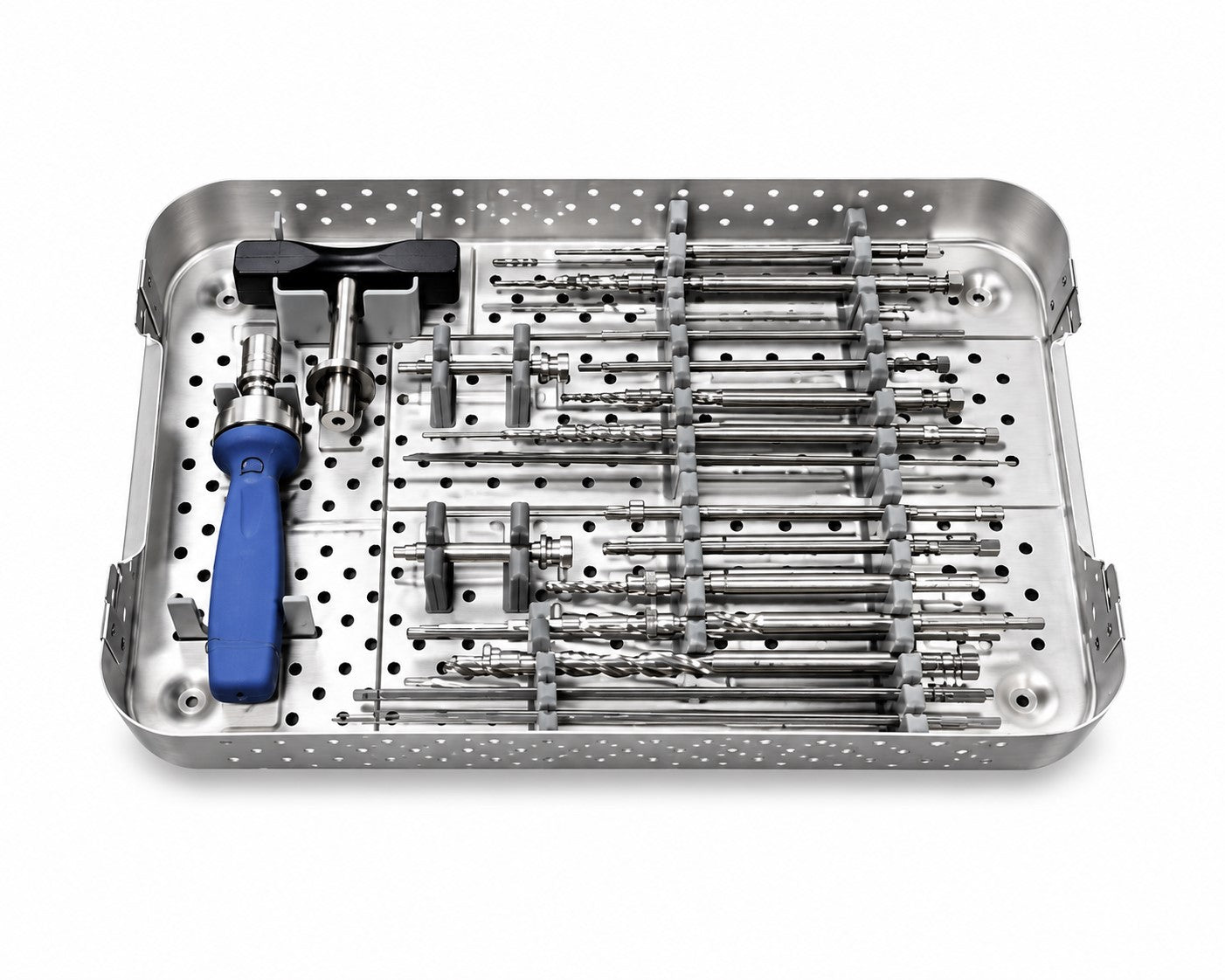
Headless Compression Screw Instrument Set, SKU PS-OP-010005 and PS-604 system reference, is a reusable German-forged stainless steel orthopedic set for preparation, reduction, measurement, insertion, and removal of compatible 4.7 mm, 5.5 mm, and 7.5 mm headless compression screws. The configuration incorporates 4.5 mm and 5.2 mm cannulated drills in standard and long patterns; Ø1.6 mm and Ø2.4 mm K-wire pathways; a Ø2.4 mm threaded guide pin; SW3.0 and SW4.0 cannulated and solid hex drivers; K-wire guides; length-specific cannulated drills for 40–65, 70–95, and 105–125 mm fixation ranges; 3.0 mm and 4.0 mm Easy Out instruments; pointed reduction forceps; T-handle and ratchet quick-coupling handles; hook, sleeves, depth gauge, and separate screw cases for all three diameters. The system supports headless compression fixation of fractures, osteotomies, nonunions, and arthrodeses involving small and larger osseous structures, including scaphoid, distal radius, metatarsal and Jones fractures, talus, malleoli, midfoot, calcaneus, tibia, patella, femur, and selected upper-extremity sites where compatible implants are indicated.
The PS-604 system maintains screw trajectory through coordinated guide-wire, cannulated drilling, measurement, and driver interfaces. For the smaller fixation pathway, the Ø1.6 mm K-wire is directed through PS-604.022 and establishes the working axis before the corresponding 4.5 mm or 5.2 mm cannulated drill is advanced. Standard and long drill versions allow the surgeon to select working reach according to anatomical depth while retaining the previously established trajectory. The larger pathway uses the Ø2.4 mm K-wire or threaded guide pin with PS-604.046, providing a more substantial axial reference for compatible large-diameter headless fixation. Cannulated SW3.0 and SW4.0 screwdrivers advance the implant while the guide remains in position, whereas the solid hex drivers provide the corresponding non-cannulated interface for compatible adjustment or removal stages. The T-handle creates a broad manual torque interface for controlled advancement, while the ratchet handle permits repeated rotational strokes when surrounding anatomy limits full wrist excursion. PS-604.055 pointed reduction forceps maintain fragment alignment before and during guide placement. The depth gauge establishes implant length after trajectory confirmation, allowing definitive screw selection to correspond to the measured osseous pathway.
Clinical use begins after fracture reduction or preparation of the intended fusion or osteotomy surfaces. In scaphoid, radial styloid, metatarsal, Jones fracture, talar, malleolar, midfoot, or selected upper-extremity fixation, the surgeon positions the appropriate guide wire along the desired compression axis and verifies its relationship to the fracture plane and adjacent joint surfaces. The 4.7 mm and 5.5 mm pathways are suited to compatible headless compression constructs where implant prominence must be minimized within smaller bones or periarticular regions. For larger fixation demands, the 7.5 mm system supports compatible fractures, fusions, and osteotomies involving structures such as the calcaneus, talus, tibia, patella, femur, ilium, humerus, radius, or ulna. After wire placement, screw length is determined with PS-604.073. The required cannulated drill is advanced over the guide, followed by screw insertion with the matching SW3.0 or SW4.0 cannulated driver. The variable drill-length group covering 40–65, 70–95, and 105–125 mm provides working reach for deeper trajectories. Final implant depth, compression, articular clearance, and fixation alignment are assessed according to the compatible screw system and operative imaging protocol.
The PS-604 tray separates its instrumentation according to screw diameter, guide size, working depth, and driver interface. PS-604.001 and PS-604.004 provide standard and long 4.5 mm cannulated drilling options, while PS-604.007 and PS-604.010 provide corresponding 5.2 mm preparation. The Ø1.6 mm K-wire and SW3.0 driver group addresses the smaller fixation pathway, whereas the Ø2.4 mm K-wire, threaded guide pin, and SW4.0 driver group provide the larger control interface. PS-604.025, PS-604.028, and PS-604.031 divide deeper cannulated drilling into 40–65, 70–95, and 105–125 mm working ranges. The pointed reduction forceps can maintain fragment contact while a guide is introduced, and the hook provides localized manipulation within the operative field. PS-604.049 and PS-604.052 Easy Out instruments provide 3.0 mm and 4.0 mm extraction interfaces for compatible revision or difficult screw-removal situations. The T-handle supplies direct manual torque, whereas the quick-coupling ratchet supports indexed rotational control. Separate PS-604.076, PS-604.079, and PS-604.082 screw cases organize the 4.7 mm, 5.5 mm, and 7.5 mm implant inventories independently, reducing size-selection errors during tray preparation and intraoperative exchange.
Set Includes:
| SKU | Description |
|---|---|
| PS-604.001 | Cannulated Drill Bit, 4.5 |
| PS-604.004 | Cannulated Drill Bit Long, 4.5 |
| PS-604.007 | Cannulated Drill Bit, 5.2 |
| PS-604.010 | Cannulated Drill Bit Long, 5.2 |
| PS-604.013 | K Wire, Ø1.6mm |
| PS-604.016 | Cannulated Hex Screwdriver, SW3.0 |
| PS-604.019 | Hex Screwdriver, SW3.0 |
| PS-604.022 | Guide for K Wire, Ø1.6mm |
| PS-604.025 | Cannulated Drill Bit, 40-65 |
| PS-604.028 | Cannulated Drill Bit, Standard, 70-95 |
| PS-604.031 | Cannulated Drill Bit, Long, 105-125 |
| PS-604.034 | K Wire, Ø2.4mm |
| PS-604.037 | Threaded Guide Pin, Ø2.4mm |
| PS-604.040 | Cannulated Hex Screwdriver, SW4.0 |
| PS-604.043 | Hex Screwdriver, SW4.0 |
| PS-604.046 | Guide for K Wire, Ø2.4mm |
| PS-604.049 | Easy Out, 3.0mm |
| PS-604.052 | Easy Out, 4.0mm |
| PS-604.055 | Reduction Forceps with Points |
| PS-604.058 | T-Handle with Quick Coupling |
| PS-604.061 | Ratchet Handle with QC Coupling |
| PS-604.064 | Hook |
| PS-604.067 | Sleeve |
| PS-604.070 | Sleeve |
| PS-604.073 | Depth Gauge |
| PS-604.076 | Screw Case for 4.7mm Screws |
| PS-604.079 | Screw Case for 5.5mm Screws |
| PS-604.082 | Screw Case for 7.5mm Screws |
| PS-604.000 | Container for Instrument Set for 4.7/5.5/7.5mm Headless Compression Screw |
The Headless Compression Screw Instrument Set is supplied as reusable orthopedic instrumentation manufactured within Peak Surgicals’ German-forged stainless-steel platform. Cannulated drills, drivers, wire guides, sleeves, and depth-related preparation instruments require detailed reprocessing because blood, marrow, bone particles, and irrigation residue can remain within internal passages after surgery. The lumens should be flushed and mechanically cleaned using validated methods, while drill flutes, guide surfaces, driver tips, Easy Out interfaces, forceps pivots, ratchet mechanisms, and quick-coupling connections require direct inspection after every cycle. Cutting edges should be examined for damage or loss of geometry, K-wires and guide pins for bending, and SW3.0/SW4.0 interfaces for wear that could compromise screw engagement. Instruments are supplied non-sterile unless specifically designated otherwise and require validated cleaning and sterilization before clinical use. Peak Surgicals supports ISO 13485 certified manufacturing standards and CE-marked reusable instruments for applicable markets. FDA procurement context relates to the applicable registration, listing, labeling, quality-system, and supporting regulatory documentation rather than a blanket individual approval claim. The dedicated container and separate 4.7, 5.5, and 7.5 mm screw cases support sterile-processing reconciliation, inventory control, and diameter-specific operating-room preparation.
| Specification | Details |
|---|---|
| SKU | PS-OP-010005 |
| System Reference | PS-604 |
| Product Name | Headless Compression Screw Instrument Set Instrument Set For 4.7/5.5/7.5mm |
| Price | $934.99 USD |
| Size/Gauge Variants | 4.7 mm, 5.5 mm and 7.5 mm screw systems; Ø1.6 mm and Ø2.4 mm guide pathways; 4.5 mm and 5.2 mm drills; SW3.0 and SW4.0 drivers |
| Instrument Count | 29 listed PS-604 catalog references including the system container |
| Instrument Category | Orthopedic Headless Compression Screw Fixation Instrument Set |
| Procedure | Fracture fixation, osteotomy fixation, nonunion treatment and arthrodesis using compatible 4.7 mm, 5.5 mm and 7.5 mm headless compression screws |
| Material | German-forged medical-grade stainless steel |
| Finish | Surgical stainless-steel finish with machined drilling, guiding, reduction and hexagonal driving interfaces |
| Sterilization | Supplied non-sterile; reusable and processed through validated institutional cleaning and sterilization protocols |
| Instrument Classification | Reusable orthopedic bone-preparation and headless screw insertion system |
| Reusable | Yes |
| Certifications | CE-marked instrument procurement, ISO 13485 manufacturing framework and applicable FDA compliance documentation |
| Warranty | 1-Year Limited Warranty covering eligible manufacturing defects under normal professional use |
| MOQ | 1 Complete Set |
| OEM / Custom Orders | Bulk and custom quotations available for hospitals, orthopedic centers, distributors and procurement teams |
| After-Sale Service | Warranty support and eligible 30-day return or replacement assistance under Peak Surgicals terms |
How does this 4.7/5.5/7.5mm set differ from a smaller Herbert screw instrument set?
The Headless Compression Screw Instrument Set covers three larger headless fixation groups rather than focusing primarily on small Herbert-pattern screw fixation. It includes Ø1.6 mm and Ø2.4 mm wire pathways, 4.5 mm and 5.2 mm cannulated drills, and both SW3.0 and SW4.0 driver interfaces. A smaller Herbert set typically uses finer wires, smaller drilling diameters, and smaller driver geometry for scaphoid and other compact osseous structures. The 4.7 mm and 5.5 mm components extend headless fixation into larger small-bone and periarticular applications, while the 7.5 mm pathway addresses substantially larger fractures, fusions, and osteotomies. This PS-604 configuration also incorporates pointed reduction forceps, Easy Out extraction tools, length-specific deeper drilling components, and three separate screw-storage cases. The sets should therefore be selected according to the compatible implant diameter, anatomical site, planned trajectory, and specific fixation technique rather than treated as interchangeable.
How are the 4.7mm, 5.5mm and 7.5mm pathways selected clinically?
Selection begins with the anatomy, fragment size, fixation load, and diameter of the compatible headless compression screw planned for the procedure. The 4.7 mm and 5.5 mm classes are used in compatible fracture, fusion, nonunion, and osteotomy constructs involving sites such as the scaphoid, metatarsals, distal radius, talus, malleolus, midfoot, and selected periarticular fragments. The 7.5 mm class extends the same headless compression principle to larger fixation sites including compatible calcaneal, tibial, femoral, patellar, pelvic, or major hindfoot constructs. The PS-604 tray separates the smaller Ø1.6 mm/SW3.0 guidance and driving pathway from the larger Ø2.4 mm/SW4.0 group. Drill length is then matched to working depth, including the 40–65, 70–95, and 105–125 mm preparation ranges represented in the tray. Final implant diameter and length remain dependent on the compatible screw system, measured bone corridor, fracture configuration, and surgeon’s fixation plan.
What do CE, ISO 13485 and FDA requirements mean when procuring this set?
The Headless Compression Screw Instrument Set is supplied within Peak Surgicals’ medical-device quality and procurement framework. ISO 13485 addresses the quality-management system used to control medical-device manufacturing and associated production processes. CE marking supports conformity requirements for applicable regulated markets in which the reusable instrumentation is supplied. For United States purchasing, FDA compliance concerns applicable manufacturer registration, device listing, labeling, quality-system, and supporting regulatory records. FDA approved should not be used automatically as a blanket description for every reusable instrument unless that exact regulatory status applies to the individual device. Hospitals and distributors can retain the relevant documentation with vendor qualification, purchasing, warranty, sterile-processing, and orthopedic instrument-tray records.
How do the T-handle and ratchet quick-coupling handle function during fixation?
The PS-604.058 T-Handle with Quick Coupling provides a broad manual grip for transmitting direct rotational force to a compatible detachable shaft. Its transverse geometry allows the surgeon to apply deliberate torque during controlled bone preparation or compatible driver manipulation. PS-604.061 adds a ratchet mechanism so the connected instrument can be advanced through repeated short rotational arcs when the operative corridor restricts full wrist movement. The quick-coupling interface allows compatible shafts to be attached and exchanged as the procedure moves between drilling, driving, or removal stages. Before load is applied, the connected shaft should be completely seated so rotational force is transferred without excessive play at the coupling. Ratchet direction and mechanical engagement should be checked before use, and the coupling and internal ratchet surfaces require direct cleaning and functional inspection during sterile processing.
What are the Easy Out instruments used for, and how should the complete tray be reprocessed?
PS-604.049 and PS-604.052 provide 3.0 mm and 4.0 mm Easy Out interfaces for compatible revision situations where a headless screw cannot be removed reliably with its standard driver interface. They are particularly relevant when the driving recess has been damaged or routine engagement cannot generate sufficient removal control. Extraction should follow the compatible implant-removal technique so surrounding bone is not subjected to unnecessary damage. After surgery, all cannulated drills, guides, sleeves, screwdrivers, and depth-related components require lumen flushing and detailed cleaning before residue dries. Pointed forceps, ratchet and quick-coupling mechanisms, drill flutes, Easy Out working surfaces, K-wires, pins, and hexagonal driver tips should be inspected for wear, bending, corrosion, or retained debris. The complete tray should then be reconciled against its PS-604 references and returned to PS-604.000 together with the separate 4.7 mm, 5.5 mm, and 7.5 mm screw cases before validated sterilization and storage.


